Corner store consumption: profiles of small Chinese convenience stores

Get a pack of cigarettes and find a nice local apartment

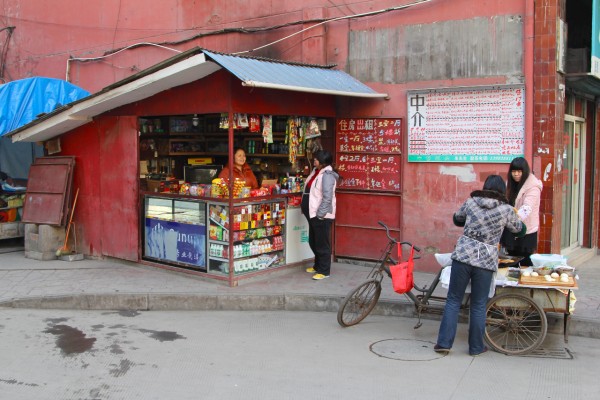
Xiaomaibu literally means small selling department, and refers to Chinese corner shops or small convenience stores usually run by an individual or a family. The person who runs such stores may sleep inside the store. The range of products and services sold in such stores varies immensely. This post highlights such xiaomaibu in a few locations around China, looking at the most popular products sold in each store along with particular services offered that make each xiaomaibu an essential local dispenser.

Danwei previously published an illustrated article on xiaomaibu – Chinese corner stores by Jonah Kessel.

# 1: “White bread” mobile breakfast

Location: near the entrance to Chongqing University, Chongqing
Top-selling product: Taoli (桃李) brand “Chunshu” (醇熟) packaged toast
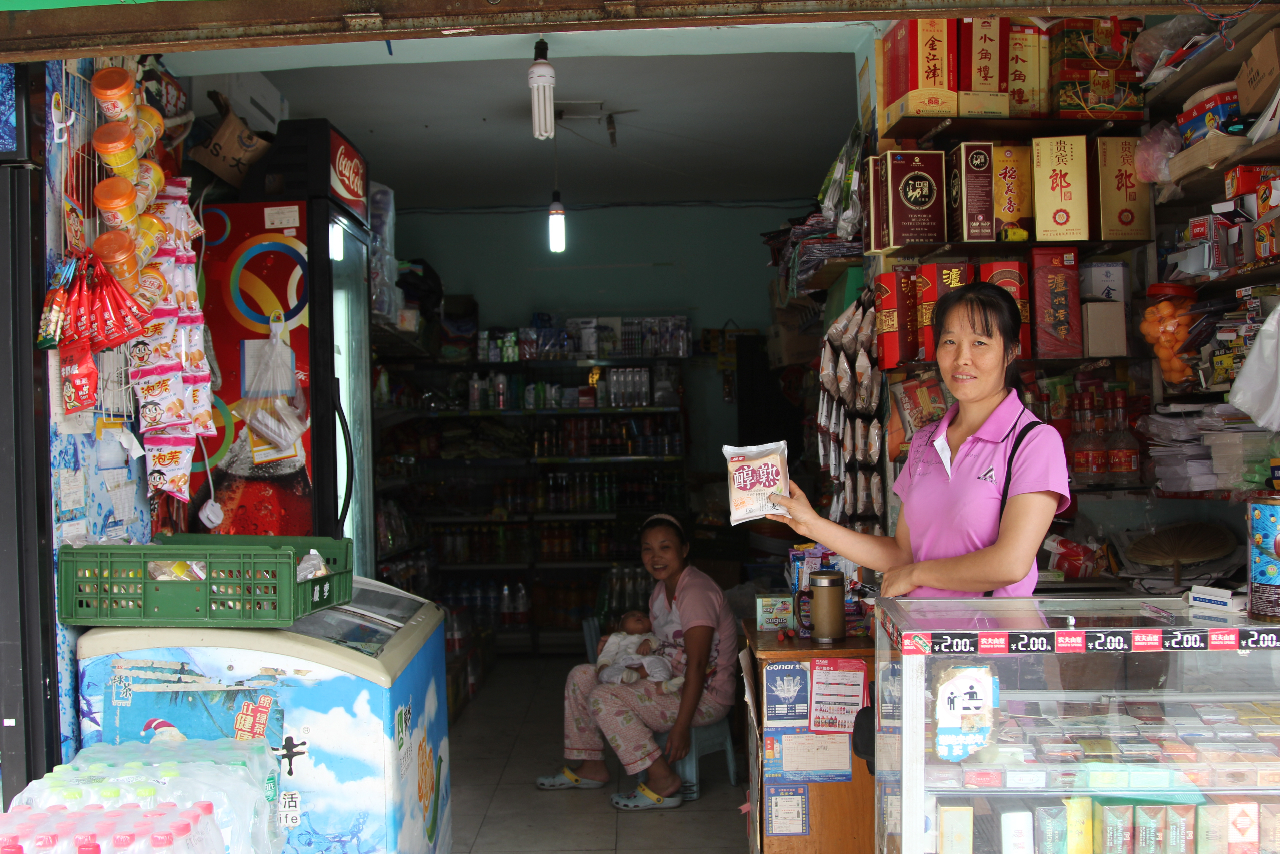
“One bite, one gulp” – White bread and milk for breakfast on the go

When the store began stocking this food product several years ago, they decided to do so primarily because they had been exposed to the stereotype that “Foreigners prefer eating bread over noodles”, and hoped to attract them. Initially it was indeed primarily foreigners who bought it, “particularly Koreans” the owner said. Then, gradually, the owner witnessed a change, and before long there were just as many Chinese buying bread as there were foreigners.

Though seemingly designed to be prepared in a toaster, the bread is not consumed by most of the store’s Chinese customers (that is, university students) in this way. Most purchase it in the morning on their way into campus for class, and eat it by holding the package of (untoasted) bread in one hand and a carton of milk in the other hand. The owner termed this style “one bite, one gulp” or, washing down each bite of toast with a swig of milk. The owner said that she thought it had mostly to do with their lack of time to sit down and enjoy a lengthy breakfast as they rush to class.

#2: Sliced fruit in syrup with re-usable jar

Location: Long-distance bus station in Chongqing
Top-selling product: Huanlejia (欢乐家) sliced fruit in syrup

Sliced fruit in syrup in a very useful jar

“I can’t speak for ‘most popular’ – all of the things I sell here are popular,” the owner of this store conceded, “but one very common choice is this [Huanlejia (欢乐家) brand] sliced fruit in syrup.” He grabbed a jar each of pineapple and peach and placed them on the counter.

It wasn’t immediately apparent why travelers are so fond of it, as consuming it required utensils and would naturally be easier while not riding a form of transportation prone to unpredictable bumps, stops, and starts such as trains and buses. Yet the owner revealed that its popularity didn’t have as much to do with the contents of the container as with the container itself. Around the lip of the glass jar is a plastic ring with a loop attached for simple carriage. “When people finish the fruit, they reuse the jar by filling it up with water or tea and carrying it with them on their trip, or they give it as a gift to whomever they are traveling to see”.

#3: Lunch and cellphone account/battery charging

Location: Residential middle school entrance in Tongren, Guizhou
Top-selling product: Tongyi (统一) brand orange juice
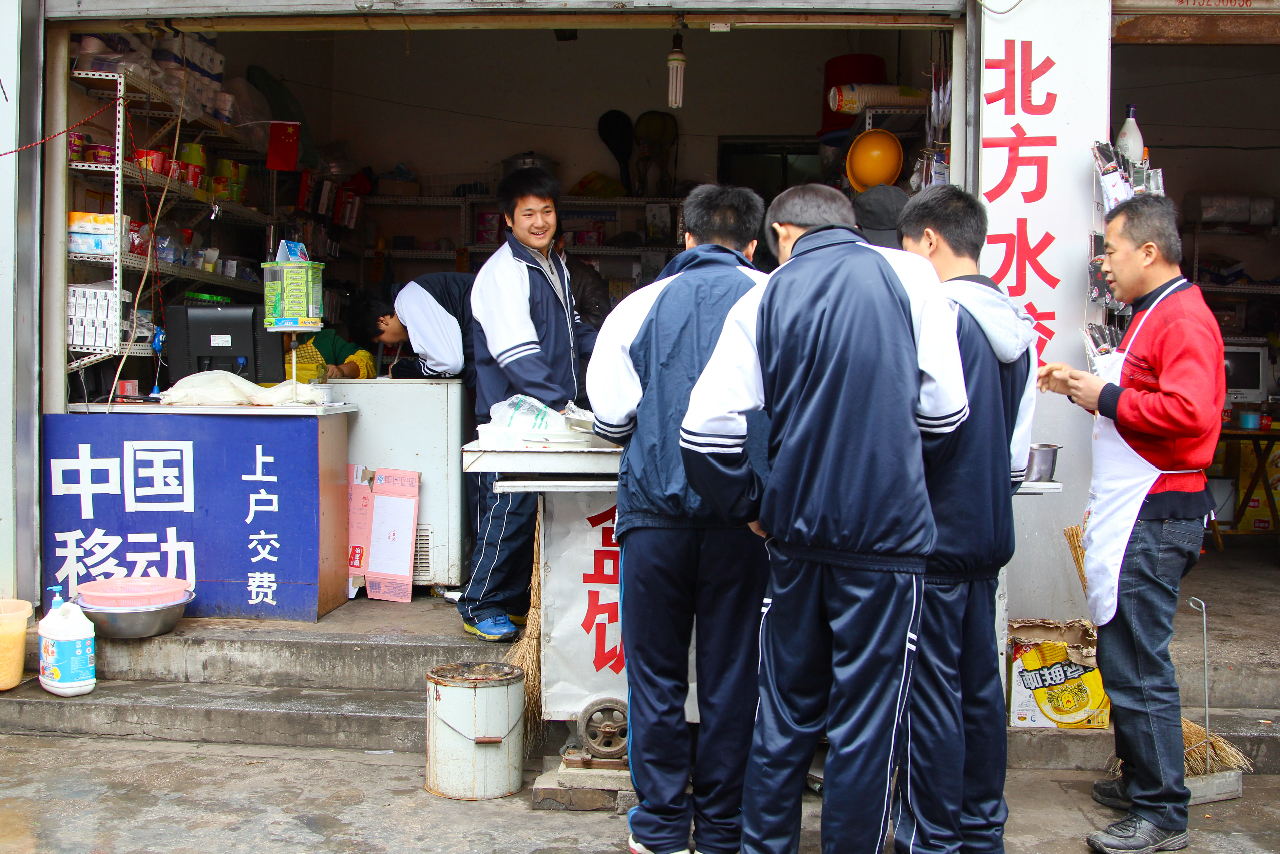
Lunch with cellphone top-up and charging

Although nominally a xiaomaibu, this store’s capacity as a retailer of daily-use goods and cold beverages is of only secondary importance to the throng of middle school students regularly passing through. The students’ priorities appeared to be 1) eating, and 2) charging and adding credit to their cellphones. Many students chose to add a relatively small amount of money – ten or twenty kuai in most cases. Every student who added credit to their phone also stayed for lunch, and a few also handed their cellphones over to the owner to be plugged into the powerstrip behind the counter.

Although a natural draw as a place to fill one’s stomach and cellphone accounts and batteries, the store owner does not receive any commission from China Mobile for charging their cellphones. “I [offer this service] for free in order to ‘serve the people’ more effectively,” he said, evoking the dictum of Chairman Mao to “serve the people” (wei renmin fuwu, 为人民服务). He identified the most common-selling item as the Tongyi (统一) brand orange juice beverage (鲜橙多).

#4: Cigarettes and real estate brokering 

Location: Near Xiangqian Square in Wanyuan, Sichuan
Top-selling product: Yun Yan (雲焰) cigarettes

Xiaomaibu and local apartment broker

Positioned at the end of an alley of residential buildings, this xiaomaibu serves as a social hub for many apartment residents. Like other xiaomaibu, the store’s inventory has been finely tuned over the course of years to correlate with and keep pace with the evolving consumption patterns of the neighborhood. The most sold item is Yun Yan (雲焰) cigarettes, produced by Hongyunhonghe (红运红河) Tobacco Group – the price a mere ten kuai (US $1.60).

In addition to serving the neighborhood’s nicotine needs, the owner has also established herself as the area’s apartment broker. While full-time professional brokers abound in China’s dense urban areas, part-time brokers such as the owner of this xiaomaibu are the norm in smaller cities like Wanyuan. The white board is for apartments that are for sale, while the chalk writing on the door of the xiaomaibu is for advertising apartments and separate rooms within larger apartments for rent.

#5: Electric vehicle charging

Location: Qingyang District, Chengdu, Sichuan
Top-selling product: Probably hot dogs
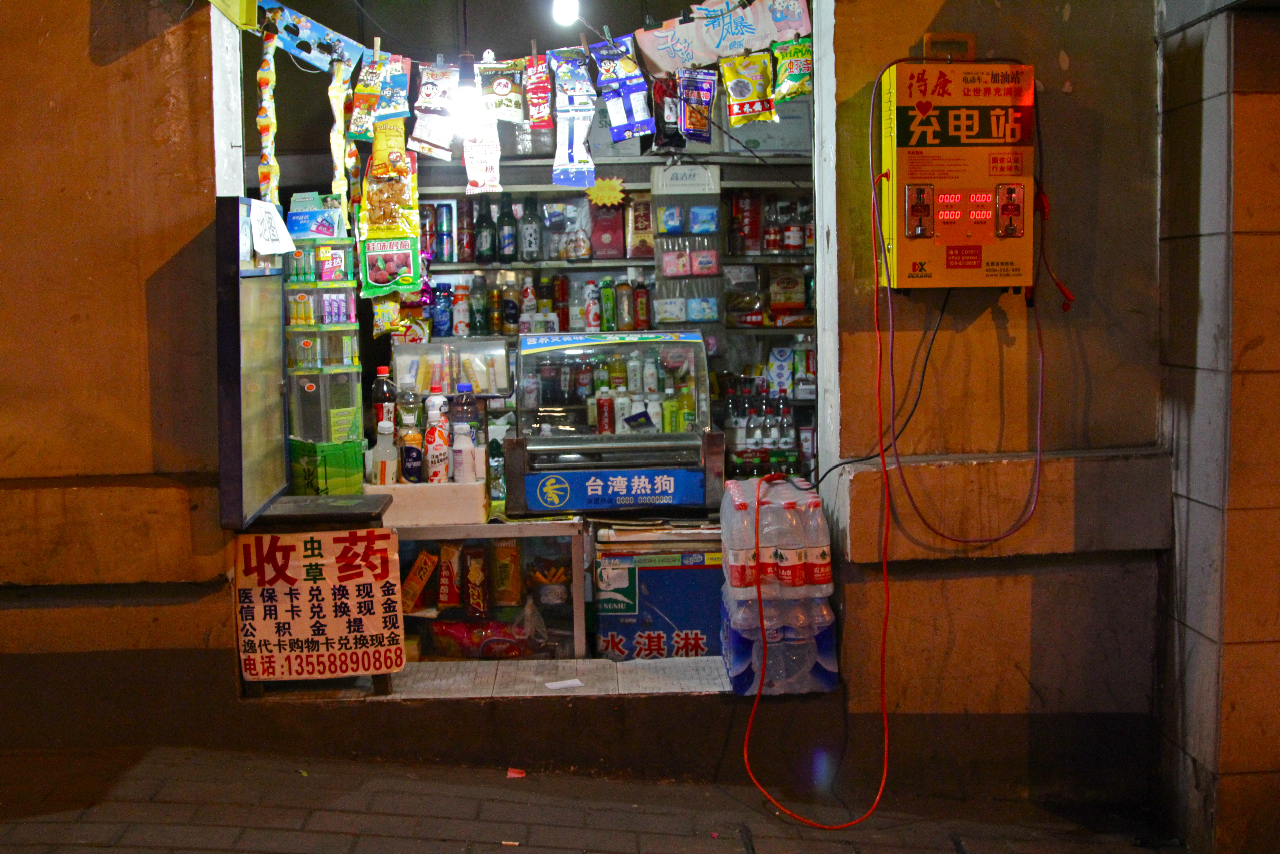
Xiaomaibu equipped with e-bike battery charger

The owner of this xiaomaibu was at a loss for deciding upon his “most popular item”, though he said that hot dogs sold consistently well on account of the children from the nearby school liking them. While this particular xiaomaibu conforms to the standards set by others across China in terms of its miniscule size (roughly the dimensions of a large walk-in closet) and convenient location (right next to a busy bus stop on a main thoroughfare), it is distinguished by its electric vehicle battery charger.

It costs vehicle owners (mostly of two-wheeled electric vehicles such as scooters and “e-bikes”) one yuan (around US $.15) to charge their batteries for ten minutes. The owner agreed to split the revenue of the charger with the company that installed it, while he himself must pay for the additional electricity consumed by the machine. The charger’s revenue varies seemingly randomly by month, ranging from around 100 kuai (US $16) up to around 300 kuai (around US $48).
Posted in Business and the Economy, Consumer Culture, Urban Culture and Cities | Tagged | Comments Off on Corner store consumption: profiles of small Chinese convenience stores

Meet Swallow, China’s champion search and rescue dog

Yanzhao Wanbao 28March p.8

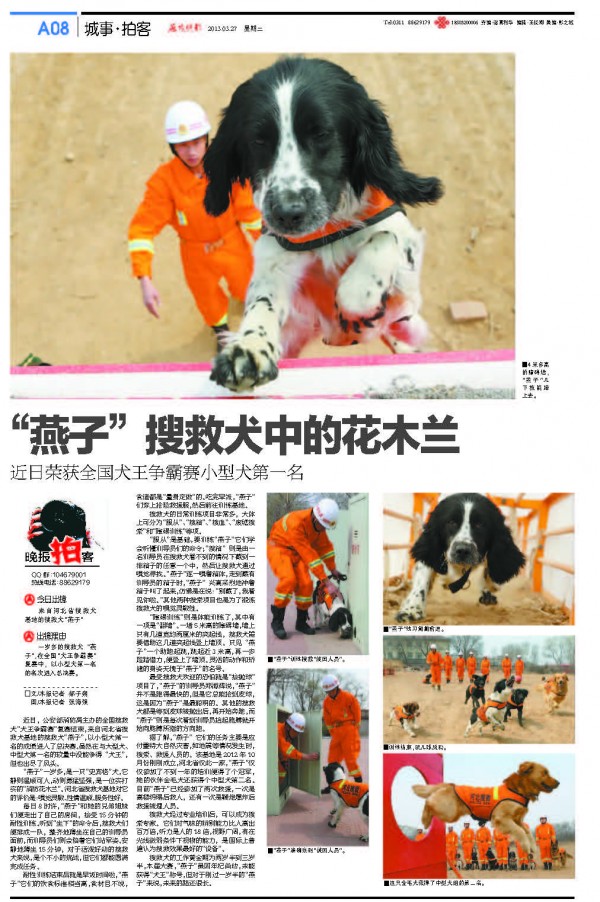
Just see Swallow in action – China’s champion search and rescue dog in the making. 

The semi-finals of the All-China Search and Rescue Dog Championships, organized by the fire department of the Ministry of Public Security, have just concluded. As yesterday’s front page of the Yanzhao Evening News (燕赵晚报) from Hebei province told us, there was one outstanding star at the event: a one-year-old Springer from Hebei province called Swallow (燕子). Swallow was top dog in the small-scale category, and will now go through to the finals of the event. According to the handlers, Swallow has a very smart sense of smell, and is very obedient.

Swallow is currently undergoing training as a search and rescue dog. Every morning at 8 am, Swallow and her companions are first taken through their paces in endurance exercises lasting around 15 minutes. At the command of “sit!” (坐下), all the dogs must line up in a line in front of their handlers, and remain in this position for another 15 minutes in a sort of “patience drill”. This completed, its time for breakfast, which is made to order for every individual dog. And then its time to strap on the search and rescue gear and head out to the training ground. The daily training routine is stiff, encompassing such exercises as learning to obey orders, searching through boxes and ruins, and jumping over barriers.

Then of course there’s also the more fun game of fetch. According to her handler, Swallow is not the fastest dog but she always manages to rush forward and grab the ball first and retrieve it. The reason for this is because she is the smartest. While all the other dogs would wait until the handler throws the ball before setting off, Swallow would already be running when the handler lifts his arm to throw the ball.

Although Swallow is still in training, she has already heroically participated in two operations. One was when a building collapsed and she searched the ruins for signs of life, while in the other case she searched for survivors after an explosion caused by fireworks. And the best thing about Swallow is that she’s still just one year old – she has a bright future ahead.

Links and sources
Yanzhao Evening News (燕赵晚报): “燕子” 搜救犬中的花木兰

Posted in Front Page of the Day, Wildlife, Nature and the Environment | Tagged , , | Comments Off on Meet Swallow, China’s champion search and rescue dog

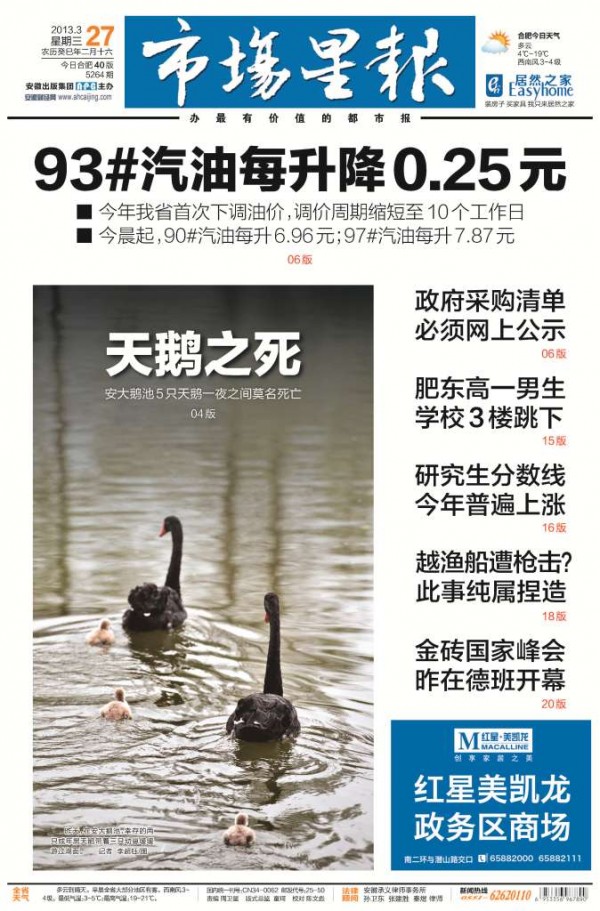
Five floating dead black swans join China’s animal apocalypse

Shichang Xinbao27March

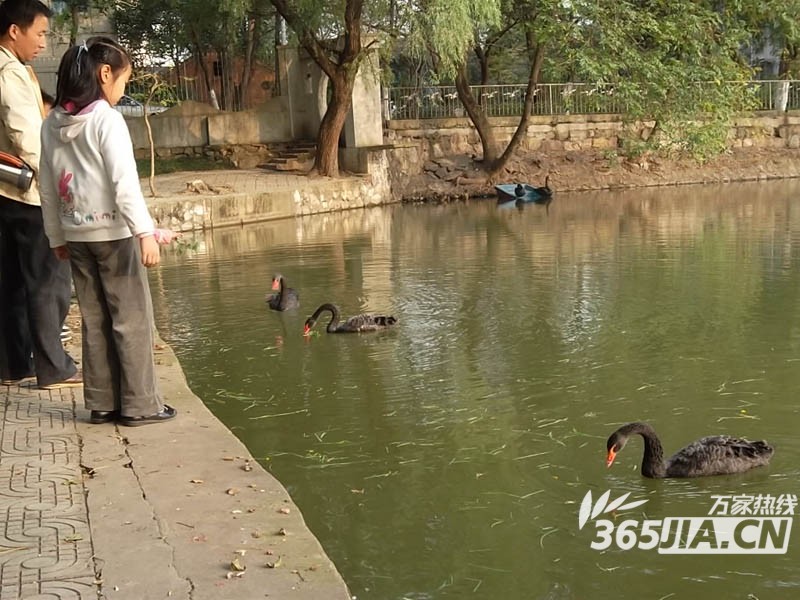
At the north-eastern corner of Anhui University’s old campus in Hefei, capital of Anhui province, there’s a scenic pond that’s inhabited by a bevy of black swans. The swans have been there for more than a decade already, and were – as the front page of local newspaper Star News (市场新报) laments today – an object of fondness for locals.

The black swans at Anhui University in happier times

Yet early this morning, five of these black and beautiful swans were found floating lifeless on the surface of the pond. The latest instance of floating dead animals in China – first pigs, then ducks, and now black swans – these mere five black swans became an object of heated discussion on the Internet right after the announcement was made.

How did they die? Was it a natural disaster or another man-made one? As Star News tells us today, upon hearing of the news yesterday it immediately sent a journalist to the scene to find out exactly what happened. What he found was just one more filthy pond filled with oily water and garbage.

The swans are something to behold. The picture above is taken from a photo album that was uploaded to the website 万家热线, or “Ten Thousand Hotline” (a news and information portal focused on Anhui province), in 2011. Now clouded with a sense of sadness, the album shows the then 13 black swans as they appeared last winter. There are now eight swans left.

The journalist was not impressed by the scene he found the pond. The water had an oily quality to it, and quite a lot of garbage could be seen on the surface. From what he could ascertain from locals, many people often used the pond to rinse cloths, mops, mats and other items containing various chemicals.

The journalist could not see the dead swans anymore, because, as he was informed, they have been preserved and will be studied carefully to determine the cause of death. After this their remains will be used as specimens for academic research.

With the cause of death as yet entirely unknown, the Star News today offers four possible causes of death in a desperate attempt to establish whether it was a natural occurrence or not:

  1. Killed by other animals: According to a witness interviewed by the journalist, on Sunday afternoon a large dog was seen chasing and biting the swans
  2. Poisoned by garbage: Just ten days ago a black swan was born in the pond, and this caused an increase in the number of visitors. Many of these were seen to throw peels, leaves and other things into the pool, and one of these items may have poisoned the swans
  3. Water pollution: In the last few years, the quality of the water in the pond worsened considerably. Incredibly, sewage was pumped into the pond sometime last year, leading to an outbreak of blue-green algae
  4. Disease or some other natural cause

So what caused these five black swans to go the same way as thousands of pigs and ducks, all discarded into a watery grave? Speaking to the people responsible for the maintenance of the area, the journalist was told that new measures are now to be implemented at the pond, including strengthening patrols by local security, improving the quality of the water, and removing the garbage. But alas, it’s too late for the five black swans, who were preyed on by predators, bombarded with garbage, and left floating lifeless like just some worthless pig.

Links and sources
Star News (市场新报): 天鹅之死 (Star News app on iTunes)
365jia.cn: 徜徉在午后温暖阳光里的安大天鹅池

Posted in Front Page of the Day, Wildlife, Nature and the Environment | Tagged , , | Comments Off on Five floating dead black swans join China’s animal apocalypse

Hubei farms and dead floating pigs

Dongchu Wanbao 26 March

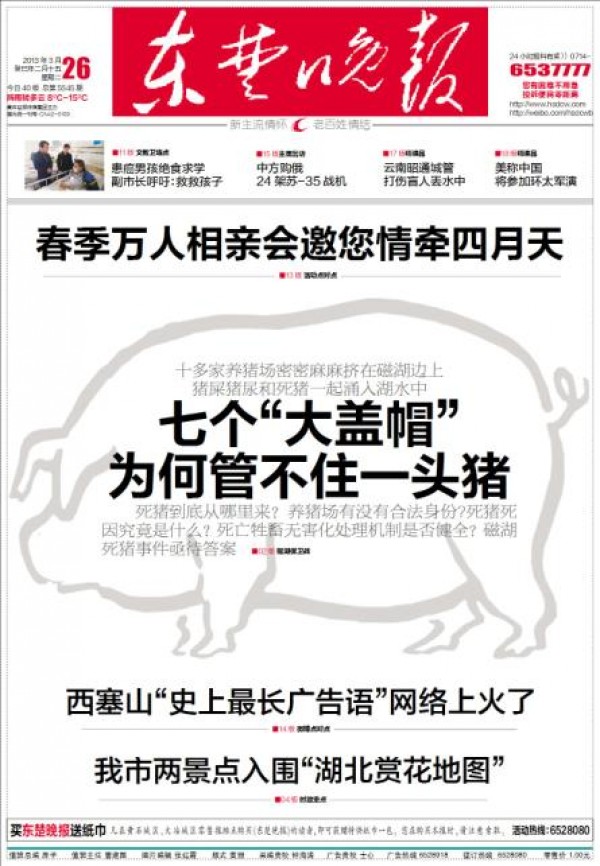
In the city of Huangshi in Hubei province there’s a lake called Cihu Lake. Situated close to the Yangtze River, the lake area appears to be an idyllic scenic spot. Yet, especially in light of recent events, Cihu Lake is blemished by the existence of ten pig farms that are situated on the south-western edge of the lake. After 108 pigs were fished out of the lake in the last few days and several thousand more in lakes and rivers elsewhere in China, the local newspaper Dongchu Evening News wanted some answers, so it sent a journalist to the ten pig farms on Cihu Lake to investigate. The situation the newspaper uncovered is startling. Not only were all the pig farms technically illegal, none of them had the proper paperwork, and the farms were falsifying the labels on their pigs’ ears.

Yet making this deplorable situation worse is the state of government regulation being applied to the pig farms, regulation which can only be described as messy and inefficient. So while we may not yet know the full details of where all the dead pigs in the rivers originated from, the out of control pig farms on Cihu Lake can shed a lot of light on the situation.

The front page of the Dongchu Evening News (东楚晚报) from Hubei province today makes an insightful contribution to our understanding of why several thousand dead pigs ended up in rivers in China. 108 pigs were fished out of Cihu Lake (磁湖) in Huangshi (黄石), Hubei province, and the newspaper today casts a suspicious eye on the ten pig farms on the south-western edge of Cihu Lake. And not without reason, because after the pigs were removed from the lake, authorities in the city went to check up on the ten pig farms and found that not a single one among them had its documents in order, and in particular none of them were holding a valid certificate for animal disease prevention.

Yet when a journalist from the newspaper went to interview some people at the ten pig farms, the manager of one farm let on more than he intended when he protested: “I have a valid business license, and that’s all you need for a pig farm!” This was strongly denied by the animal health authorities in Huangshi, who maintained that you can only obtain a business license once you have the animal disease prevention certificate.

According to regulations from the Ministry of Agriculture, however, the Cihu pig farms are not even supposed to exist. The regulations specify that no pig farm can be situated closer than 500 meters from sources of drinking water or from residential areas, and the Cihu Lake pig farms fail on both these criteria.

Not only are the documentation of the pig farms not in order, the labels on their pigs’ ears are all highly suspicious as well. The label is supposed to state exactly where each and every pig came from, yet the pigs fished out of Cihu Lake have labels linking them to locations far and wide such as Anhui, Zhejiang and Jiangsu provinces – but none from Hubei. What this suggests is that the farms on Cihu Lake didn’t bother to update the labels or simply falsified them.

Throwing dead pigs in rivers is in fact nothing new and has been happening for years. So why, the newspaper asks, has regulation of this issue been so lax? In fact, as the journalist discovered, government regulation on the issue of pig farming is convoluted to say the least, with no less than seven different government departments (e.g. agriculture, quality supervision, health and hygiene, etc.) having some responsibility for regulation. So the journalist decided to get in touch with each of these departments to find out who is really responsible, but the only reply he got was “it’s not our responsibility”, before being fobbed off with the instruction to get in touch with some other department.

With this chaotic situation, thousands of dead pigs in rivers seem a lot less surprising, if not any less awful.

Links and sources
Dongchu Evening News (东楚晚报): 随意丢弃病死畜禽 将进行案值2-3倍罚款; 磁湖死猪事件引发社会各界高度关注; 十多家养猪场挤在磁湖边上 猪屎和死猪涌入湖水中

Posted in Front Page of the Day, Health and Medicine | Tagged , , | Comments Off on Hubei farms and dead floating pigs

Taking the shine off Apple’s China prospects?

Apple in CCTV's crosshairs

Apple in the crosshairs, and the shadow of Google’s misadventures in China

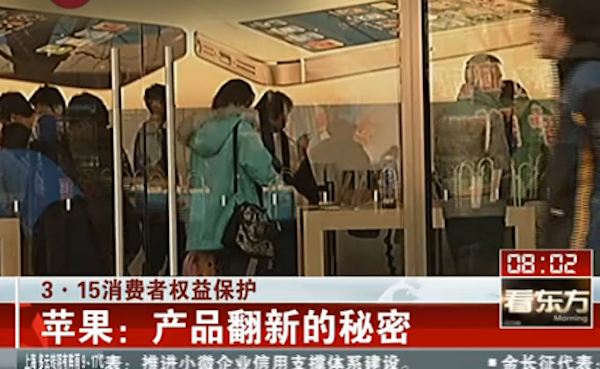
On March 15 — World Consumer Rights Day — China Central Television (CCTV) broadcast its annual investigative program that seeks to expose companies that harm or mistreat Chinese consumers. Several companies, both foreign and domestic came under the spotlight, and the program rehashed familiar accusations of Chinese consumers being treated unfairly by multinationals. Specifically, CCTV accused Apple of discriminating against Chinese customers by offering lower levels of service and charging fees for replacing back covers of faulty iPhones, which is done for free in other countries.

There also seems to have been an organised campaign on Sina Weibo in which celebrities criticised Apple for the problems exposed by the CCTV report. The campaign backfired when the aptly named Peter Ho tweeted his message criticizing Apple, but forgot to delete the instructions it came with telling him to post it at 8:20 pm, just after the CCTV report aired. The word on the street in Beijing is that this campaign was organized on behalf of one of Apple’s competitors. Samsung is the name most often cited, but this is only hearsay. (See China Media Project’s posting for more on what has become known as the 8:20 affair: Did CCTV conspire to smear Apple?.)

The CCTV broadcast was not the first time Apple has been accused of treating its Chinese customers differently from those in other regions. On 15 February 2012, Beijing Business Today (北京商报) a weekday business newspaper published by the Beijing Daily Group, ran a report critical of the high support fees and mandatory replacements for damaged iPhones at Apple stores in China. The focus of the article was on Apple repair staff purportedly pressuring consumers into paying high prices for comprehensive replacement of iPhone parts rather than lower-price part repairs. Rather than simply fixing the broken screen, it cost up to RMB 1,598 to replace a broken screen, main board, and battery with factory refurbished parts on a water-damaged iPhone. The article also quoted from Chinese consumer protection laws governing fair treatment of customers, and concluded by asking how long Apple can expect to survive if it exhibited such disregard for its customers. (“Who is hurt by Apple’s sky-high service fees?” 苹果天价售后服务伤了谁)

Most of the information contained in the CCTV report was in the Beijing Business Today article — the phone back enclosure that isn’t replaced, the 90-day warranty that might violate regulations — with one key difference: the Beijing Business Today article compares the prices Apple charges for replacement parts to the much lower service fees that other shops charge for basic repairs to suggest that Apple’s high prices demonstrate an arrogant disregard for consumers, but it does not mention Apple’s behavior in other countries. CCTV’s report, on the other hand, emphasizes this “double standard” of customer service, and it was the allegations of discrimination against Chinese consumers that appeared in the astroturfed celebrity microblog posts after the program segment was aired. The sense that Chinese consumers are being treated worse than consumers in other countries has cropped up in the way the media reported on Apple in the past (e.g. delayed product launches, handling of scalping) and may be the reason that this turn of the news cycle received more attention than the complaints in 2012.

Although the attempt to drive online public opinion through celebrity microblog posts was exposed and is now the butt of online mockery, it’s instructive to compare CCTV’s report on Apple’s misdeeds to its June 2009 report on the “pornographic content” of Google’s predictive search technology. In that incident, CCTV was roundly mocked when it was revealed to have used one of its own interns as key evidence of public disgust with Google. Additionally, evidence pointed to the possibility that it might have generated the list of obscene predictive searches in the week leading up to its national broadcast (see links to Danwei stories below for more). But the online backlash to CCTV did nothing to help Google, and the TV segment, however flawed and manipulative it may have been, was merely the public prelude to a government-ordered cleanup and overhaul of the Internet search market in China.

In a move possibly related to Apple’s run-in with CCTV, Google’s mobile operating system Android was recently singled out for criticism by a government report in China. A white paper (PDF) by the Ministry of Industry and Information Technology’s China Academy of Telecommunication Research warned of excessive dependence on the Android mobile operating system in China, where 80% of smart phones apparently use Google’s operating system. The report accused Google of discriminating against Chinese companies.

The signs are clear that regulators and establishment media would both be happy for foreign mobile phone handsets and operating systems to lose market share. This should be remembered by anyone betting on Apple as a China play, including CEO Tim Cook who earlier this year told Xinhua News Agency that he believes China will become Apple’s largest market.

Links and sources
China Media Project: Did CCTV conspire to smear Apple?
Beijing Business Today (北京商报): 苹果天价售后服务伤了谁 
China Digital Times: Chinese Report Warns of Android Invasion
Danwei: State media blames Google for porn, Google says “Gao Ye” is a sensitive word in any form
CNN: Tim Cook: China will be Apple’s top market
Xinhua: Interview: Apple CEO expects China to become biggest market

Posted in Business and the Economy, Consumer Culture, Internet and Media | Tagged , | Comments Off on Taking the shine off Apple’s China prospects?

More dead pigs and a thousand dead ducks dumped in rivers

Tianfu Zaobao 22 March

Has tragedy become farce? As the vile mystery of several thousand dead pigs floating down rivers in Shanghai continues to roil, Chinese newspapers today report that a thousand dead ducks have been found floating down a river in Sichuan, and fifty dead pigs (mostly piglets) have been found stranded on a shoal in the Xiangjiang River in Changsha, Hunan province.

Yet there’s no need to panic, the newspapers point out, the ducks and pigs have all been buried and no sources of drinking water have been polluted. No, only our own souls remain polluted with the stench of rotting animals cast into rivers to float out of sight and out of mind.


Dead ducks in Sichuan
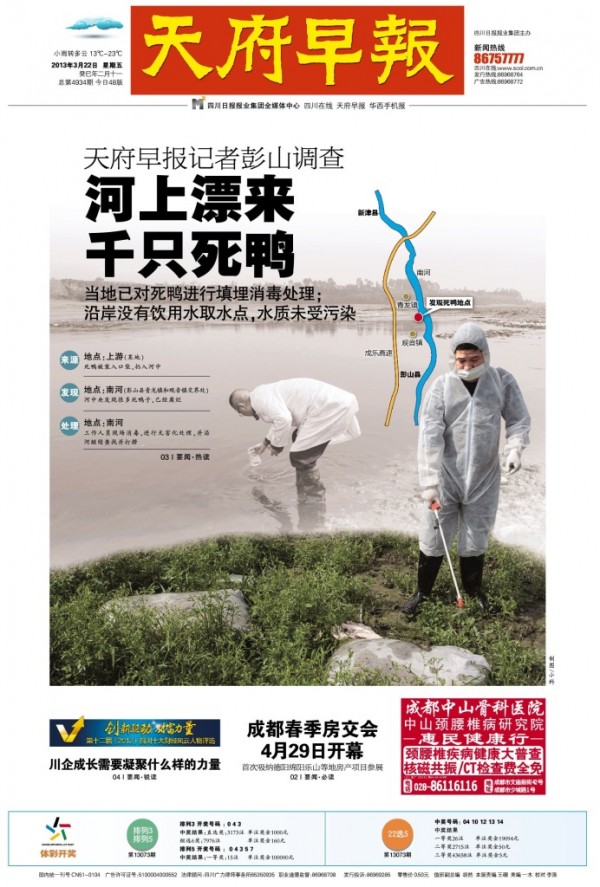
The front page of the Tianfu Morning News (天府早报) from Sichuan province today reports that on the afternoon of 19 March, more than a thousand dead ducks were found floating down the South River at Pengshan county (彭山县) near the city of Meishan (眉山市) in Sichuan province.

On that afternoon, the phone rang at the local branch of the environmental protection office. The caller informed the agency that there’s an almighty stink in Pengshan, because there’s dead ducks floating down the river. Officials rushed to the scene and later found more dead ducks – in various states of decay and some wrapped in white bags – piled up on a river bank some distance upstream close to the towns of Qinglong (青龙) and Guanyin (观音). The ducks were piled on this spot a few days before – by whom no-one knows – and the river gradually swept them along.

When CCTV reported the news yesterday, journalists from Tianfu Morning News rushed to scene and were able to ascertain that all the dead ducks had been fished out, disinfected and buried. And since the South River is not a source of drinking water in the area, there’s no cause for alarm.

This is the overriding message of Tianfu Morning News’s coverage today of the dead ducks in the river. With front page images of white-clad officials testing the water, we’re told that there is no danger to humans in the slightest. Right at the top of the paper’s coverage, there’s the following question and answer series to put everyone at ease:

Where did the dead ducks come from? Uncertain at this point.
Did the dead ducks die from some illness? Uncertain at this point.
How have the dead ducks been dealt with? Buried at an appropriate location.
Any impact on the sources of drinking water? No.
Will any of the dead ducks make it onto the market? No.

More dead pigs in Hunan
The front page of the Xiaoxiang Morning Herald from Changsha in Hunan province today reports that fifty dead pigs were yesterday found stranded on a shoal in the Xiangjiang River (湘江) in Changsha. After they were discovered yesterday morning, the pigs were fished out and buried not far from the river. Most of the pigs were very young.

Upon closer inspection, one of the pigs was found to have a tag in its ear. The tag was imprinted with the serial number 1430181.

RIP 1430181 in your watery grave, such a trendy way for a pig to die in China these days.

Links and sources
Tianfu Morning News (天府早报): 千只死鸭河中漂 已填埋无危害
Xiaoxiang Morning Herald (潇湘晨报): 三汊矶大桥附近漂来50多头死猪

Posted in Front Page of the Day, Health and Medicine, Wildlife, Nature and the Environment | Tagged , , | Comments Off on More dead pigs and a thousand dead ducks dumped in rivers

China’s “most famous peasant” dies, and he never appeared on the cover of Time

Xinxiaoxibao 19 March

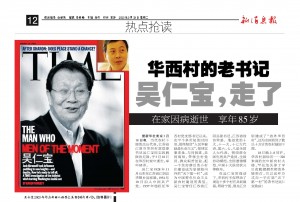
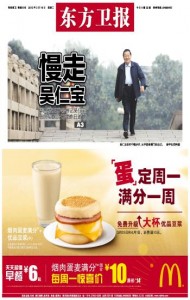
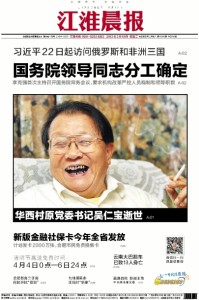
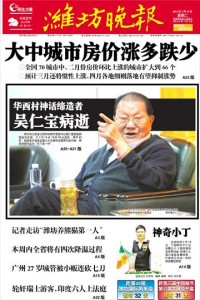
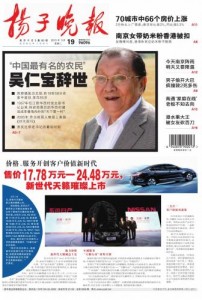
What’s a little embellishment of a famous man after his death? Chinese newspapers today note with sadness the death of a man that became known as “China’s most famous peasant”, Wu Renbao (吴仁宝). Wu was the man responsible for transforming little Huaxi village in Jiangsu into a prosperous city of 35,000 people: China’s “leading village under heaven” (天下第一村). Wu died last night at the age of 85 of lung cancer, and his face is on the front pages of many newspapers today (scroll down to see gallery).

The newspapers today mourn the passing of the man with fulsome praise, yet when Xinhua broke the story on Weibo last night just after six in the evening, it reported that Wu had appeared on the cover of Time magazine in 2005. Hence today this same assertion is included in all the newspapers’ coverage of Wu, making it all the more regrettable that this assertion simply isn’t true. New News (新消息报) from Qinghai province even kindly printed said Time cover with Wu Renbao, which is actually a blatant fake that compounds the embarrassment of Xinhua and the newspapers today.

Wu Renbao and China’s “first village under heaven”
Huaxi village (华西村) in Jiangsu province was established in 1961 with an original population of 667 people. When Wu Renbao (吴仁宝) took over as Party Secretary of the village, it had assets of 25,000 yuan and debts of 15,000 yuan. Yet under Wu’s energetic leadership, the village began construction and investment projects to develop the village and the surrounding countryside. From 1978, Wu oversaw the development of a unique Huaxi-style investment model where profits were re-invested and shares were distributed to all residents of the village.

The outcome of all this was visibly astounding. Huaxi is now a prosperous town of 35,000 inhabitants with skyscrapers and luxury cars. It has even started to flaunt its wealth: in 2011, a 328-meter high-rise hotel housing a statue of an ox made from a ton of gold was opened in Huaxi. The man said to be behind the “miracle of Huaxi” was Wu Renbao. In 2012 a movie was made about his life and achievements in transforming Huaxi. Entitled simply “Wu Renbao”, the movie was made as a “gift” to the 18th Party Congress last year.

The Time cover that wasn’t

Embarrassing dupe: Wu Renbao “on the cover of Time“, as reported in New News today

In their fulsome praise of Wu Renbao today, China’s newspapers all mention that he made the cover of Time magazine in 2005. So I went looking through all the covers of Time magazine in 2005 and came up empty-handed. It was then, however, that I discovered that the newspaper New News (新消息报) from Qinghai province had kindly printed the said Wu Renbao Time cover, inadvertently revealing that it and all the other Chinese newspapers had been embarrassingly duped by a blatantly fake Time cover. It boggles the mind how this newspaper didn’t notice its terrible mistake, with the fake cover being such a nut job of nonsensical grammar. The fake Wu Renbao cover, it emerged, was in fact ripped off of this Time cover from January 2006. This fakery has already been reported on Weibo today (e.g. here or here), and elsewhere on the Chinese Internet.

Yet before we completely dismiss New News as a sorry excuse for a newspaper, it would probably be remiss not to mention that this snafu (as with everything else related to Chinese news reporting) was likely first propagated by Xinhua itself. Looking back at the paper trail of news reports yesterday, it does appear as if Xinhua was first with publishing a story of the news of Wu’s death and the claim that he appeared on the cover of Time magazine in 2005 in a report published at around 20:30 last night. As mentioned above, Xinhua had already reported the false assertion on its Weibo account just after six last evening.

Inexorably in China, all news leads back to Xinhua, and then all the rest follow.

Here’s a gallery of front pages today on Wu Renbao:

Links and sources
Ndnews: 网友称吴仁宝上《时代周刊》封面照是PS
Oriental Guardian (东方卫报): “天下第一村”华西村原党委书记吴仁宝逝世; 曾作为封面人物登上美国《时代》周刊
Time: The Richest Reds in China
New News (新消息报): 华西村的老书记吴仁宝,走了; 吴仁宝的宁夏情; 1.3亿多奖金留给集体曾登美国《时代周刊》; “天下第一村”人均存款超百万 
Xinhua: “中国最有名的农民”吴仁宝辞世 曾登上时代周刊封面

Posted in Front Page of the Day | Tagged , , , , | Comments Off on China’s “most famous peasant” dies, and he never appeared on the cover of Time

It’s Xi Jinping!

Qingnianbao 15March

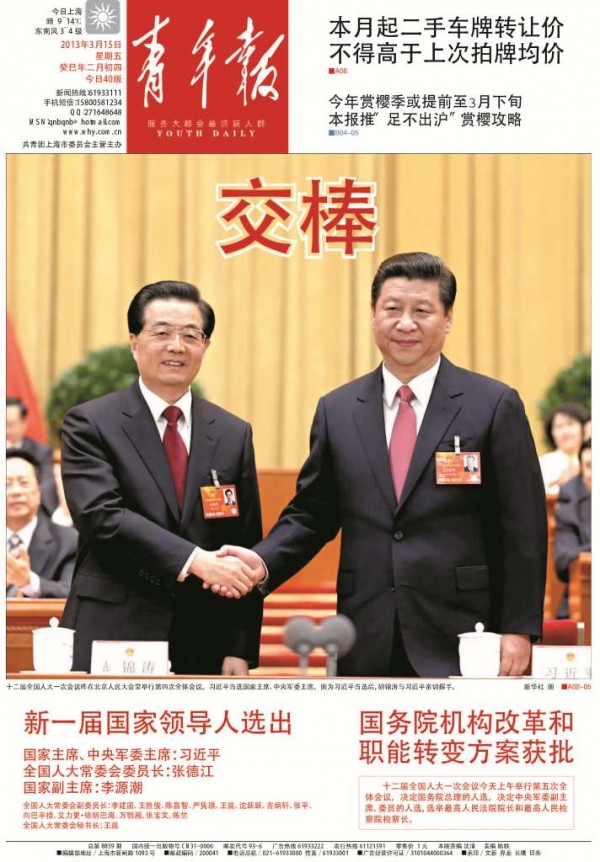
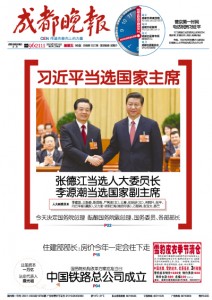
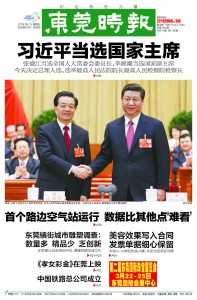
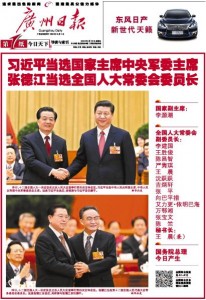
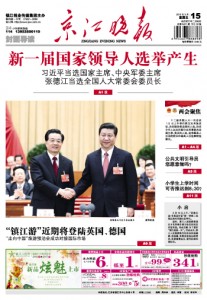
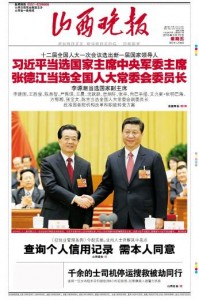
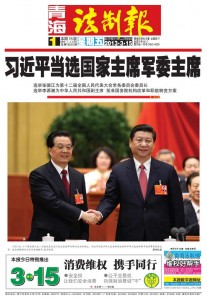
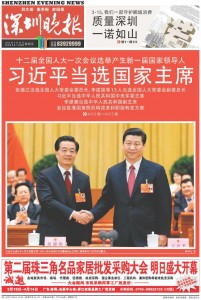
Yesterday was the day: the baton has been passed to a new generation of leaders. The very moment of this transition was captured in the form of a handshake between former president Hu Jintao and new president Xi Jinping yesterday at the annual session of the 12th National People’s Congress in Beijing. Thus there’s only one leading headline on the front pages of China’s newspapers today: “Xi Jinping elected as state president” (or some variation of this), and there’s one recurring front page image: the inter-generational transitional handshake between Hu and Xi. As shown above, the Youth Daily (青年报) even put the words “Passing of the baton” (交棒) right above the handshake image on its front page.

Some newspapers have today also published biographies of Xi and the other new leaders, along with a description of how the elections took place yesterday. Admittedly there’s not much else to say except that the delegates voted, the votes were counted, and the results were announced. Thus the Qinghai Legal Daily (青海法制报), for example, today uses the handshake image on its front page and reports all these matters very matter-of-factly, adding at the end that “once the results of the vote were announced, everyone present rose up and applauded heartily for a long time”.

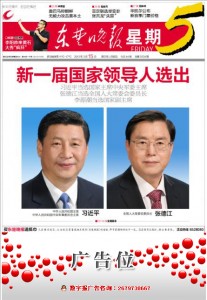
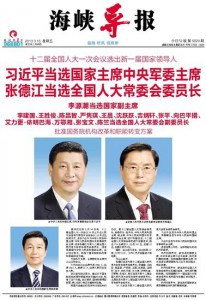
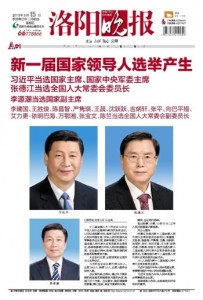
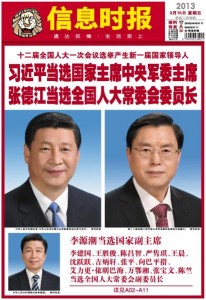
Yet Xi doesn’t have the front pages all to himself today. He shares the limelight with a few other top new leaders from yesterday’s elections, notably Zhang Dejiang (elected chairman of the Standing Committee of the National People’s Congress) and Li Yuanchao (elected vice president), among others.

So there are two types of front pages in China today (see the two galleries below):

    • the transitional handshake, and
    • the line of portraits

And here they are:

The transitional handshake


The line of portraits


Links and sources
Qinghai Legal Daily (青海法制报): 习近平当选国家主席军委主席; 中华人民共和国主席、中华人民共和国中央军事委员会主席 习近平简历; 第十二届全国人民代表大会常务委员会委员长 张德江简历

Posted in Front Page of the Day | Tagged , , | Comments Off on It’s Xi Jinping!

Changsha’s unruly drivers challenged to be like butterflies shaking their wings

Sanjin Dushibao 13March

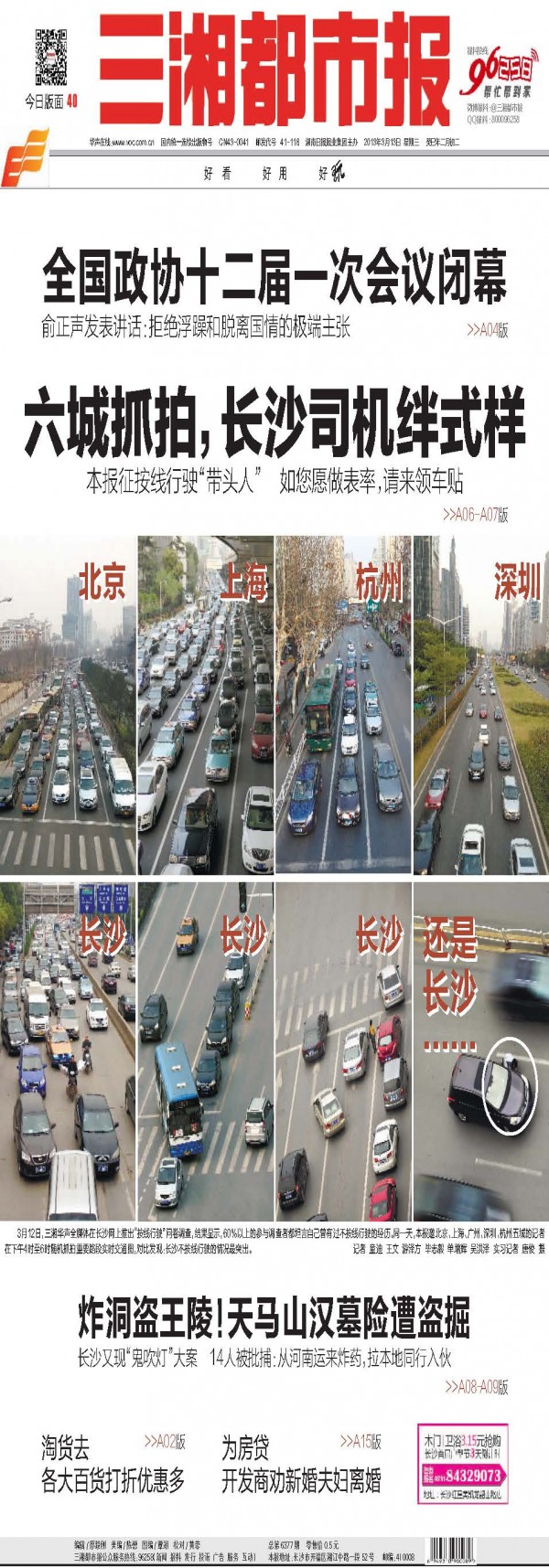
The front page of the Sanxiang Metropolis Daily from Changsha, the capital of Hunan province, today unloads on the city’s unruly drivers. The front page is festooned with a line of images of orderly straight lines of traffic in Beijing, Shanghai, Hangzhou and Shenzhen, contrasted with a line of images of a muddled rabble of cars moving every which way in Changsha. One of these images even shows a stationary car in the middle of a highway with the driver on foot next to the car, under the words “this is also Changsha”.

The images are some of the evidence compiled yesterday by the newspaper in a multi-region fact-finding operation. The object of the operation was to establish which of the cities has the most unruly drivers, i.e. the ones worst at driving patiently in orderly lines. The newspaper conducted an online survey in Changsha before sending a journalist driving around the city to observe first-hand the state of its driving, and what he found wasn’t pretty. It then organized journalists in the other cities mentioned above (plus Guangzhou) to do some observing of the traffic in their own cities and take some pictures of what they saw.

As the front page so graphically illustrates, Changsha’s drivers are the worst of the lot. Hence the Sanxiang Metropolis Daily today does some soul-searching for its readers. What to do about the city’s muddled roads? What the newspaper first proceeds to do today is guilt-trip its readers in Changsha about the bad driving in the city, which is so uncivilized. It then informs them of a rather odd campaign launched in the city to inspire “new citizens” to become model drivers. As a single butterfly can shake its wings and cause a storm, it urges, so the drivers of Changsha must drive orderly and thereby shake their wings and ignite a civilized storm of orderly driving. Anyone who fails to fall for this passionate rhetoric is reminded that there are now high definition cameras on the streets of the city, and they will record every instance of uncivilized driving.

The survey

“You have more cars than we do, your roads are narrower, yet why does your traffic move faster than ours?”

The Sanxiang Metropolis Daily just can’t understand why Changsha’s driving has to be so bad, especially in comparison with the other larger cities. And everyone in Changsha agrees that its very bad. The newspaper cites a survey carried out on a Changsha website yesterday asking respondents about their driving habits. Shockingly, the newspaper relates, of the 414 respondents, more than 60% said they have previously disobeyed rules for driving orderly in straight lanes, but more than 70% said that they were forced to do so. The respondents blamed new and inexperienced drivers who entered intersections too slowly, leaving other drivers no choice but to swerve around them. Additionally the questionnaire revealed two common further reasons for the bad driving:

  1. Some drivers force others aside, racing forward and crowding into every gap, so drivers can’t just wait patiently in their lanes.
  2. Many roads in Changsha are filled with construction sites, and if you don’t race ahead you’ll just languish in traffic jams.

So the common perception seems to be that if you don’t rush forward and push into every single gap in front of you, you’ll be stuck in endless traffic jams. This essentially lawless conception of driving is wreaking havoc on Changsha’s roads. The newspaper relates statistics provided by an employee of a local insurance company. Over a period of six years, the employee found that his company processed around 20 accidents every day, and on average 60% of these accidents are caused by drivers driving recklessly across lanes. According to the traffic police, in the three months of the year to date, on average around 500 drivers a day were penalized for this offence in Changsha.

The fact-finding operation

To establish for itself the state of driving in Changsha, the Sanxiang Metropolis Daily yesterday sent one of its journalists out in a car with a mission to record every instance of bad driving. What the journalist found was rather depressing, because only five minutes in he reported the following:

8:55 – Arrived at Mayuanling (麻园岭), small car ahead with number plate 湘E02945 constantly changing lanes from the right side of a three-lane highway all the way to the left.

Three minutes later, he reported again: small car with license plate 湘A00305 “continuously changing lanes and inserting itself into the fast lane”. And so on it went all day, “continuously changing lanes”, “racing to fill a gap”, “cut off by another vehicle”, etc.

On the same day, the newspaper requested journalists in five other cities, namely Beijing, Shanghai, Guangzhou, Shenzhen and Hangzhou, to go out on the roads in their respective cities and observe to what extent drivers drove orderly and obeyed the rules. The result of all this was graphically illustrated on the front page: nice orderly lines of cars in all the other cities, chaos in Changsha.

Be like butterflies and shake your wings 

With the evidence thus so overwhelming, the newspaper proceeds to lay out the full moral implications of this sorry state of affairs in Changsha. Under the heading “Who will dare take up this challenge?,” the newspaper tells of a new campaign set up by the transport section of the local public security bureau called “Civilized City, Orderly Driving” (文明城市,有序行车). The campaign is related to the readers with the slightly odd use of a butterfly metaphor. After asking readers to “Take hold of this beautiful butterfly,” the newspaper lays out the following challenge:

If you drive a car and you are willing to abide by the motto “I am a new citizen, I drive orderly”, you should phone the number below and declare yourself a model driver, and we’ll award you with a “beautiful” car allowance.

Yet lest you think this is going to be easy:

Anyone taking up the challenge will have their every move on the roads carefully monitored by everyone, there will be countless eyes observing your uncivilized driving, which will be revealed by [new high definition] cameras on the road.

But don’t be discouraged, because to inspire readers to take up this daunting challenge, the newspaper finishes with a poetic appeal for drivers to think of a single butterfly which, shaking its little wings in the Pacific Ocean can kickstart a massive storm. “We also have a butterfly,” it says, “which also desires to shake its wings and ignite a ‘storm’ of orderly and civilized driving in Changsha”.

With the passion and the poetic metaphors flowing, the newspaper reminds its readers that just a momentary slip of a wrong decision can have a fatal impact on Changsha. The phrase “I am a new citizen, I drive orderly” is not just a slogan, its a challenge:

Your actions are small seeds that will germinate, form branches and grow big. All of you are brave pioneers…We along with you look forward to this “butterfly shaking its wings” effect.

Be inspired Changsha – shake your wings and rain down fire and brimstone in a righteous storm of civilized driving.

Links and sources
Sanxiang Metropolis Daily (三湘都市报): 六城同拍,长沙人最急七成司机称被逼变线; 见缝插针看起来快实际上拖慢整座城市

Posted in Front Page of the Day, Urban Culture and Cities | Tagged , , | Comments Off on Changsha’s unruly drivers challenged to be like butterflies shaking their wings

Smooth talking entrepreneurs at the Two Sessions

Qiyejia Ribao 12 March

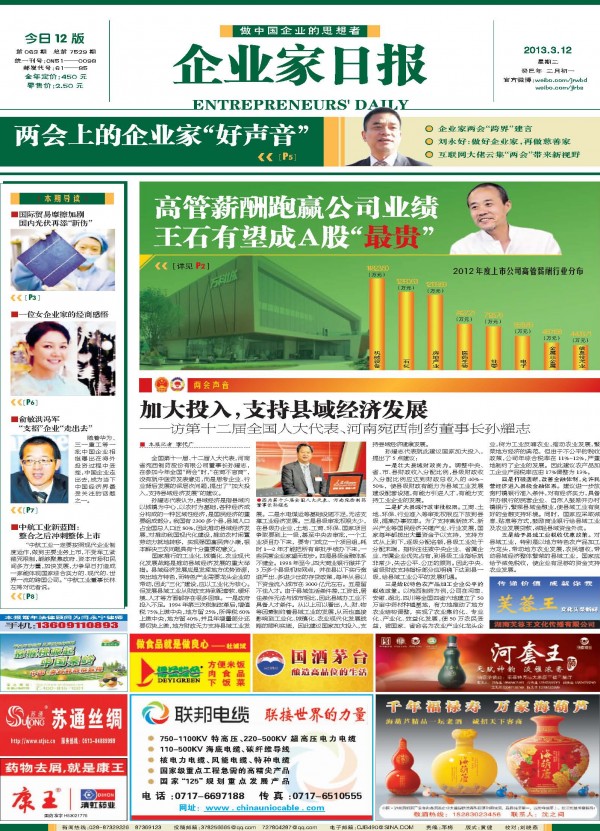
If you thought that the Two Sessions taking place in Beijing right now were boring and trite and not made for vigorous discussion and a frank exchange of ideas, the Entrepreneurs’ Daily newspaper is today intent on convincing you that the outspokenness of a group of Chinese entrepreneurs is setting this year’s Two Sessions on fire. The newspaper today has a front page roundup of the “smooth talking” of a few leading entrepreneurs at this year’s Two Sessions, ranging from the wacky suggestions of Chen Guangbiao to more practical ideas for reforms in certain industries.

The Two Sessions that are taking place in Beijing at the moment are a symphony of all kinds of sounds, as the Entrepreneurs’ Daily (企业家日报) puts it so enthusiastically today, but one type of sound is audible above the cacophony:

The brain storm of the representatives at this distinguished political meeting is a type of miraculous radiating symphony. Yet the “smooth talking” of entrepreneurs at the Two Sessions is without doubt the most resonant sound in this symphony.

In every conceivable issue under discussion at the Two Sessions, the newspaper relates, the entrepreneurs are focusing their vigorous candor on the people’s welfare, displaying both their commonplace wisdom and civic sense of responsibility. Entrepreneurs “these days” are not merely interested in their own business matters, but are focusing their attention on all aspects of society.

Altruistic Zong Qinghou
Soon after the Two Sessions commenced this year, Two Sessions delegate Zong Qinghou (宗庆后), chairman and CEO of Hangzhou Wahaha Group and purportedly the richest man in China, called for working class people in China to be exempted from personal income tax. Such a fighter for the average man, Entrepreneurs’ Daily concludes, Zong stands out in more ways than one among China’s richest people.

Loony Chen Guangbiao
On 2 March, the billionaire entrepreneur Chen Guangbiao (陈光标) stood at the northern entrance of the Great Hall of the People in Beijing to welcome arriving delegates and members of the media with his personal brand of cans filled with clean air. Although not formally a member of the NPC or the CPPCC that collectively constitute the Two Sessions, Chen has appeared at the meetings every year since 2000 to make some bold statement. He appeared at last year’s Two Sessions wearing a Lei Feng cap, while this year he wore an all-green outfit of suit, tie and hat.

Shortly after this year’s Two Sessions commenced, it was revealed online that Chen had made a few suggestions for the meetings. One of his suggestions was for all the delegates to watch the 2012 Chinese movie “On the Nanniwan Frontier” (Chinese name: 南泥湾). While this is indeed a patriotic film, the suggestion could not have gone down entirely without a few awkward responses as the film was directed by and starred Diana Pang (彭丹), a Hong Kong actress who previously starred in a number of softcore porn films that are still banned in mainland China.

Some of Chen’s other wacky suggestions included reform of China’s family planning policy so that any person with a level of education no higher than junior high school are not allowed to have children; and the establishment of an annual “Save Food Day” on which everyone should go hungry for a day. One can wonder how long (if at all) Chen’s suggestions were discussed, but smooth talking he surely did do.

Novel ideas from Zhang Jindong, Li Shufu, and Chen Lijun
There is also the type of entrepreneur who wants to see more practical reforms in his or her respective industry. Zhang Jindong (张近东), chairman of Chinese appliance retailer Suning, gave his two cents worth by suggesting that the full May Day Golden Week holiday should be re-instated as this would encourage domestic consumption and improve the lives of average people. Zhang also suggested that China’s legal system should be further reformed to encourage entrepreneurship and to create a healthy and fair environment for the rapidly growing e-commerce market.

The chairman of car manufacturer Geely, Li Shufu (李书福), on the other hand, wants to see some legislation on air quality, the raising of the individual tax threshold, and the opening of China’s taxi industry. Chen Lijun (陈励君), a business leader in the solar panel industry, had a completely different kind of suggestion: she wants to see civil service posts in China opened to foreign talent.

All these suggestions caused heated discussion on the Internet, if not in the Great Hall of the People.

Links and sources
Entrepreneurs’ Daily (企业家日报): 两会上的企业家“好声音”

Posted in Business and the Economy, Front Page of the Day | Tagged , , | Comments Off on Smooth talking entrepreneurs at the Two Sessions