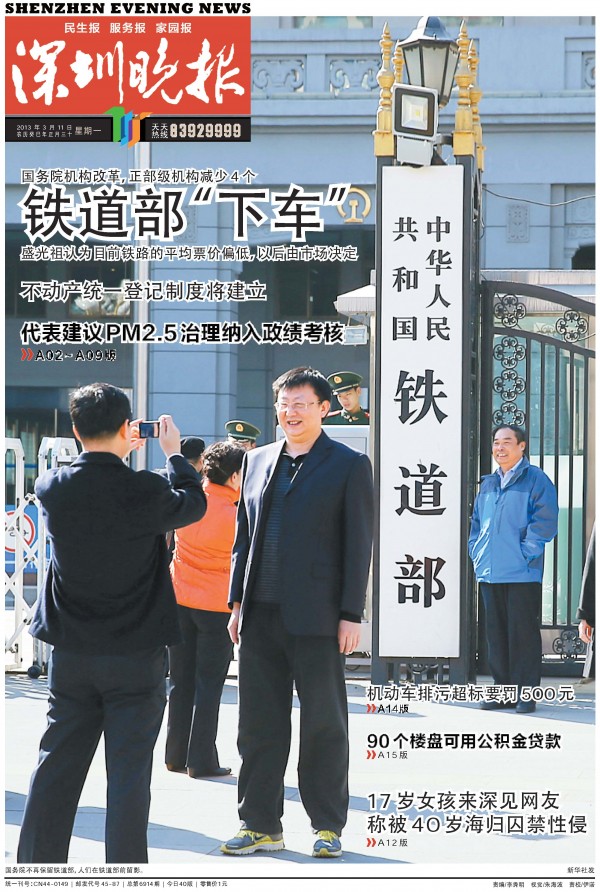
Farewell Ministry of Railways

深圳晚报

China’s newspapers today slightly ruefully report the departure of an institution as old as the PRC itself: the Ministry of Railways. The behemoth ministry has overseen the rapid development of the railway network in China in the last decade but was dogged by claims of massive corruption (especially in connection with its disgraced former minister Liu Zhijun, he of “18 mistresses” infamy), and its fate appeared to have been sealed by the disastrous Wenzhou train crash in July 2011.

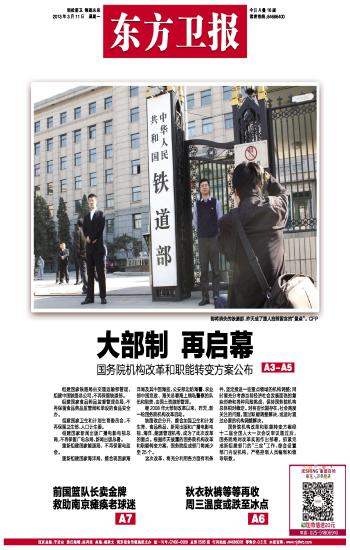
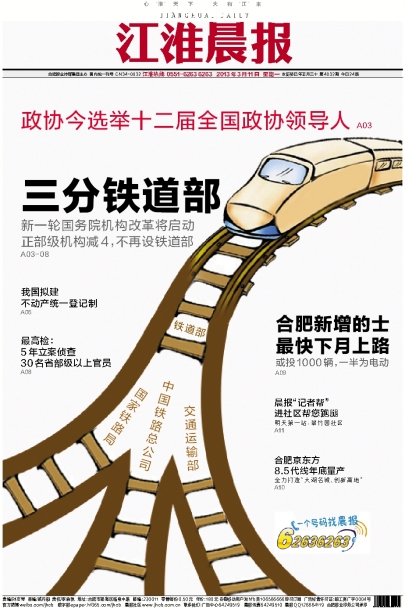
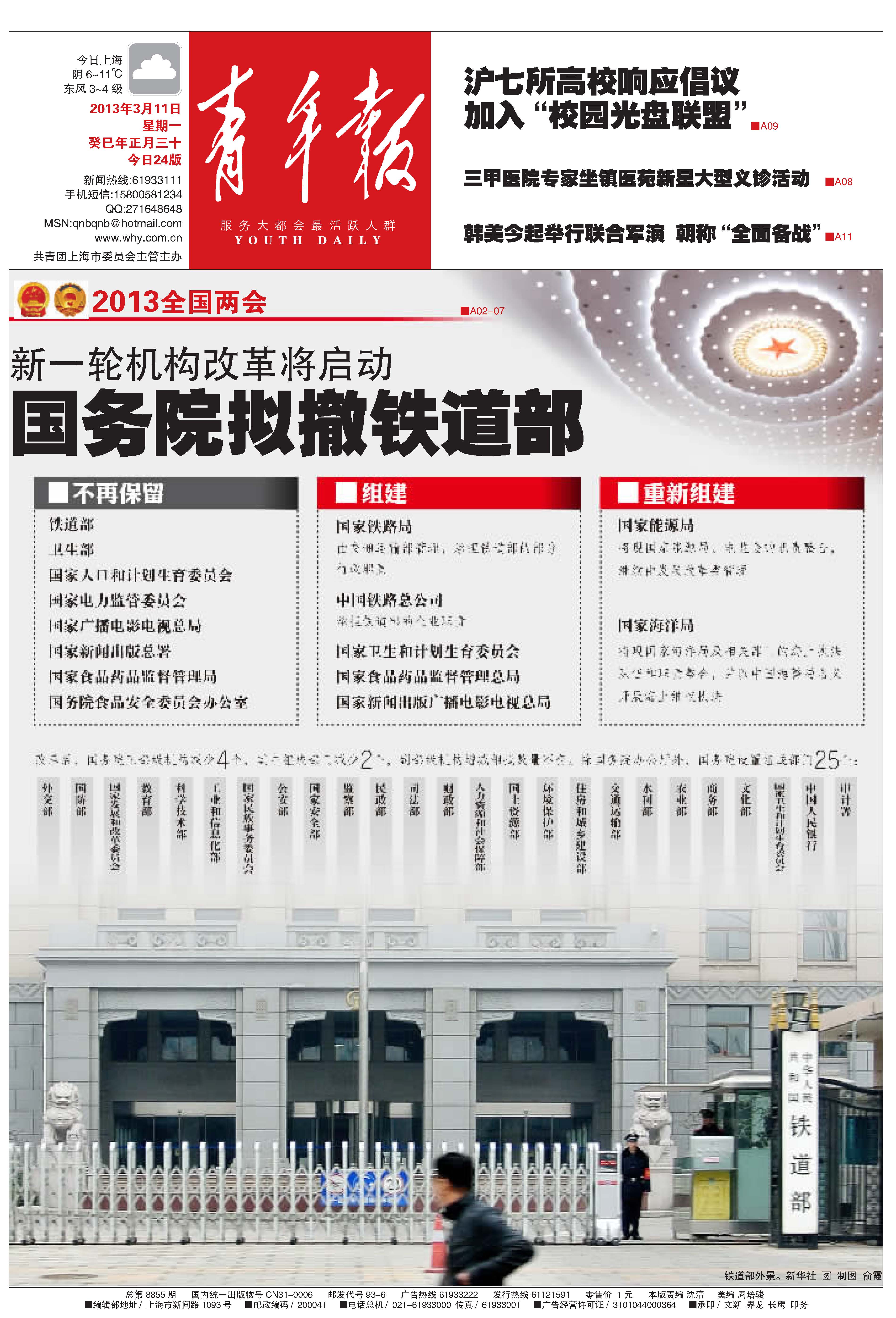
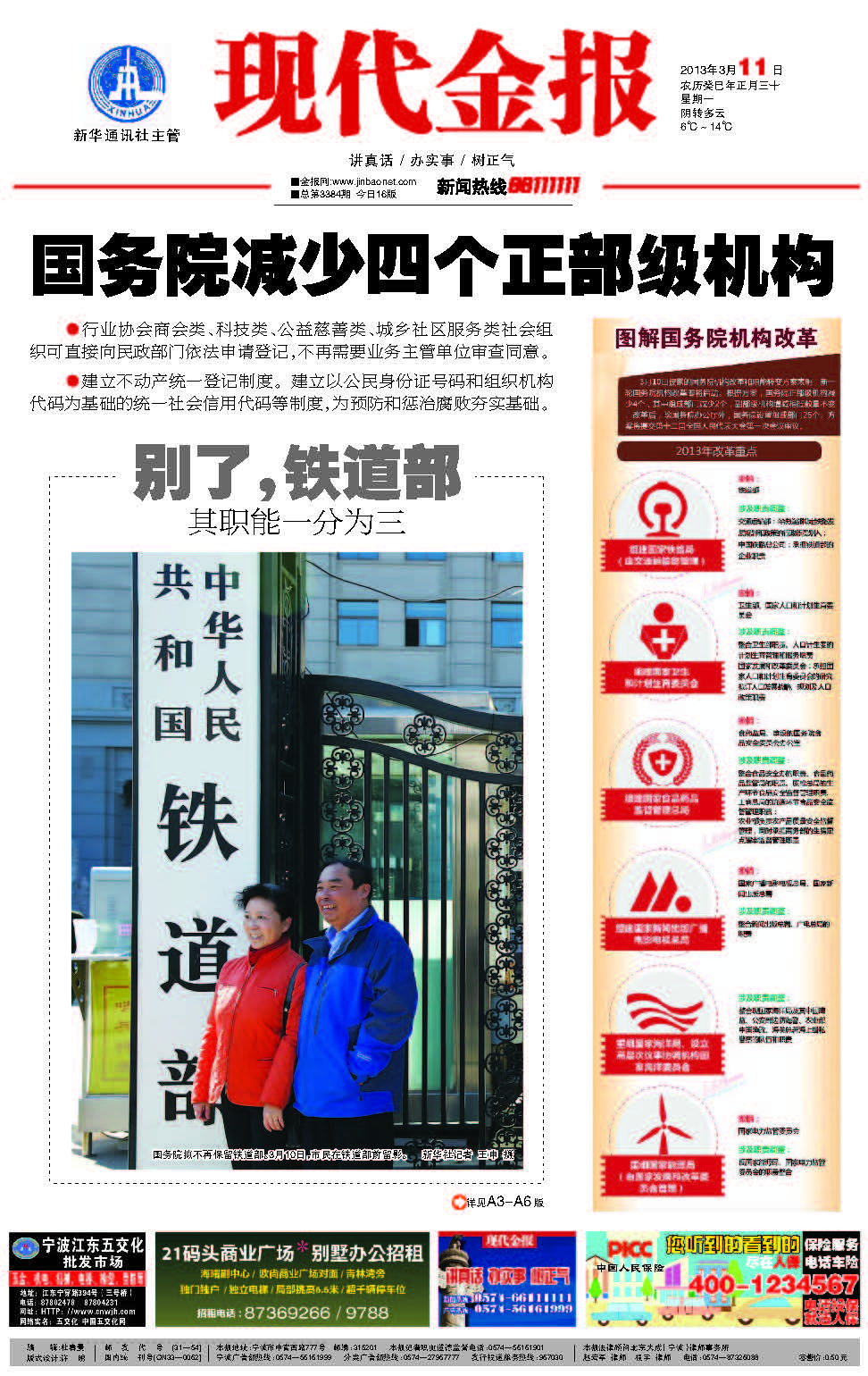
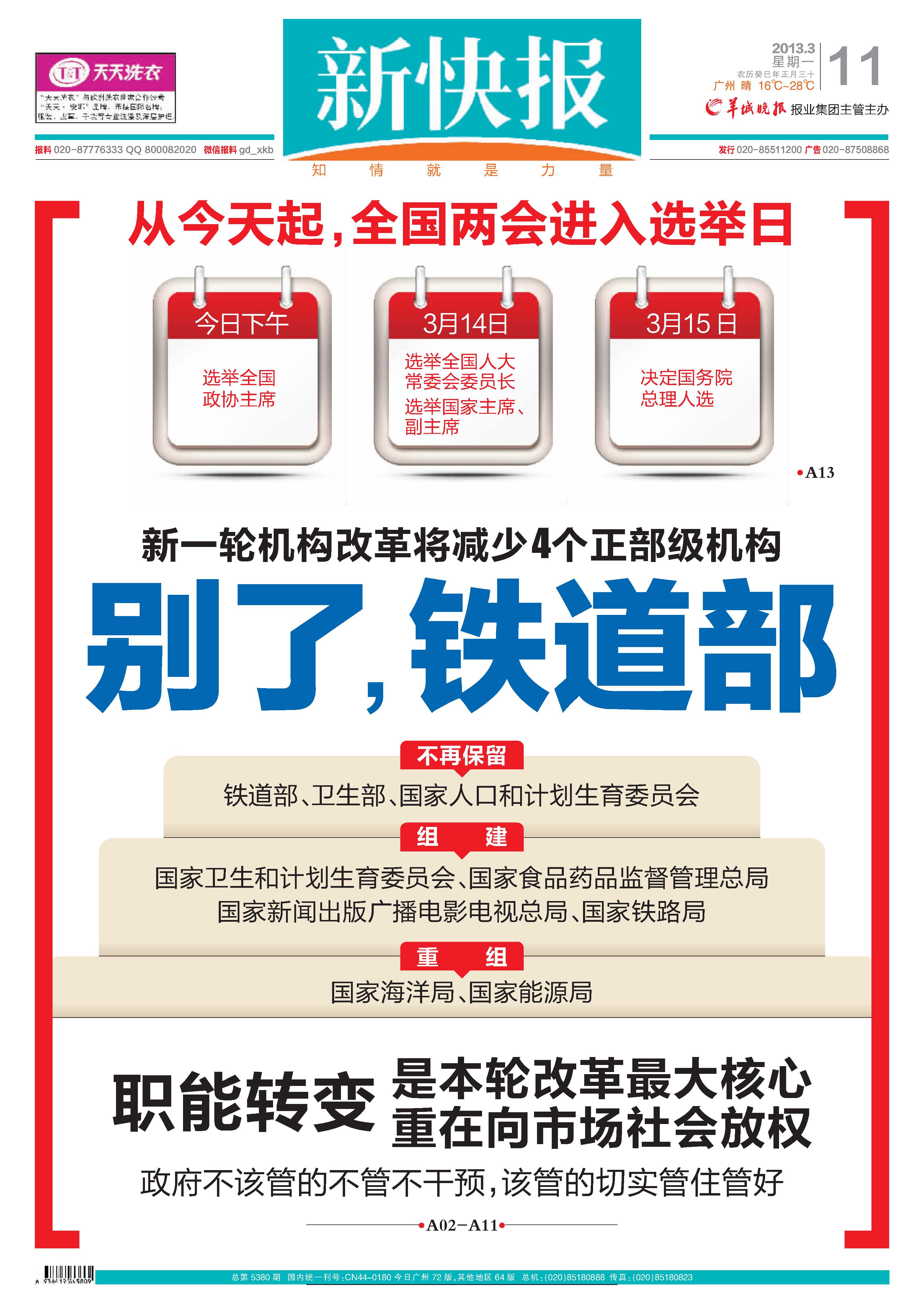
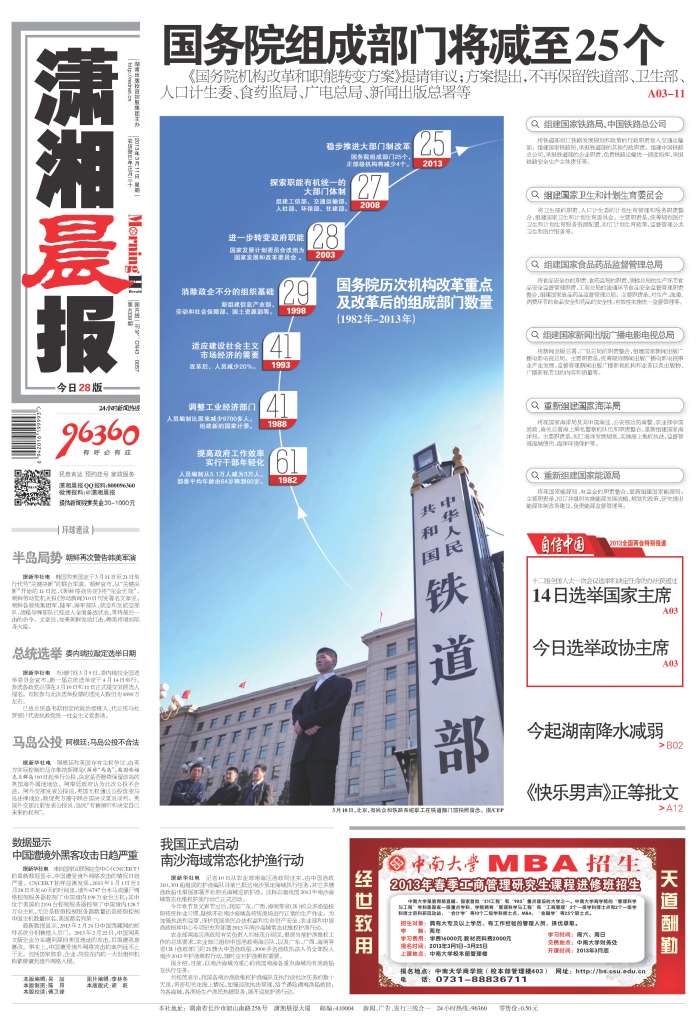
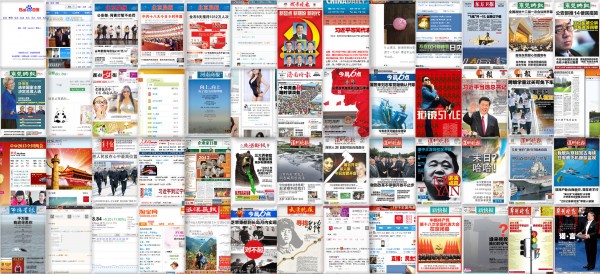
The main front page story on China’s newspapers today is the imminent dismantling of the Ministry of Railways, a stalwart ministry dating back all the way to 1949 (and further back into the Qing and Republican periods with its predecessor, the Ministry of Posts and Communications). News of its demise has today caused the newspapers to bid an emotional farewell to something akin to an old friend who’s finally passed on in old age. Various front pages today display images of people posing for pictures in front of the Ministry of Railways building in Beijing to capture a last memento before the sign on the gate is taken down.

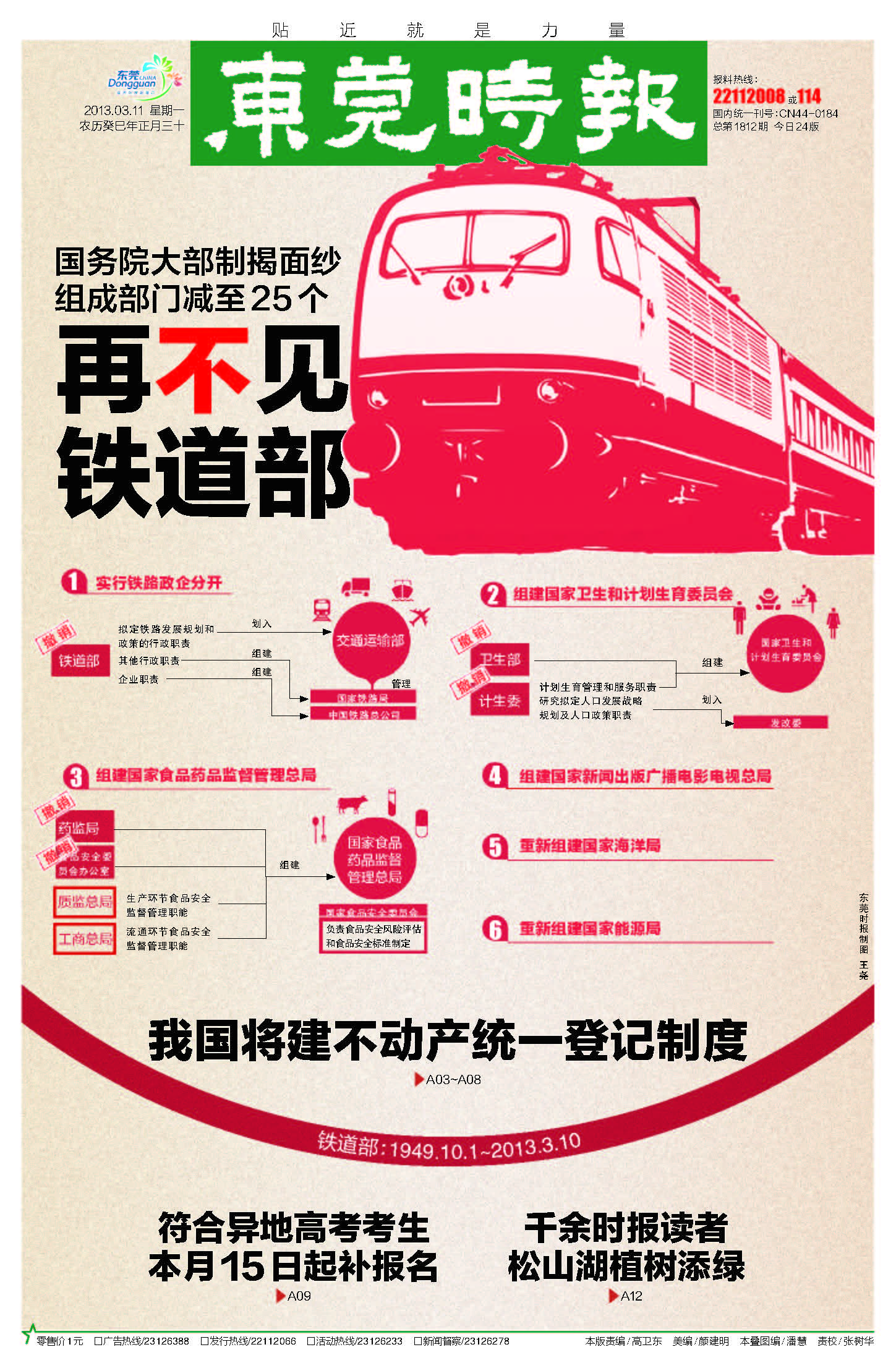
A plan to restructure a number of government departments was tabled yesterday at a session of the National People’s Congress in Beijing (for a more detailed outline of the plan see reports in Global Times or New York Times). The new plan includes for the Ministry of Railways to be broken up and the responsibilities of its railway operations to be transferred to a newly created state-owned company, while its regulatory functions will be taken over by the Ministry of Transport.

Speaking after the new plan was announced, the current and (sure to be) last Minister of Railways, Sheng Guangzu (盛光祖) was quick to point out that no staff layoffs are on the cards, and he welcomed local and foreign investors to invest in the new state-owned railway company that will party replace the ministry. When asked whether the new company will be listed and whether existing staff will be allocated any of the shares, Sheng replied that all these things are still to be worked out, before adding, “its better to remain more strict with state-owned companies” (“国有企业还是严一点好”).

Links and sources
AP: China’s leaders take aim at Railways Ministry
Dongguan Times (东莞时报): 撤销铁道部 组建国家铁路局 和中国铁路总公司
Shenzhen Evening News (深圳晚报): 铁道部“下车”

Posted in Business and the Economy, Front Page of the Day | Tagged , , | Comments Off on Farewell Ministry of Railways

Law and ethics in cases of rape

PA2910211-115x115This is the 1510 Digest, a weekly roundup of recent essays and articles published on the Chinese web, with links to translations on the Marco Polo Project.

China just celebrated International women’s day, even offering women half a day off work. This celebration of women’s contribution to society aligns with the communist rhetoric of women ‘holding half the sky’. However, a long road remains to gender equality, and Chinese women in their daily life are still exposed to multiple forms of violence and discrimination.
Today’s post will look more closely into sexual violence against women – with articles analysing the question of rape from different angles. The selection below does not pretend to cover the full extent of the debate, but only serve as a starting point for further reflection. Sociologist and gender specialist Li Yinhe lines up arguments in favour of punishing marital rape, historian Liu Zhaoxing questions why so few rapes were recorded in former periods of Chinese history, and Shi Po discusses the growing phenomenon of ‘date rape’.

Why am I in favour of punishing marital rape?
By Li Yinhe, 13 December 2010

In line with other articles by Li Yinhe, sociologist specialising in gender question, this piece presents an argument for social change based mostly on strict legal arguments. Why support the punishment of marital rape? The criminal code takes precedence over the marriage code, and contains no special clause excluding married partners from rape charges. Excuses for marital rape correspond to the logic of patriarchy, which contradicts constitutional commitment to ender equality. Only the final argument invokes a broader principle: a woman’s individual right not be raped, whether married or not.

Marco Polo translation: Why am I in favour of punishing marital rape?
Original link: 我为什么赞成惩罚婚内强奸

Why were there fewer rapes in ancient times?
By Liu Zhaoxing, 30 May 2012

In China’s historical records, rape is a very rare crime compared to theft or murder. In this piece, historian Liu Zhaoxing reflects on possible causes why sexual violence against women is almost absent from Chinese history.
The feudal attachment to chastity put women in bondage. Even a re-marriage was seen as a form of debauchery, and there are recorded instances of women who chose self-mutilation or suicide rather than remarriage. In such conditions, argues the author, it is unlikely that a victim of rape would report the crime. This was made even more unlikely by the provisions of the law: the judge would only consider rape to have occurred if a woman resisted with all her strength to the end – as evidenced by sever damage to her body – or her own death. If a woman gave in to threats of violence or was forced into submission, she would be accused of ‘debauchery’, suffer public humiliation, and receive a humiliating punishment, while judges would be lenient on the criminal. In such conditions, it is not surprising that Chinese history recorded only rare instances of rape.

Marco Polo translation: Why were there fewer rapes in ancient times?
Original link: 受害妇女若告官九死一生

Ethics and law in cases of rape
By Shi Po, 17 April 2012

This article was written after the province of Shaanxi saw similar cases of ‘date rape’ happen in short succession. These cases shared similar characteristic: a man and a woman are introduced or meet online, they go out, he invites her to a hotel room, where she refuses to have sex. Overcome by desire, the man abuses her, after which the woman asks for a large sum of money. When the man refuses to pay, she denounces him to the police. Is this rape or extortion? In all cases, the judges decided for the first, and sent the men to prison. But cases of rape today differs from what happened in the 70s and 80s. Then, rape occurred in the wilderness, when women went out on their own. Now, they tend to happen in hotel rooms after internet meetings, and in such a situation, interpreting evidence can be more difficult.

Shi Po then discusses the following cases in more details:
1) A 14 year old girl working in a karaoke bar was taken back to a house by her cousins after agreeing to sleep with them for $300 each. But other men joined, and the girl had sex with each of these men two or three times that night – most of the men were also minors. In the morning, she tried to get away, but only after asking for the money. Was this a shameless girl asking for prostitution money, or a case of rape and abuse? In the end, the men were all convicted to prison, though the cousins had reduced sentences.
2) In a small town, a peasant woman of 42 was raped by three men in their twenties, and her foot was injured. Her brother went to get hospital money, and denounced the perpetrators after they refused to give any. One of them, after giving himself in, consistently denied the rape, though not the other facts. Was this just fear of losing face on his part, or a sense that in all cases, money can atone for rape, and therefore, this is a crime that can be bargained. In this case, after negotiations failed, the three men were convicted, but the woman received no compensation.

To conclude, Shi Po proposes the following analysis to explain both the role of money in cases of rape, and neglect of the system for the victim: “In old times, the concept of rape was as a crime in which the property of a father or a husband had been infringed upon. These days with the existence of sexual intercourse that can be exchanged for money, a woman resisting rape is tantamount to protecting her personal property. Thus, in a certain sense, a sex conflict can evolve into a conflict over money. Faced with the cold and sober law, we still have a lot sympathy for the victims. Current laws regarding the compensation for the violation of “virginity rights” are limited to compensation for psychological damages, but supplementary civil action compensation does not include compensation for psychological damages. Thus, in rape cases, the rapist standing in the courtroom is the focus of everyone’s attention while the victims’s rights and interests are often overlooked or even forgotten.”

Marco Polo translation: Ethics and law in cases of rape
Original link: 强奸案里的伦理与法律

All articles in this digest and a large range of other Chinese readings are accessible at Marcopoloproject.org. Some are available in English, French and Spanish translation. (You can join the project if you’d like to help with translations.)

Danwei is an affiliate of the Australian Centre on China in the World at The Australian National University. This posting is a result of one project that is part of that on-going collaboration.

The China Story, China Heritage Quarterly and East Asian History are publications of the Australian Centre on China in the World.

Posted in 1510 Digest, Crime and Corruption | Tagged , , , , | Comments Off on Law and ethics in cases of rape

Master Kong: How Internet rumors can affect share prices

Master Kong Stock Chart

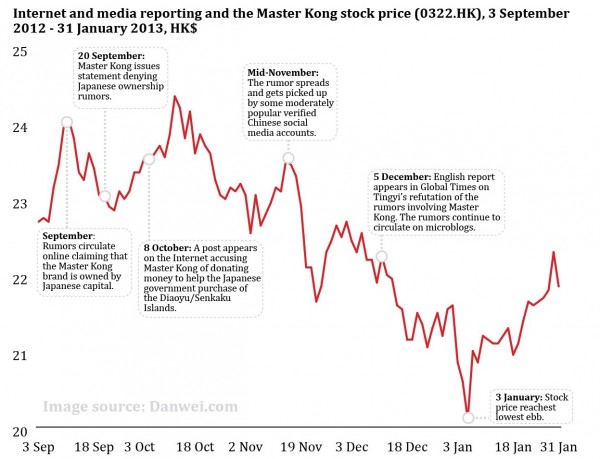
The chart above illustrates how Internet rumors can ravage a company’s stock price. The company in question is Master Kong (康师傅), China’s best-loved brand of instant noodles.

In 2011, Master Kong ranked second only to Sony in a survey of the most valued brands in China, as conducted by research firm TNS. Master Kong was founded in Tianjin, China, in 1991 by two Taiwanese brothers, and listed on the Hong Kong Stock Exchange in 1996 as Tingyi (Cayman Islands) Holding Corp. (This article will refer to the company as Master Kong for simplicity.)

Although the company’s board includes Taiwanese and Japanese members, Master Kong has always existed and operated only in mainland China. The company is the leading player in China’s instant noodle restaurant market as well as a producer of drinks and snacks (and soon even a smart phone). In the last few months of 2012, Master Kong experienced a PR crisis when rumors linked the company to the wrong side of the Diaoyu Islands dispute.

In the shadow of the Diaoyu Islands

On September 5 2012, the Japanese government announced that it had reached agreement with the Kurihara family, the so-called private owner of three of the five Diaoyu or Senkaku islands, on “nationalizing” the uninhabited islands. The previous month had seen contentious visits to the islands by nationalist activists from Hong Kong and Taiwan, as well as Japan. On September 15, the biggest anti-Japanese protests since China and Japan normalized diplomatic relations in 1972 broke out in cities across China, and the Japanese embassy in Beijing was besieged by thousands of protesters. Over the next couple of days the protests turned violent, with protesters clashing with police, attacking Japanese-made cars, and barricading Japanese restaurants.

In this tense atmosphere, the heat was also turned up on Chinese social media, and at some point during September, speculation started to appear on Weibo that Master Kong was owned by Japanese capital and should therefore be boycotted. On the September 20, Master Kong issued a statement in which it denied the speculation. On October 8, however, the speculation regarding Master Kong’s true owners was surpassed by the appearance of a potentially deadly rumor in the context of the Diaoyu Islands dispute raging at the time. It is impossible to pinpoint where and from whom exactly the rumor originated, but a definite early source was the Sina blog 逆风松涛的博客 (Mifeng Songtao’s Blog). On the afternoon of 8 October, a short post entitled “Master Kong donated 300 million yen to Japan for it to buy the Diaoyu Islands” (康师傅为日本购中国钓鱼岛捐三亿日元) was posted on the blog, which read in part:

Tear off Master Kong’s outer layer, and a sheepskin of Japanese goods appears! It has been revealed online that the company which calls itself Taiwanese has actually been bought out by Japan’s Asahi Breweries. With Master Kong’s drinks and noodles visible everywhere on Chinese soil, this grieves us greatly! We are firmly resolved not to buy anything from Master Kong from now on. Everybody spread this message, let all our compatriots know! Asahi Breweries contributed 300 million yen for Japan to buy the Diaoyu Islands, this trashy company!

The rumor spread over the Internet rapidly. Four days later, on October 12, Master Kong’s stock price on the Hong Kong Stock Exchange began a steady decline that would continue into the new year.

From rumor mongering to turf war

Master Kong continued to deny the rumors, even soliciting help from the Chinese government: On October 31, the spokesperson of the Taiwan Affairs Office of the State Council, a PRC government body, denied that Master Kong is in any way a Japanese brand.

A few days later, on November 3, the plot thickened considerably when the Taiwanese paper China Times (华夏时报) published a story outlining Master Kong’s views on recent events. A representative from Master Kong revealed in the article that his company had started noticing the strange rumors appearing online from September 18, and it had started collecting evidence from this date. Eventually, after piecing together various bits of information, Master Kong was able to get to the bottom of the rumors, and identify (as the company’s representative put it) the “manipulator behind the scenes” (幕后操纵): none other than Uni-President (统一集团), one of Master Kong’s chief competitors in the instant noodle market in China.

The article explained that although the Japanese firm Sanyo Foods invested in Master Kong in 1999, it never became a majority shareholder; the Taiwanese company Ting Hsin International Group (顶新集团) retained this position throughout.  For its part, Uni-President denied any involvement when The China Times reporter contacted them for a response to Master Kong’s accusations.

In early December The Beijing Times (京华时报) also ran a piece on what it called “unfair competition” in the instant noodle market in China. It noted that the rumors regarding Master Kong were being spread by text message and social media. The next day, Global Times reported on the story for the first time in English.

In the first week of January 2013, Master Kong’s stock price arrested its long decline that started in October. Yet if Master Kong can now finally turn the corner from the rumors that dogged it from September last year, its experience serves as a reminder of how damaging and unpredictable Internet rumors can be in the age of social media.

Links and sources
Want China Times: Master Kong parent targets instant smartphone success
Wall Street Journal: Noodles and Electronics: Asia’s Most Valued
逆风松涛的博客: 康师傅为日本购中国钓鱼岛捐三亿日元
CNTV: 国台办发言人否认“康师傅”是日本品牌
China Times (华夏时报): 800亿方便面市场无间道
The Beijing Times (京华时报): 康师傅称再遭黑手造谣攻击
Tencent News: 康师傅 大灾面前涌大爱
Global Times: Master Kong to fight back

Posted in Business and the Economy, Consumer Culture, Internet and Media | Tagged , , , | Comments Off on Master Kong: How Internet rumors can affect share prices

Intelligence from the Chinese Media and Internet

China Media Montage

Danwei provides intelligence from the Chinese Internet, social media and the press to track investments, brands and issues of concern to companies and financial institutions. We also publish articles and translations on this website.

Commercial insights from Chinese media and the Internet

With more than 500 million Internet users and tens of thousands of state-owned and commercial news organizations, websites and official publications, Chinese traditional and social media are rich sources of information about companies, brands and markets — yet much of this information does not appear in English.

Danwei’s media intelligence and digital due diligence services help companies and financial institutions stay on top of news and public opinion; understand the factors and forces that affect government policy, consumer sentiment, and the share prices of companies that operate in China; and prepare for and respond to crises.

Please click here for a case study adapted from Danwei’s research work.

Danwei’s methodology
Danwei tracks social media, news portals, government websites, databases of traditional media and all types of publicly accessible Chinese documents, and then filters and evaluates the results using a combination of automated technology and human analysis. If you have issues in China that you need to understand, we’ll tell you:
• What is being said
• Who is saying it
• Why it matters
• What to ignore

Danwei’s reports are customized for each client and can include:
• Company Intelligence with stock market implications
• Digital Due Diligence: Audits of brands, companies and people
• Critical Issue Analysis: Real time updates about topics of interest to investors, financial decision
makers and companies
• Daily, weekly or monthly intelligence reports
• Custom research
• Translations and summaries of statements, publications and social media chatter by
government, consumers, lawyers, customers, industry specialists, social media influencers, and other stakeholders

About Danwei
Danwei was founded as a media tracking website in 2003, and began offering research services in 2006. All Danwei’s deliverables are edited by a team with decades of experience in research, media and the Internet in China. See our press page for media mentions and citations.

Danwei is a research service from the Financial Times (FT), and works closely with the FT’s China Confidential, an indispensable compass for investors and corporations navigating the Chinese investment landscape. All reports are entirely confidential; Danwei is an independent entity that does not share information with the Financial Times newspaper.

Danwei also publishes translations from the Chinese media and articles about Chinese media, culture, consumers and business on this website.

For more information about our services, please contact Jeremy Goldkorn at jeremy -at- danwei.com.

Posted in China Media Landscape | Tagged | Comments Off on Intelligence from the Chinese Media and Internet

The elegant new spokesperson vs. the steadfast old cultural icon

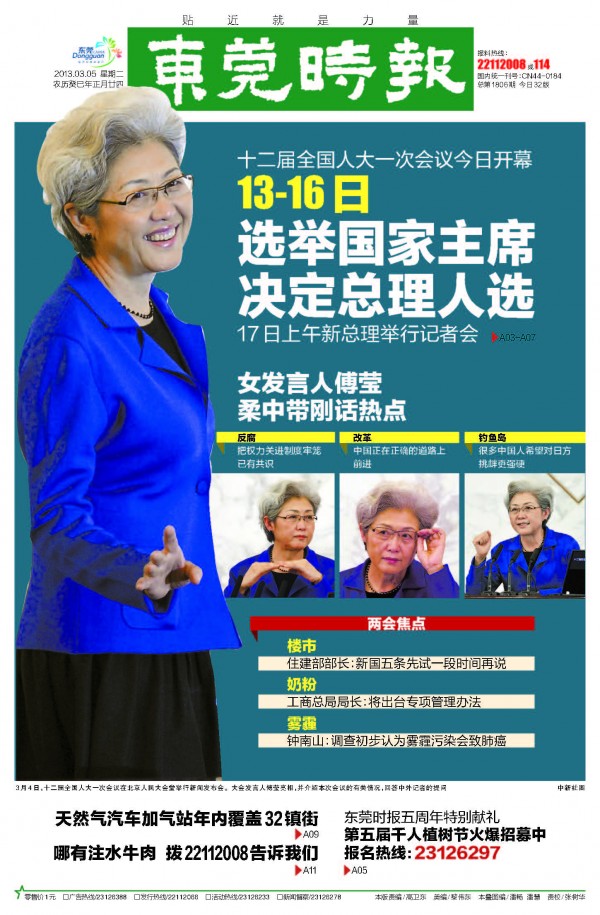
Dongguan Shibao5Mar

Today is Lei Feng Day, but there’s an elegant and amiable woman who stole his thunder on China’s newspaper front pages today.

Who would you put on your front page today? There’s the elegant, amiable, humble, eloquent and female new spokesperson of the Two Sessions who held her first news conference yesterday…


And then there’s this guy who turns fifty today….

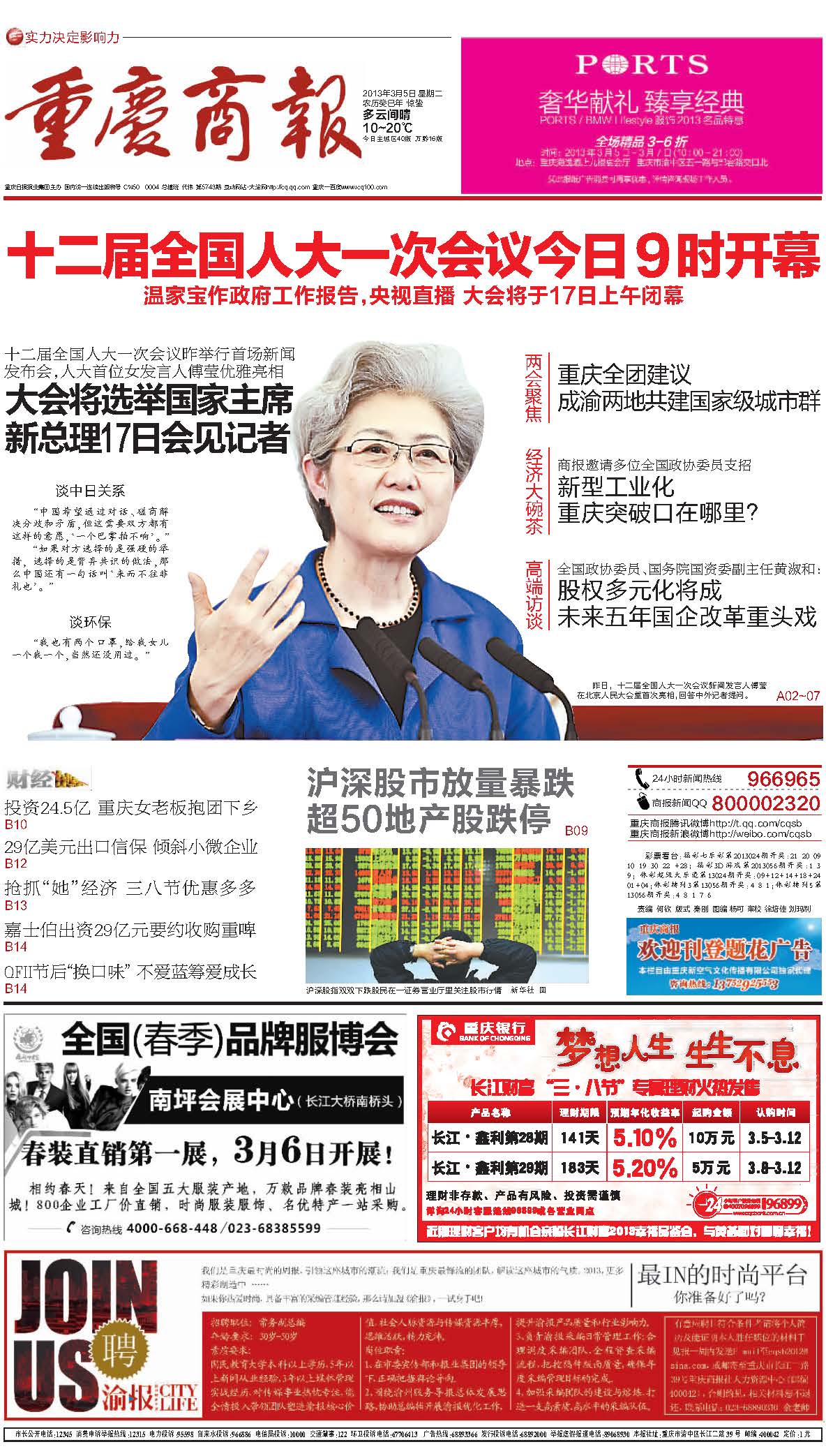
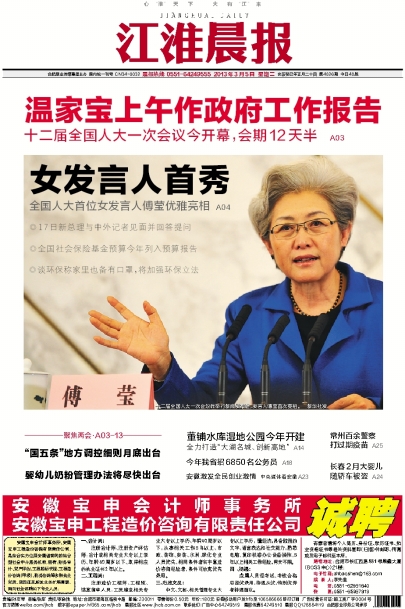
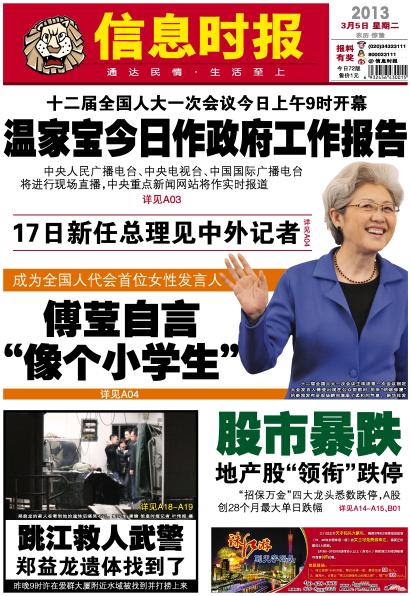
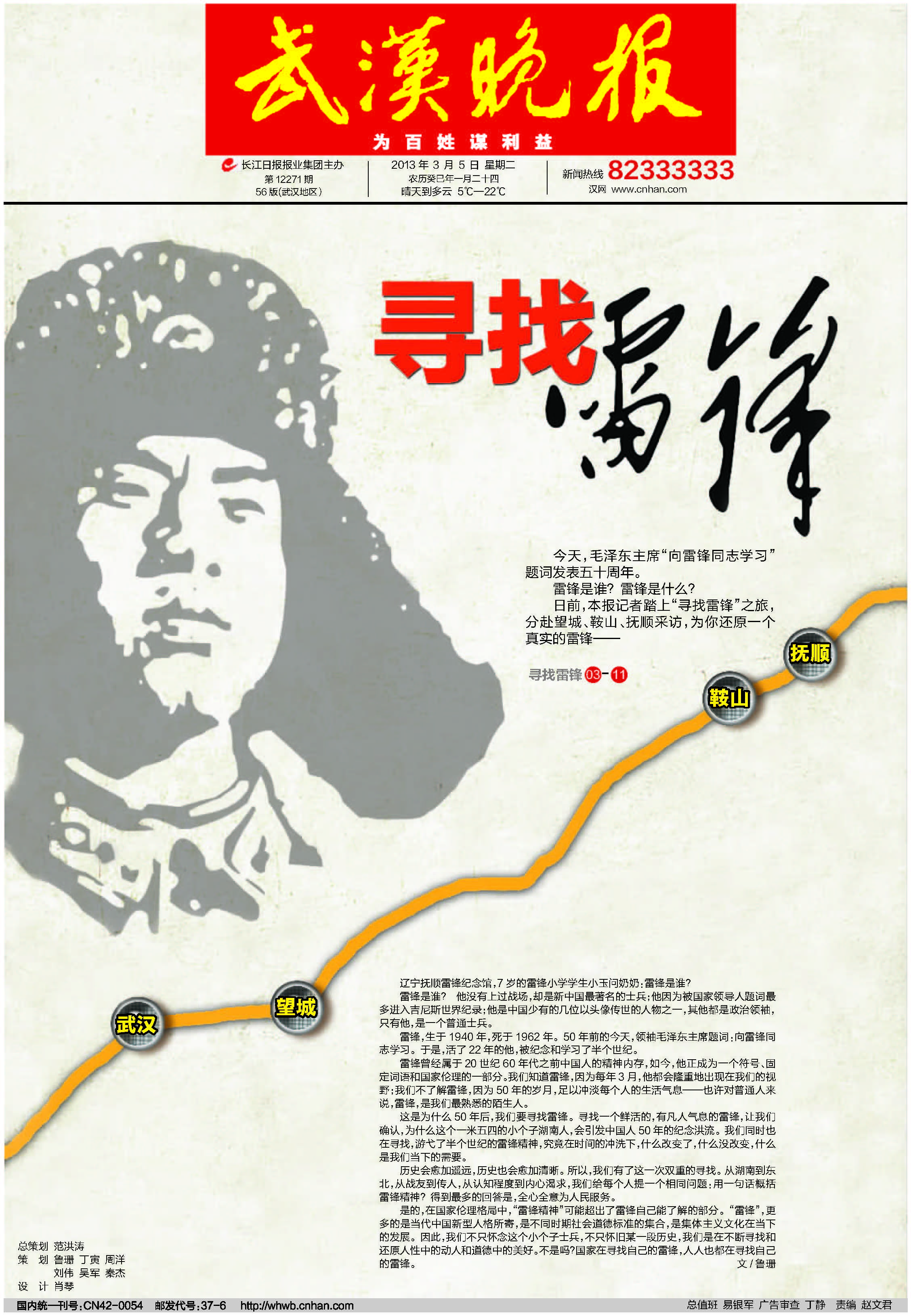
Two faces dominate China’s newspaper front pages today. One is the “elegant”, “gentle” and “amiable” new female spokesperson of the Two Sessions taking place in Beijing. Deputy Foreign Minister Fu Ying headed the event’s first press conference yesterday as the first ever female spokesperson at the Two Sessions. The other is the mythical cultural icon Lei Feng, as it is Lei Feng Day today. Naturally, however, the doughty old Lei Feng is slightly overshadowed by the graceful and soft-spoken Fu Ying.

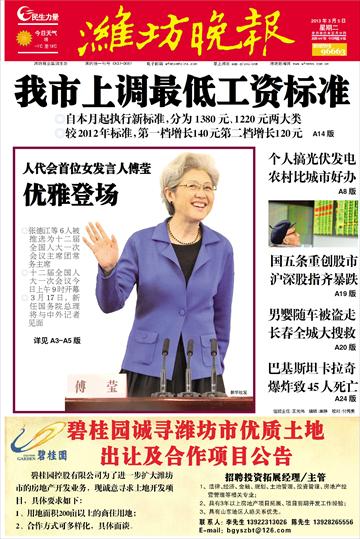
Here’s how the Weifang Evening News (潍坊晚报) from Shandong province described how the new spokesperson, who was formerly China’s Ambassador in the Philippines, Australia, and finally in the UK, presided over her first Two Sessions news conference yesterday:

Slightly curled white hair, gentle intonation, amiable smile, graceful temperament…. When Fu Ying appeared as the appointed spokesperson at the first news conference at the Two Sessions yesterday morning and faced the public, she added a gentle air to the usually stormy news conferences.

Opening the news conference with an apology for being slightly late and for being a bit of a novice with such matters, Fu Ying’s humorous opening remarks displayed (as Weifang Evening News put it) “this female diplomat’s maturity”. And it only got better from there, as the newspaper recounts, because in the next hour Fu Ying discussed a variety of issues with foreign reporters such as the government budget, anti-corruption measures, the Sino-Japanese relationship and ongoing reforms by “speaking frankly with assurance” (侃侃而谈) and by being “gentle and cultivated” (温文尔雅). (For a detailed assessment of the actual content and implications of Fu Ying’s remarks, see SCMP or Caixin).

With her calm and collected manner, the newspaper says, Fu Ying received a lot of praise from people online. “Appearance and temperament not bad”, one said; “What a pretty woman!”, another commented.

So how is Lei Feng to compete with THIS?

There’s a few Lei Feng-related front pages today trying to make the most of 50 years of the spirit of the selfless soldier who sacrificed everything for Party and country:

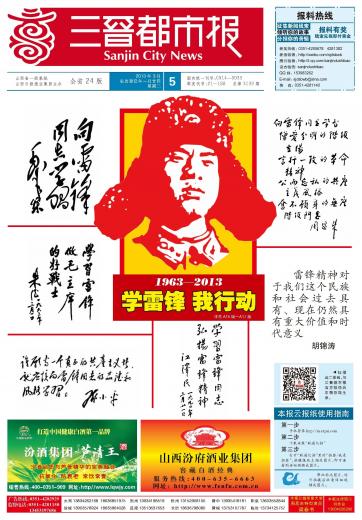
  • In Sanjin City News from Shanxi province you can read a few anecdotes by elderly people describing when they first heard about Lei Feng and what the latter meant to them through their lives.
  • Wuhan Evening News from Hubei province is the newspaper to turn to today for Lei Feng. It has a special section of no less than nine pages called “Looking for Lei Feng” (寻找雷锋), with no Fu Ying in sight anywhere. In an article called “Do you know Lei Feng?” you can read the entire life story (including all myriad skills and achievements) of the man, followed by the full media and cultural aftermath of all the Lei Feng songs, various types of merchandise (including the “now-fashionable Lei Feng cap”), an exposition on the “Lei Feng Spirit”, and a scan of Lei Feng’s Internet presence (“Do you know that Lei Feng has more hits on Baidu than the actress Zhang Ziyi?”); and closing with the line “We are all Lei Feng…” Nine pages full of this stuff.
  • In the Western Sea Metropolis Daily (西海都市报) from Qinghai province you can read about the special Lei Feng-themed events that the newspaper helped organize.

Links and sources
Weifang Evening News (潍坊晚报): 很多中国人希望中国更强硬
SCMP: China vows to uphold judicial independence of Hong Kong
Caixin: Highlights of CPPCC: “Shutting Power in the Cage”
Information Times (信息时报): 17日上午新总理见中外记者
Sanjin City News (三晋都市报): 1963—2013 学雷锋我行动
Wuhan Evening News (武汉晚报): 你知道雷锋吗?

Posted in Front Page of the Day, Internet and Media, Traditions | Tagged , , , , , | Comments Off on The elegant new spokesperson vs. the steadfast old cultural icon

“Red descendants” at this year’s “two sessions”

Dushi Nvbao 4Mar

The annual session of the Chinese People’s Political Consultative Conference (CPPCC), dubbed China’s leading political advisory body, commenced at the Great Hall of the People on Tiananmen Square in Beijing yesterday, and will run until 12 April. Traditionally held concurrently with the annual session of the National People’s Congress (NPC), China’s highest legislative body that will convene on 5 March, the two meetings are collectively referred to as the “two sessions” (两会).

The mood at this year’s two sessions is slightly more subdued than usual, with Xi Jinping’s incoming administration aiming to restrict ostentatious displays of wealth, lavish banquets, and excessive exchange of gifts that were the hallmark of meetings in recent years. This year the 2,237 delegates will have to make do with alcohol-free buffets.

This year’s two sessions and the reforms supposedly to be discussed there dominate the front pages of China’s newspapers today (see gallery below). The City Lady (都市女报) from Shandong province, however, has as usual taken a slightly different view with a front page story on the “Red descendants” at the two sessions this year, i.e. the delegates who are children and grandchildren of previous Party leaders.

On the City Lady‘s count, there are in total at least 24 “Red descendants” at this year’s CPPCC, 15 men and nine women. The three images on the newspaper’s front page (see image above) are three of the nine female “Red descendants” delegates, namely (from left to right) Deng Xiaoping’s daughter Deng Nan (邓楠), Li Ping’s daughter Li Xiaolin (李小林), and Zhu Rongji’s daughter Zhu Yanlai (朱燕来).

Also included among the 24 are Mao Zedong’s grandson Mao Xinyu (毛新宇), Zhou Enlai’s niece Zhou Bingjian (周秉建), Zhu De’s grandson Zhu Heping (朱和平), Chen Yun’s son Chen Yuan (陈元), Wan Li’s son Wan Lifei (万季飞), Li Xiannian’s daughter Li Xiaolin (another 李小林), and Li Dazhao’s grandson Li Hongta (李宏塔).

Three new arrivals
Three of the 24 are this year appearing for the first time, namely Chen Yuan (the current Chairman of China Development Bank), Lieutenant General Xu Xiaoyan (徐小岩) (son of Xu Xiangqian, a former Marshal in the People’s Liberation Army), and Ren Kelei (任克雷)(son of former Guangdong Party Secretary Ren Zhongyi).

Classification by occupation
After checking on the official occupation of each of the 24, City Lady came up with the following classification: Eight are in government or political posts; ten are in business; five hold military posts; and one is a scholar.

Of the ten “Red descendants” that are listed as employed in business, Li Ping’s daughter Li Xiaolin is particularly noteworthy. The CEO of China Power International Development, a Hong Kong-listed company, she is known variously as the “first sister” or the queen of China’s power market.

Here’s how a few other newspaper front pages today covered the two meetings in more conventional fashion:


Links and sources
The Guardian: Chinese elite tighten their designer belts at sober annual congress
City Lady (都市女报): “红后代”在两会

Posted in Front Page of the Day | Tagged , , , , | Comments Off on “Red descendants” at this year’s “two sessions”

Did you lose something? Micro Lei Feng can help

Dongnan Shangbao 1March

Is there no end to the multifarious usefulness of the paragon of selflessness and virtue that is Lei Feng? A little early for Lei Feng Day on March 5, but the front page of the South-East Business Daily (东南商报) from Zhejiang province today tells us that, in order to encourage the study of the spirit of Lei Feng and of volunteerism, we present: “Ningbo Micro Lei Feng!” (宁波微雷锋)

This latest installment of the cultural hegemon that is Lei Feng is a piece of software that runs of the omnipresent (in China) mobile messaging service WeChat (微信 in Chinese). Jointly produced by South-East Business Daily, the Ningbo City Public Transport Company and the Ningbo Public Security Bureau, “Ningbo Micro Lei Feng” can be installed by users of WeChat and then used in conjunction with the messaging service.

The point of “Ningbo Micro Lei Feng” is for people to report any lost and found objects in public areas in Ningbo. If you lost your mobile phone on a bus, for example, you can tell Micro Lei Feng as much as you can about your lost phone. Micro Lei Feng will then inform the transport and police authorities of your lost phone, and they can keep their eyes open for it. But ideally, someone else will see your lost phone on the bus and immediately tell Micro Lei Feng about it, so Micro Lei Feng can match the two lost and found reports. Such, at least, would be an ideal outcome for some good old Lei Feng spirit.

Below is a little look back at some of the Lei Feng-related posts we’ve published on Danwei over the years. Lei Feng is rocking on in the 21st century.

2006
A Lei Feng two-fer
You can’t be Lei Feng all the time
Lei Feng to star in Internet game
Guns, lost sons and Lei Feng condoms

2007
Another year, another Lei Feng

2009
Lei Feng and 60th anniversary fashion
Lei Feng heritage for the whole world

2010
Kneel before Lei Feng
Lei Feng, serving the people in the 21st Century

2012
Lei Feng in the age of the microblog
Anyone seen Lei Feng?


Links and sources
South-East Business Daily (东南商报): “宁波微雷锋”公众微信开启

Posted in Front Page of the Day, Internet and Media, Traditions | Tagged , , | Comments Off on Did you lose something? Micro Lei Feng can help

There’s a void called the countryside – visions of dying village life

3701796830


This is the 1510 Digest, a weekly roundup of recent essays and articles published on the Chinese web, with links to translations on the Marco Polo Project.

Migrant workers tend to be presented as an anonymous mass, and thought of either as a problem for Chinese cities and infrastructures, or an example of inequalities and discrimination in contemporary China. This week’s post invites us to look at rural-urban migrations from a different angle, by focusing on the relationships and continuity between cities and country towns. Zhang Zejia’s ‘There’s a void called the countryside’ and Li Tianqi’s ‘These old people back home who ‘got old’ both explore this ongoing attachment to the rural hometown. Through the vision of a dying rural world, they also reveal the complexities of personal attachment to rural memories, the strength of family networks, and the significance of yearly return journeys to the rural hometown for city dwellers.

There is a void called the countryside
By Zhang Zejia, 08 December 2012

In this piece, writer Zhang Zejia throws a light on the continuity between urban and rural populations by describing the relationships between his relatives who stayed in the village and those who moved out to the city.
He begins by describing a small shop in his hometown, run by an ‘uncle’, where he likes to go where he returns. This shop was a village landmark in his youth, and is still a magnet for relatives returning. But the owner, in spite of his cordial welcome, shows a discreet bitterness at seeing the success of his richer city relatives.
In Shenzhen, his family home is another landmark for the family. Relatives would use it as a landing place, and stay there for more than a year, until they could find a stable job, get married, and build a local social network. Meanwhile, the village emptied, leaving the elderly behind, their lives only briefly brightened by a small child, whom parents would send over to the care of grand-parents until it was old enough to come live in the big city.
Zhang Zejia draws a comic and moving portrait of these characters – the gossipping lady who drowns him in endless memories of a great-great-aunt, or the silent man sitting on his porch, who just started blankly in the air. His piece finishes on two contrasting portraits of village folks: his smiling grand-mother who scrapes off cent after cent to give him a few Yuan at New Year, but will now receive a pension, and joyfully save more; and a daring uncle planning his move to Shenzhen, and anticipating his happy life in the big city.

Marco Polo translation: There is a void called the countryside
Original link: 有一种空虚叫做农村

These old people back home who ‘got old’
By Li Tianqi, 19 February 2013

Every year, when he returns to his hometown for Chinese New Year, Li Tianqi enjoys exchanging gossip with groups of old men who sit under trees and walls, enjoying the sunlight. For him, these old men are an endless source of knowledge on everything in the village. But this year, new faces have replaced old familiar ones – maybe signalling the passing of a generation. His father, whom he caught alone, listening to Shaanxi opera on an MP3 player, is another symbol of this disappearing village life. And so Li Tianqi asks, now that people are moving away, who will remember the village, after all the elders die? And if the memories of the villages die, what will it mean for the country? He invites his readers to reflect on this question, which he deems more crucial than economic outcomes.

Marco Polo translation: These old people back home who ‘got old’
Original link: 村里那些老了的老人们

All articles in this digest and a large range of other Chinese readings are accessible at Marcopoloproject.org. Some are available in English, French and Spanish translation. (You can join the project if you’d like to help with translations.)

Danwei is an affiliate of the Australian Centre on China in the World at The Australian National University. This posting is a result of one project that is part of that on-going collaboration.

The China Story, China Heritage Quarterly and East Asian History are publications of the Australian Centre on China in the World.
Posted in 1510 Digest | Tagged , , , , , | Comments Off on There’s a void called the countryside – visions of dying village life

Shanghai nonagenarian writes comic book memoir commemorating love of his life

Dongfang Zaobao 27Feb p.1

Rao Pingru (饶平如) has lived a long life marked by great hardship and perseverance. Yet Rao survived war, famine, incarceration, separation and illness, and lived his entire life with undying love for one woman. Now aged 91, Rao’s long life was characterized by all the trials and tribulations that the Chinese people experienced in a turbulent twentieth century. His story is anachronistic in our current age of self-absorption and fleeting love, and will soon fade back into the mists of time. But old though he is, Rao has determined to preserve his journey and the memory of his beloved wife of 60 years, Mao Meitang (毛美棠).

So ever since his wife died in 2008, Rao has been engaged in writing a comic book history of his life and lifelong love with Mao Meitang. After working on the project daily for five years, the comic book will be finally published in April this year under the title “The Story of Us” (我俩的故事).

The Oriental Morning Post (东方早报) from Shanghai today featured Rao’s comic book history on its front page. It is a deeply moving tale. The following are the news report and some excerpts published by the Oriental Morning Post today:

Early life and war against Japan

Rao was born in Jiangxi (江西) province in 1922 as the son of Qing dynasty government official. He was only 11 years old when he first met his future wife, Mao Meitang, who was the daughter of one of his father’s close friends. She came over with her father one day, and the two of them played around the house.

A few years later, however, Rao’s life was turned upside down by the outbreak of war against Japan in 1937. In 1940, Rao was accepted for officer training at the Whampoa Military Academy (黄埔军校) in Guangdong, where the Republic of China’s officers were educated. Before he left his home in Jiangxi, his father had given him the present of a small poem, which read:

On the day that Japanese pirates invade China, it is time for the scholar to cast aside his pen(倭寇侵华日,书生投笔时).

Four months later, Rao graduated as an artillery officer in the Kuomintang army, and was sent on his way to Chengdu in Sichuan province. When there was a train, he took it, but he walked much of the way to Chengdu on foot.

Love, marriage and separation

After serving six years in the army and seeing it through all the way to the end in 1946, Rao received a letter from his dad asking him to go home and get married. In his years in the army, Rao said afterwards, he did have the chance to start intimate relationships with other women, but he always refrained from doing so – he had his eye only on Meitang.

So soon Rao found himself back in Nanchang, Jiangxi province. He and Meitang first confessed their love for each other in Hubin Park (湖滨公园), when she sang songs and he played his harmonica. Soon afterwards they were married, and in 1951 they settled in Shanghai, where Rao found a job as an accountant.

These years in Shanghai in the 1950s are the fondest memories for Rao, a time when he and Meitang could enjoy life together in peace. In 1958, however, their joyful existence was shattered when Rao was sent for Re-education through labor (劳教), because he was a Kuomintang soldier in the war. Rao was sent to a farm in Anhui province where he did backbreaking manual labor, while Meitang stayed on alone in Shanghai, eventually getting a job moving cement at a museum in the city. They would be separated for 22 years, during which time they wrote nearly a thousand letters to each other, never doubting for a moment that they will always be faithful to one another.

Reunification and illness

Rao was finally allowed to return home in 1979, and he found a job as an editor at a publishing house in Shanghai. They lived happily together once more, but misfortune struck again in 1992 when Meitang was diagnosed with diabetes and kidney problems. Gradually her condition worsened, and she became psychologically deranged as well. She finally died in hospital in March 2008. On the day of her passing, Rao was notified that his wife’s condition had suddenly worsened, and he reached her deathbed one minute before she died. He held her hand and kissed her one last time.

“The Story of Us”

Meitang’s death in 2008 inspired Rao to begin work on the comic book memoir to preserve their story for his descendants. In the years since, Rao acquired a cat to keep himself company, started learning the piano, and has worked around two hours every day on the book.

When asked whether he had anything to say to the youth of today, Rao replied the following:

Life is short, I am now already 90 years old. The older I get the more I realize that time moves very fast. If you look at the television, you see young people getting married for three months, they quarrel, and they just get a divorce. You can’t just divorce because of small things that come up. You should really treasure the time of your youth, and treasure the present. (人生苦短,我到90岁,越是年老越觉得光阴太快。你看电视,年轻人结婚三个月,吵吵架,不好就离婚。不能碰到很小的事情就离婚,应该多珍惜青春,珍惜现在。)

Links and sources
Oriental Morning Post (东方早报): 我俩的故事 ; “我们俩的一生都在画里”

Posted in Front Page of the Day, Health and Medicine | Tagged , , | Comments Off on Shanghai nonagenarian writes comic book memoir commemorating love of his life

Welcome to Black Dragon River (a.k.a the Stinking Sewer)

Shenyang Wanbao 25Feb v2

There is a little stretch of river in the city of Shenzhen in Guangdong province where black water meets an endless stream of human filth. The place apparently doesn’t have a name, but some online commentators have referred to it as Black Dragon River (黑龙江), substituting the name of one of China’s provinces to highlight the overwhelmingly black color of the river. The local people who endure living in this place have simply taken to calling it the Stinking Sewer (臭水沟). Located right next to a number of factories as well as an electronic wholesaler and resident blocks – all of whom disgorge their garbage straight into the river – Black Dragon River is already for years now a black, stinking hole.

Naturally online commentators have offered various amounts of money for the head of the local environment protection bureau to take a swim in Black Dragon River. Yet as one journalist from Shenzhen Evening News went to see for himself, people do live there, and have been doing so for years. All this time, Black Dragon River has been black and filthy.We reported last week how Jin Zhengmin (金增敏), a businessman from Zhejiang province, offered to give the head of the local environment protection office 200,000 yuan if he swam in a polluted river in Ruian (瑞安市) in Wenzhou, Zhejiang province. As the front page of the Shenzhen Evening News reports today, ever since Jin made this call on his Weibo account on 16 February, use of the phrase “Environment protection bureau chief please go swim in the river” (请环保局长下河游泳) has become popular on the Chinese Internet. Said environment protection bureau chiefs are now being offered much larger sums to go take a dip in some polluted river.

One such request highlighted by the Shenzhen Evening News came from a Weibo user in Shenzhen with the username @胖小谦 (Fat Little Modesty). On Saturday last week, this user uploaded a picture of a river in Bao’an (宝安) in Shenzhen, adding that everybody who went anywhere near it recoiled from the stench. He called the place Black Dragon River (黑龙江). Various other people echoed his calls for the bureau chief to go and wade in the black water, with some pledging more money as a reward.

Noticing these conversations on Weibo, a journalist from Shenzhen Evening News went over to this so-called Black Dragon River to see for himself, and his report confirmed the hideous nature of this place. Situated right next to a wholesale electronics market (益华电子城旁) in an industrial zone in Shenzhen, Black Dragon River is a small section of the Shajing (沙井) River that links further south with the Zhujiang River Estuary. The journalist’s first impressions of the place went as follows:

When the journalist was still 200 meters away from the river, filthy fumes started assaulting his nostrils. The muddy stream itself was the color of blackest ink; looking up over a hundred meters on the course of the river, the sludge was rendered completely black.

The residents living nearby told the journalist that for all the six or seven years they have been living at the spot, the river was always as black as it is presently. The fumes in particular have been very difficult to live with all along, especially in time of summer when a plague of mosquitoes makes the place even more unbearable. The local residents informed the journalist that Black Dragon River doesn’t actually have a name, so they just call it the Stinking Sewer (臭水沟). The name is indeed apt, as the local factories and residents all dump their sewage in the river.

Soon after seeing this horrible sight, the journalist put through a forlorn call to the Bao’an Environment Protection Bureau and Water Affairs Office, but the line just rang and rang, and no-one answered. No-one will save Black Dragon River.


Links and sources
Shenzhen Evening News (深圳晚报): “请环保局长下河游泳”

Posted in Front Page of the Day, Health and Medicine, Internet and Media, Wildlife, Nature and the Environment | Tagged , , | Comments Off on Welcome to Black Dragon River (a.k.a the Stinking Sewer)