Whitening toothpaste safety scare

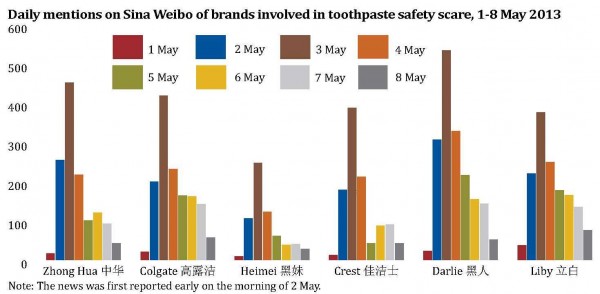
Toothpaste Safety Scare Mentions on Weibo

This post is an extract from the Danwei Bulletin, a briefing of company and market news collected from the Chinese news and social media before the information appears in English language reporting and sent to premium subscribers of the FT’s China Confidential and Danwei. Please click here for more information.

✭

On May 2, Modern Life Daily 当代生活报 reported on a study of test results of whitening toothpaste from Guangxi University for Nationalities, located in Nanning. The study found that six brands of whitening toothpaste contained ‘carcinogenic sulfites’. In response, the China Oral Health Products Industry Association cast doubt on the methodology of the study, but the report caused a spike of social media conversations on Sina Weibo, many of them negative.

As the chart above illustrates, the day the news was first reported in the media (May 2, the blue lines), it caused an immediate spike, followed by a larger spike the next day (the brown lines). Conversation gradually receded over the next few days.

The brands and companies affected are listed below. Note that the report concerns only whitening toothpastes, not the full range of products offered under the brands listed here.

Companies and brands affected
Zhonghua 中华 (Unilever NYSE:UN)
Colgate 高露洁 & Darlie 黑人 (Colgate Palmolive NYSE:CL)
Heimei 黑妹 (Masson Group – privately held)
Crest 佳洁士 (Procter & Gamble Company NYSE:PG)
Liby 立白 (Guangzhou Liby Group – privately held)

Posted in Business and the Economy, Consumer Culture | Tagged , | Comments Off on Whitening toothpaste safety scare

Fake sanitary pads: Massive margins driving rampant piracy

Sanitary Pads_Page_2

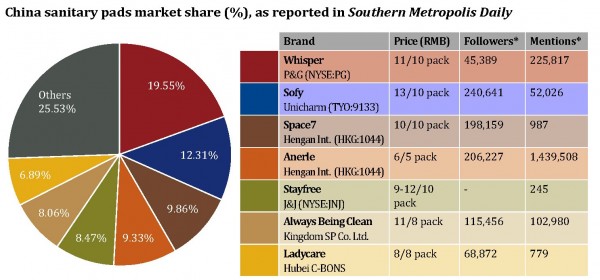
A typical sanitary pad customer will use the product for several decades, so a company with a strong brand and good distribution has a license to print money. And where there is money in China, there are pirates. Southern Metropolis Daily 南方都市报 last week reported that counterfeit sanitary pads worth over 150 million yuan were seized by police in a port city famous for its smugglers: Quanzhou in Fujian province.

The report explains that the reason why there are so many knock-off sanitary pads is the high gross profit of sanitary pad production, i.e. about 65%. The counterfeiters use cheap substandard materials, driving their margins sky-high. The report includes a number of interesting facts about the industry:

  • Tampons do not have high use rates in China but sanitary pads are popular: there are currently about 400 million regular consumers of sanitary pads, a market that was worth 41.1 billion yuan (US$ 6.6 billion) in 2010
  • The top ten brands (domestic and foreign) control 80% of the market with foreign brands at the high-end and domestic brands offering cheaper products
  • The article says China exported US$ 327 million’s worth of sanitary pads and imported US$ 10.1 million’s worth in 2012
  • The government has increased duty rebates on sanitary pads at what the article calls a ‘remarkable rate’ since 2009 in order to encourage exports

Notes on the chart
– Another of Proctor & Gamble’s (P&G) products called “Always” was also mentioned in the counterfeiting scandal despite not being marketed by the company in China.
– Followers * and Mentions*: Social media followers and mentions data from Sina Weibo; “Mentions” are for 2013 to date. Data collected by Danwei.
– The data in this posting is based a Southern Metropolis Daily 南方都市报 report published on 23 April 2013 which uses data from the following source: 2011-2015年中国卫生巾行业市场研究及发展规划调研报告 (2011-2015 China Sanitary Pads Industry Market Research and Development Report), published in July 2011 by China Market Research Reports. The market share data is for 2010.

✭

The Danwei Bulletin 
The posting above is an excerpt from The Danwei Bulletin (Issue 5, 1 May 2013), a weekly report produced by Danwei and published on the FT’s China Confidential website and sent to premium subscribers. The Danwei Bulletin is a briefing of company and market news collected from the Chinese news and social media. We focus on information that has not appeared in English language reporting or not yet been noted by the investment and business media and communities.

A brief summary of each week’s report can be viewed on the China Confidential website, and the full edition is available by subscription.

For more information on The Danwei Bulletin or on our custom media monitoring and research services, please contact jeremy@danwei.com

The Danwei Bulletin: Stay ahead of the English news
The examples below illustrate how Danwei Bulletin readers get the scoop on business stories long before they hit the international media.

Gold Price
April 25 – Danwei Bulletin
Despite gold prices dropping in the last week, demand in China remains strong
Chinese social media websites were buzzing with reports of mainland Chinese visiting Hong Kong to buy gold. One photo that was widely shared shows a branch of the jeweler Chow Tai Fook with shelves completely empty after a visit by goldbug mainlanders.

May 3 – South China Morning Post 
Chinese mothers beat Wall Street to force gold price rebound
Attempts by Wall Street funds to drive down bullion value through short selling thwarted by Asian mothers swooping in to buy for weddings.

May 9 – Bloomberg
At least 30 tons of gold were sold between April 29 and May 2 in Hong Kong, up more than 50 percent from last year, according to estimates by the city’s Chinese Gold & Silver Exchange Society.

Nongfu Bottled Water – major bottled water and beverage brand
April 3 – Danwei Bulletin
Bottled Water – Scandals continue
Wang Hai, a veteran Chinese anti-fraud activist, has suggested that there may be quality problems with Nongfu Spring tea beverages… Nongfu… has been on the defense recently, fending off charges that its water sources are polluted

May 3 – CCTV English – China Central Television News
Via Twitter
Nongfu Spring, China’s leading bottled water, pulled from shelves in Beijing as it failed national standards.

May 4 – Shanghai Daily
Industry body seeking Beijing ban for Nongfu Spring water
The Bottled Water Sales Association of Beijing published a notice yesterday saying that Nongfu Spring water was not only in violation of national standards but also guilty of false advertising and misleading customers.

Posted in Business and the Economy, Consumer Culture, Crime and Corruption | Tagged , | Comments Off on Fake sanitary pads: Massive margins driving rampant piracy

May Day aftermath: 180 tons of trash left on Gulangyu Island

Haixi Chenbao 2May

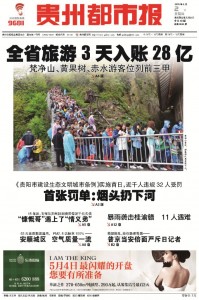
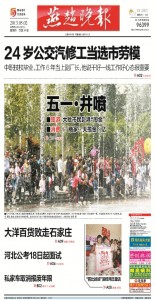
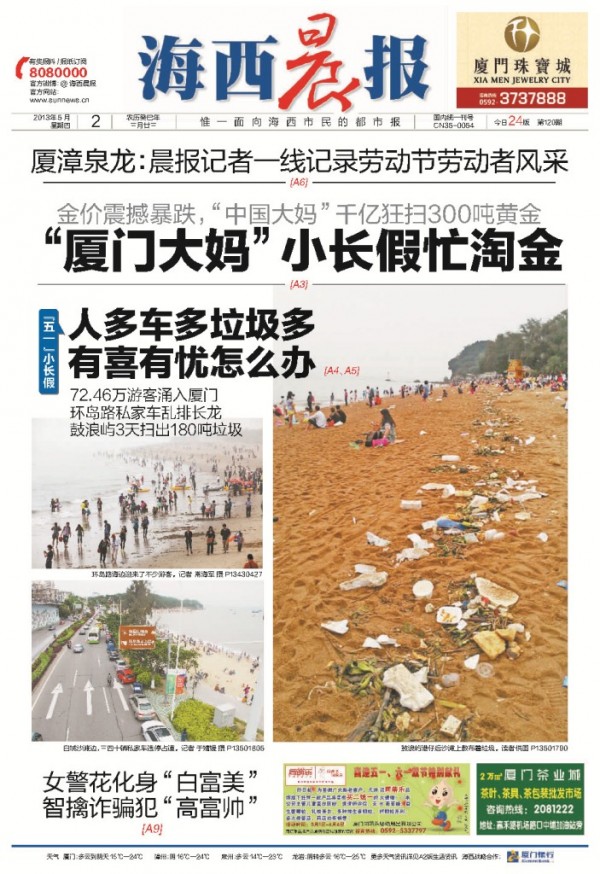
Another public holiday in China, another mountain of trash. The front page of the Haixi Morning Post (海西晨报) from Xiamen today is one of a few newspapers around China looking back on a public holiday of gridlocked traffic, congested scenic spots and – inevitably – mountains of trash, again.

As the Haixi Morning Post reports today, after the three-day May Day holiday the scenic island of Gulangyu (鼓浪屿) off Xiamen welcomed a total number of 186,700 tourist visits – and then had to sweep up 180 tons of trash, a new record for the May Day holiday. This is despite the fact that the total number of tourist visits was down by 3,000 compared to last year, when the trash left behind on the island totaled 165 tons.

What this means, then, is that less people are making bigger mountains of trash. In fact, on May 30th a mere 66,000 tourists left behind a full 75 tons of trash, a feat towering above the 80 tons of trash left behind by no less than 120,000 people on the 2nd of October last year during the Golden Week Holiday.

All this is despite that during the May Day holiday the island was equipped with more than 100 sanitation vehicles, 100 rubbish bins, and almost 300 hygiene officials. The latter worked every day from 4:30 am to 12:00 pm to clean up the trash but – as the newspaper sardonically puts it – “were unable to always maintain a clean environment”.

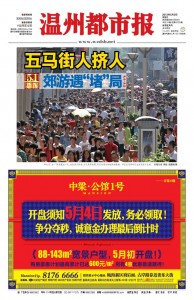
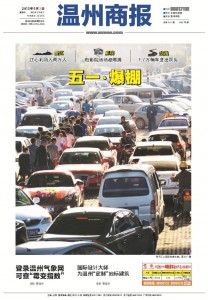
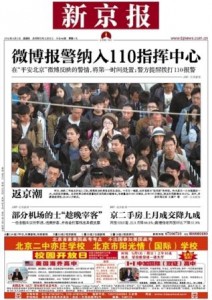
Here’s a few other front pages from China today on the congested and crowded May Day holiday:

Links and sources
Haixi Morning Post (海西晨报): 鼓浪屿3天扫出180吨垃圾
 
Posted in Front Page of the Day, Wildlife, Nature and the Environment | Tagged | Comments Off on May Day aftermath: 180 tons of trash left on Gulangyu Island

Corporate earthquake donations and social media

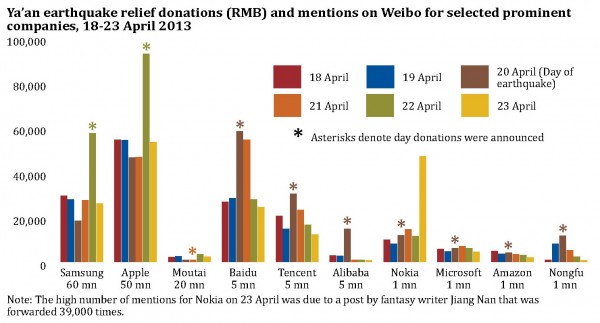
Weibo Quake Donations Chart_Page_1_Page_1

Soon after the Sichuan earthquake of 2008, donation fever gripped China as individuals and companies lined up to donate funds for disaster relief. Some of this enthusiasm turned sour: Internet users drew up a spurious list of the top ten “international iron roosters” 国际铁公鸡 accusing global brands like Samsung, Nokia, and Coca-Cola of donating nothing to the earthquake relief effort despite reaping in millions in profits in the China.

After the Ya’an quake of April 20 this year, companies foreign and domestic have been swift and public about their donations, and donation announcements have sparked considerable discussion on China’s social network services. The chart above illustrates the conversation spike on Sina’s Weibo microblog platform for ten prominent brands after their donations were publicized in the media. Apple and Samsung are notably prominent.

The above is adapted from The Danwei Bulletin, a weekly report produced by Danwei and published on the FT’s China Confidential website and sent to premium subscribers. The Danwei Bulletin is a weekly briefing of investment intelligence from Chinese media and Internet, presenting company and market news collected from the Chinese news and social media. We focus on information that has not appeared in English language reporting or not yet been noted by the investment and business media and communities.

A brief summary of each week’s report can be viewed on the China Confidential website, and the full edition is available by subscription.

For more information on The Danwei Bulletin, please contact jeremy@danwei.com.

Posted in Business and the Economy, Consumer Culture | Tagged , | Comments Off on Corporate earthquake donations and social media

Traffic policeman leaves black Audi with fake plates blocking gate

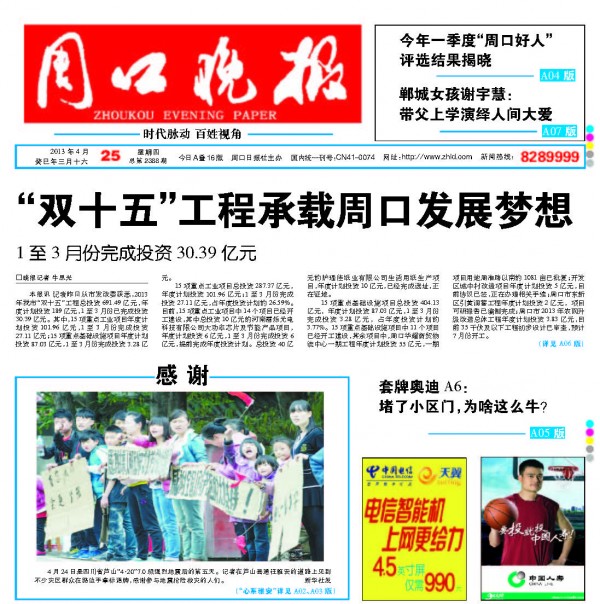
Zhoukou Wanbao 25Apr

The black Audi has a reputation in China as the car of choice for the rich and powerful. Or for anyone pretending to be rich and powerful. And sometimes the dividing line between reality and pretense can become blurred. With the headline “Car blocks entrance to small community, is it the car that’s awesome or the driver?”, the front page of the Zhoukou Evening Paper from Zhoukou (周口) in eastern Henan today relates the story of a black Audi whose driver, a traffic policeman, clearly considers himself above the law.

At around 1 pm on Tuesday this week, members of a residential community on Zhongzhou Road (中州路) in the city of Zhoukou in Henan province were perplexed to find an Audi A6 with license plate AC0298 parked in front of the gate of their community, blocking all traffic in and out.

A journalist rushed over to the scene and soon found out who the absent driver was, as this is apparently not the first (but the third) time this had happened: a young man aged 20 who wears a police uniform.

According to the article, the guard explained:

The black Audi didn’t have the requisite card to enter, so I wouldn’t let him in. I asked him why he wanted to enter, but he didn’t reply, so we we’re deadlocked. This lasted for about a minute, whereupon the driver got out of his car, locked the doors, and walked off with the young woman he had with him in the car, which was left there in front of the gate.

About an hour later the driver of the Audi appeared again, and some of the residents – now clearly somewhat perplexed as no-one could drive in or out – tried to reason with him. But with a cigarette in his mouth he was completely unperturbed and deaf to their appeals. Someone soon phoned the (real) police, who checked up on the license plate. Turns out not only was the license plate fake, so were the tags on the windshield. Yet it emerged that the driver – a man named Li – was indeed a member of the traffic police of the local Public Security Bureau (PSB).

At 4 pm on Tuesday when the journalist left the scene, the black Audi was still there. But when he returned the next morning, he found the Audi parked on the inside. A resident then informed him that the previous evening at 6 pm, an officer of Mr Li’s PSB unit had appeared with said Mr Li to apologize for the inconvenience.

Not satisfied at leaving it there, the journalist went over to the traffic police where Mr Li worked to ask him about the fake plate and tags. Mr Li insisted that he had only lent the car from someone else (whom he would not name), and knew nothing about the fake plate and tags.

The newspaper ends its report by noting that fake number plates can land you in jail for 15 days and cost you a fine of up to 5,000 yuan. Yet it then asks forlornly: will Mr Li face justice?

Links and sources
Zhoukou Evening Paper (周口晚报): 车堵小区门,是车牛,还是人牛?

Posted in Front Page of the Day | Tagged | Comments Off on Traffic policeman leaves black Audi with fake plates blocking gate

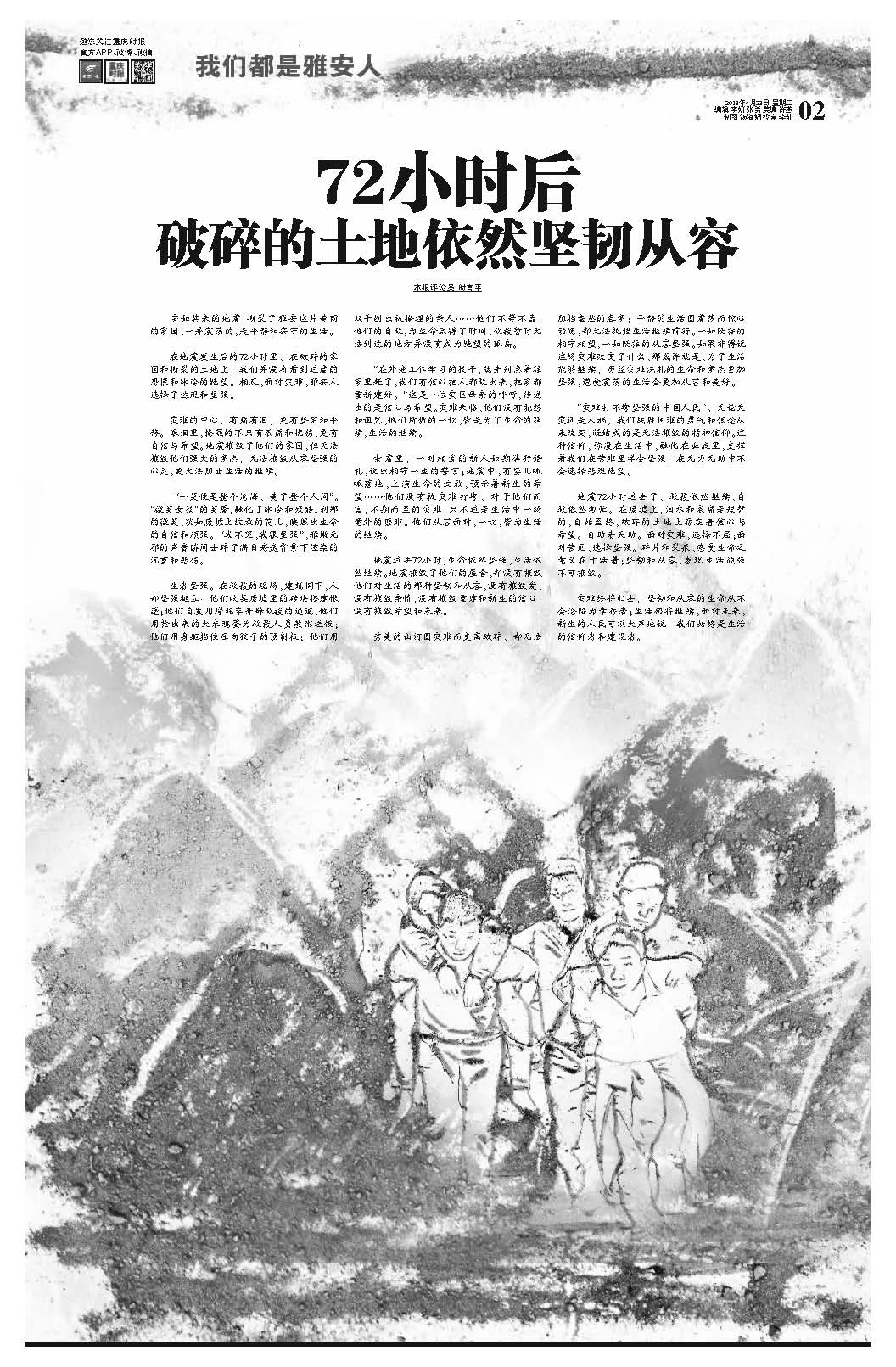
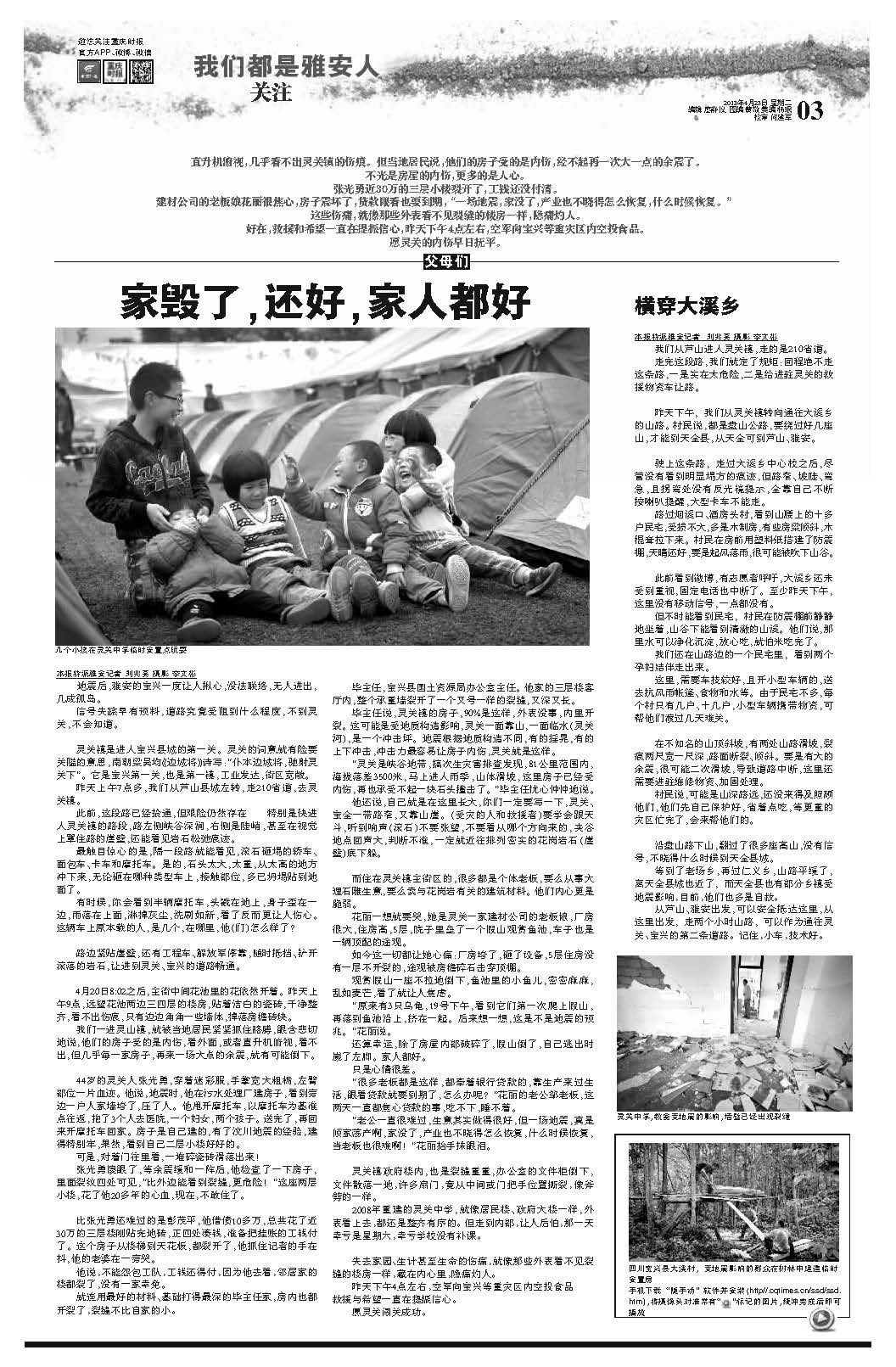
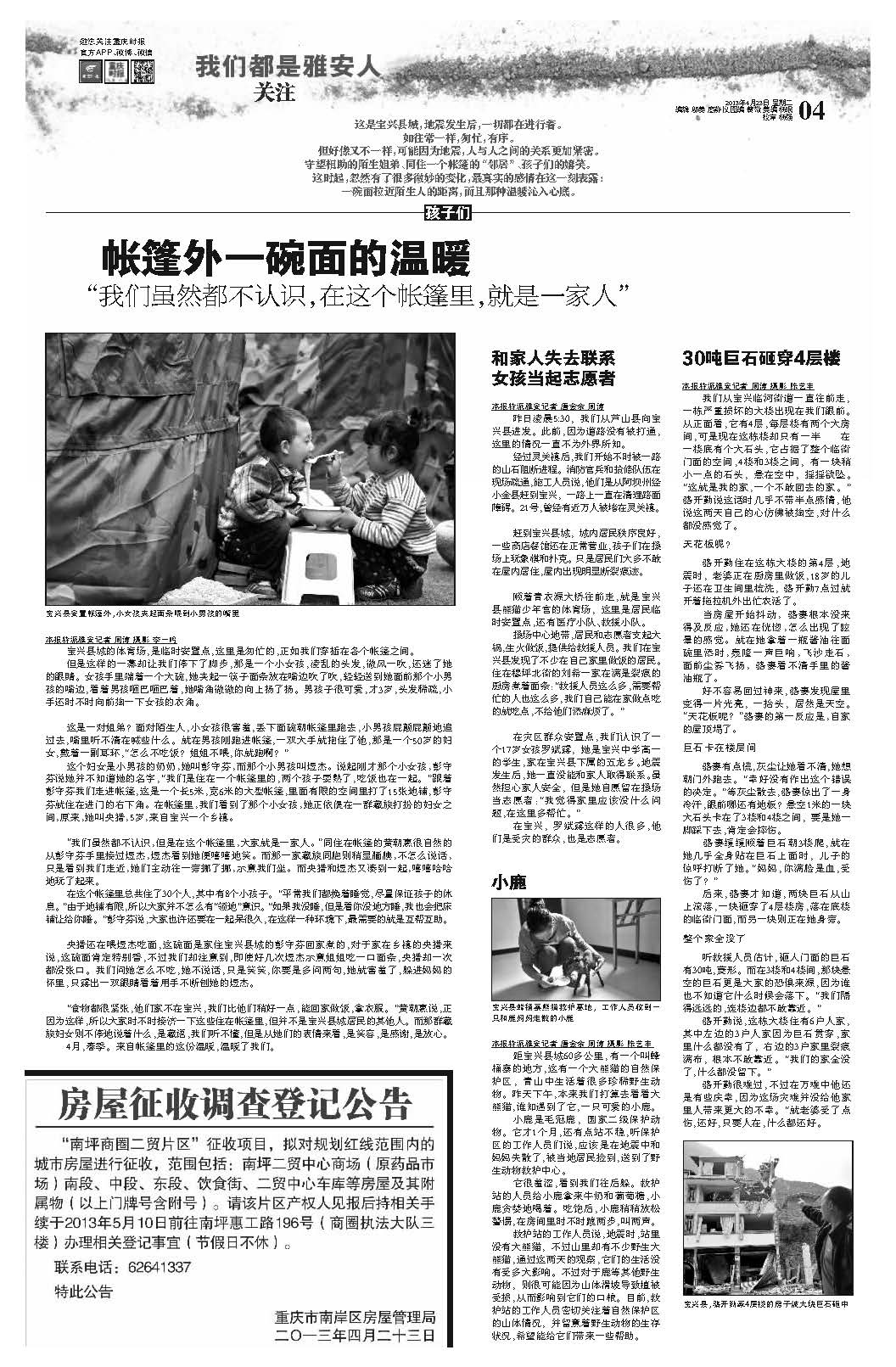
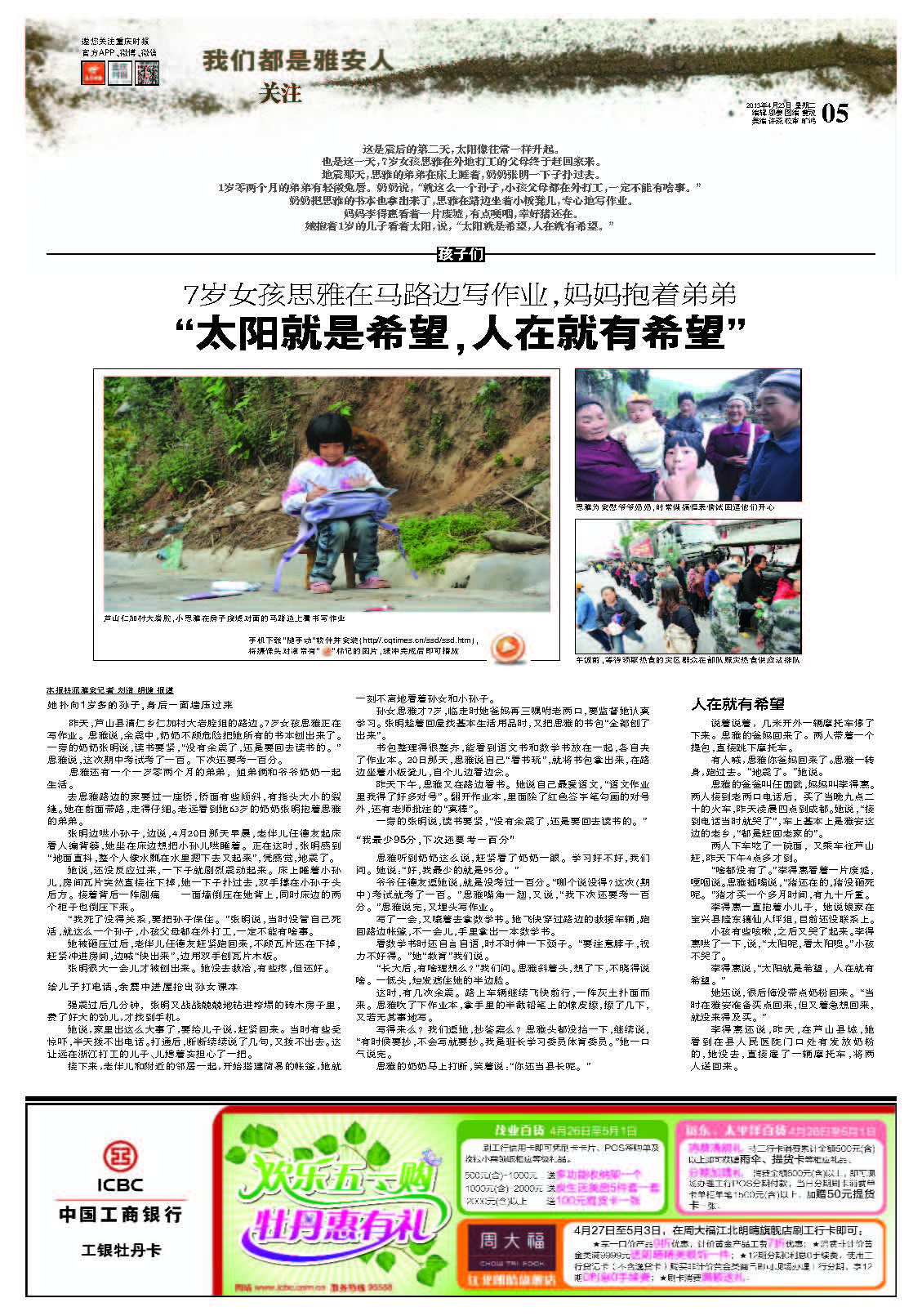
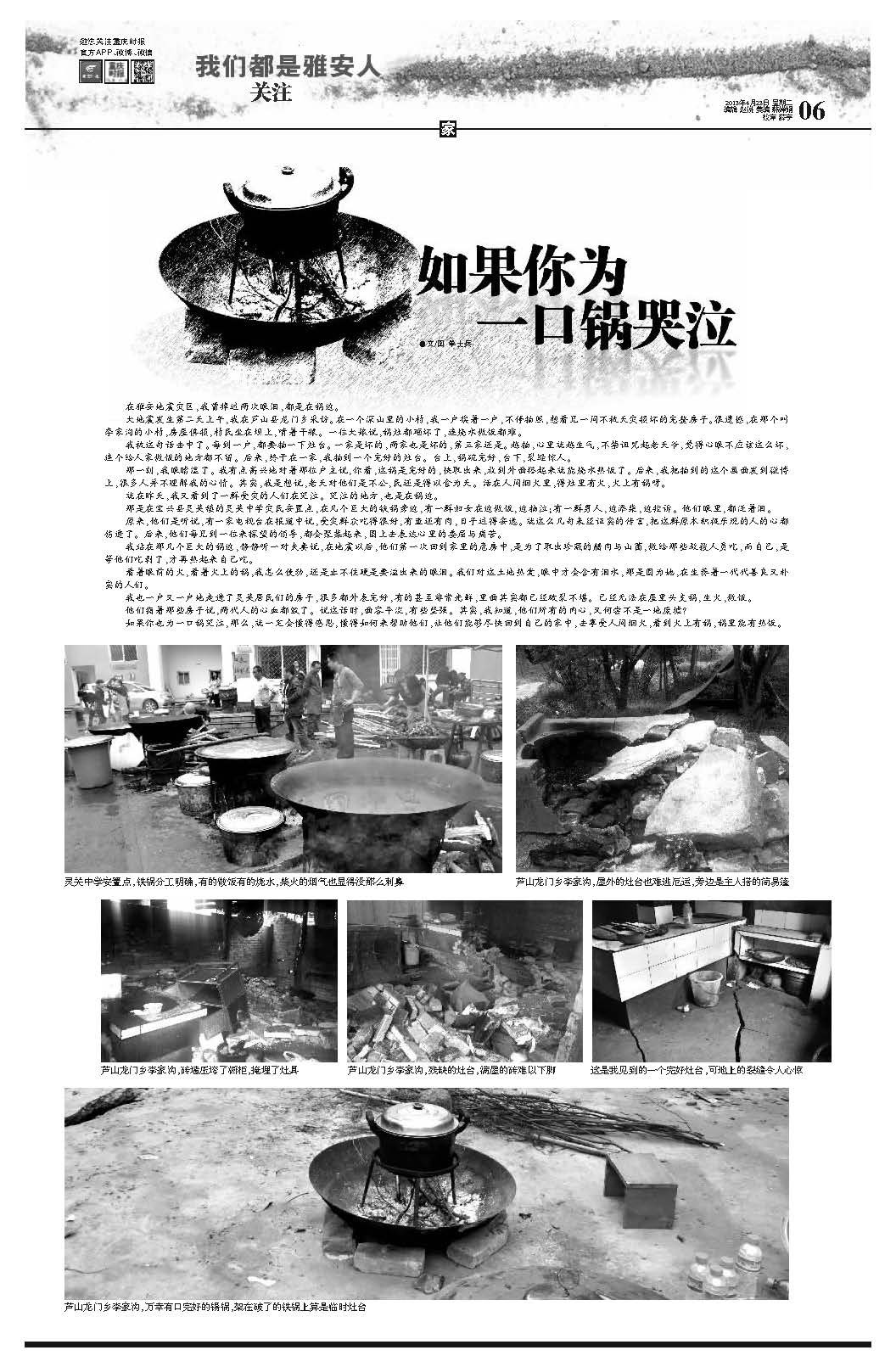
Weeping over broken pots in Ya’an

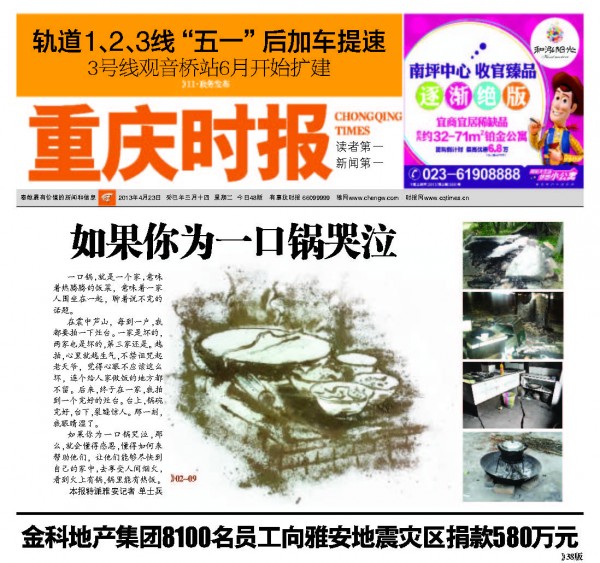
Chongqing Shibao 23Apr

“In the Ya’an earthquake disaster zone I sobbed twice, and both times were by the side of cooking pots”.

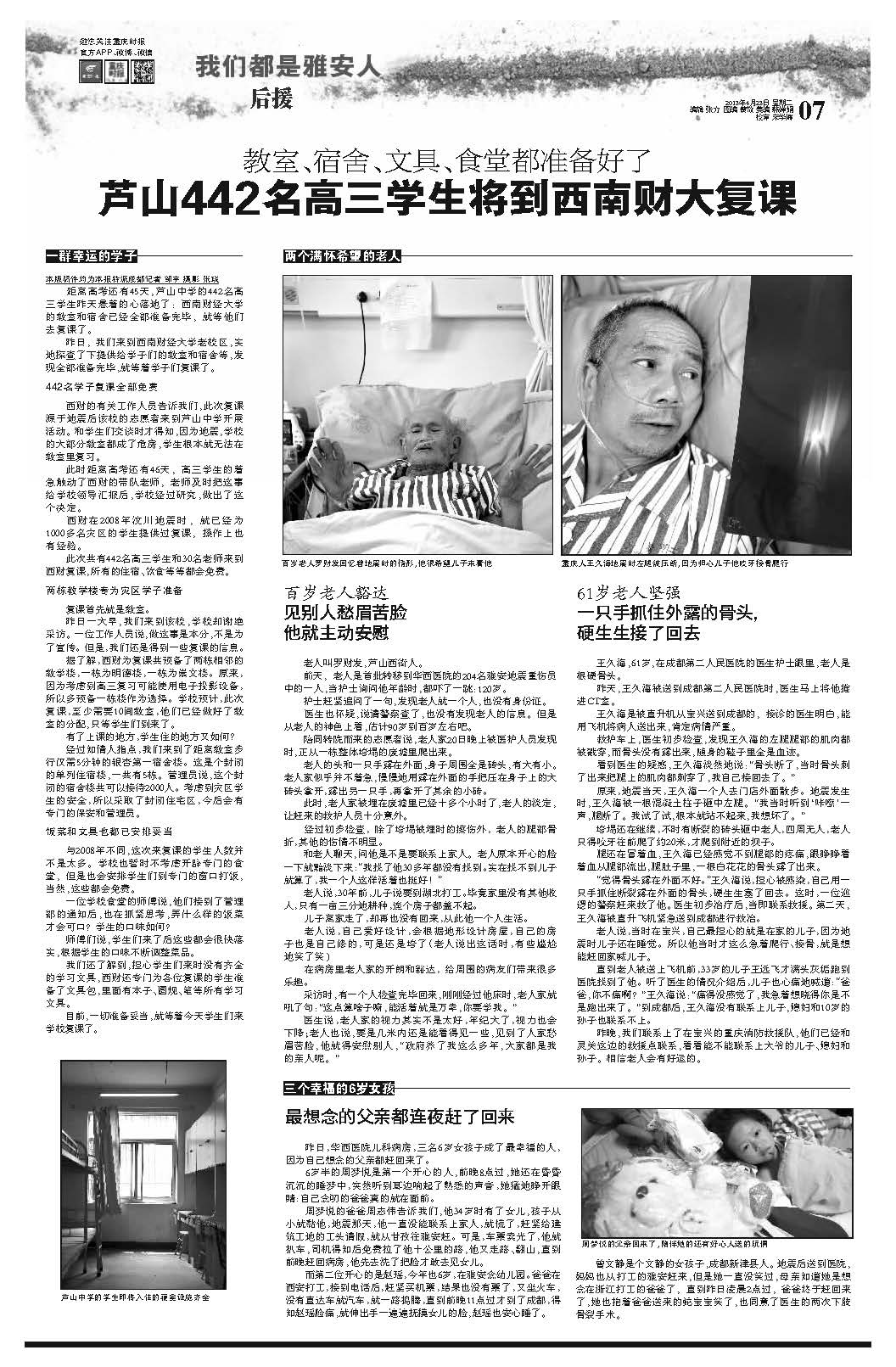
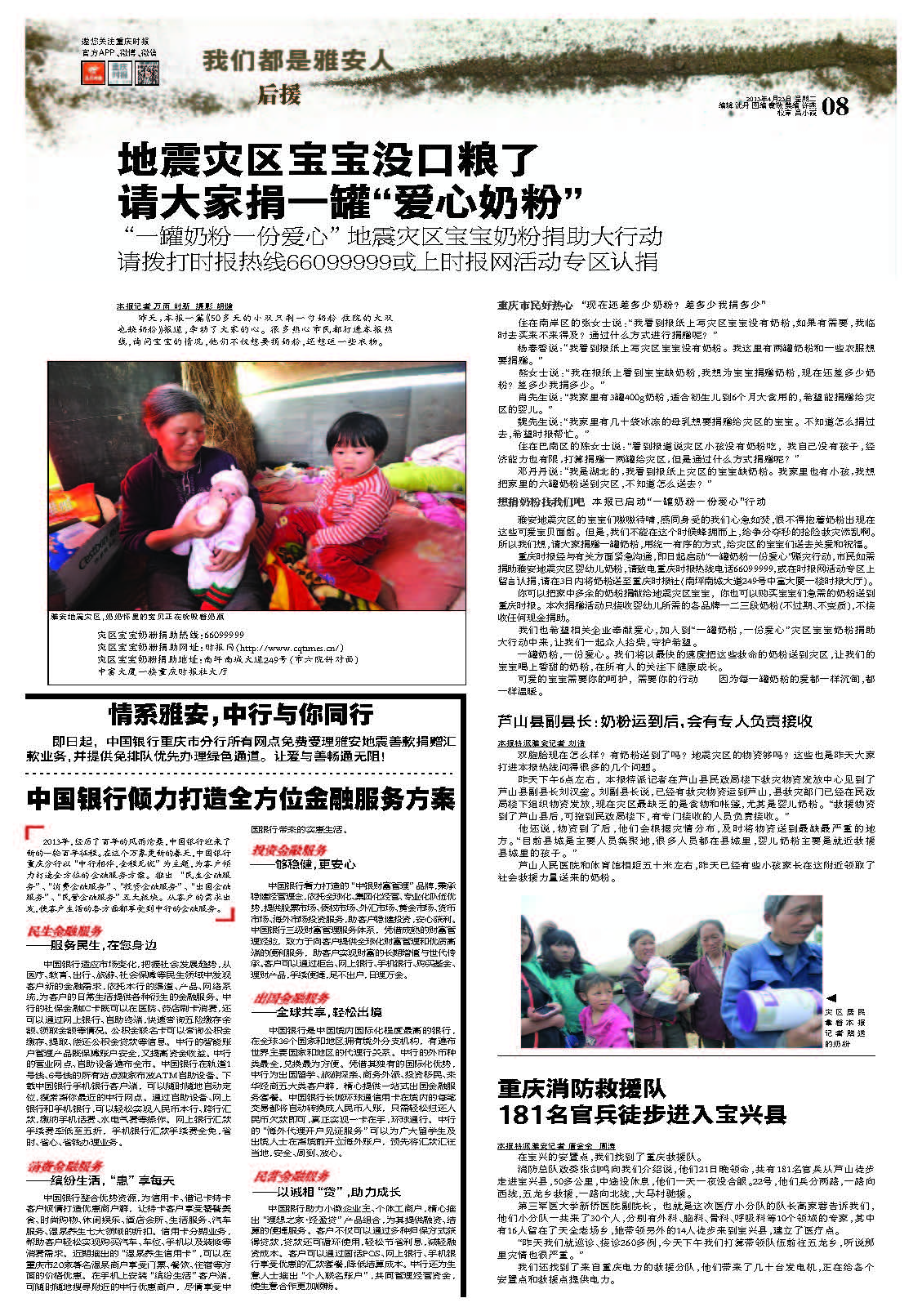
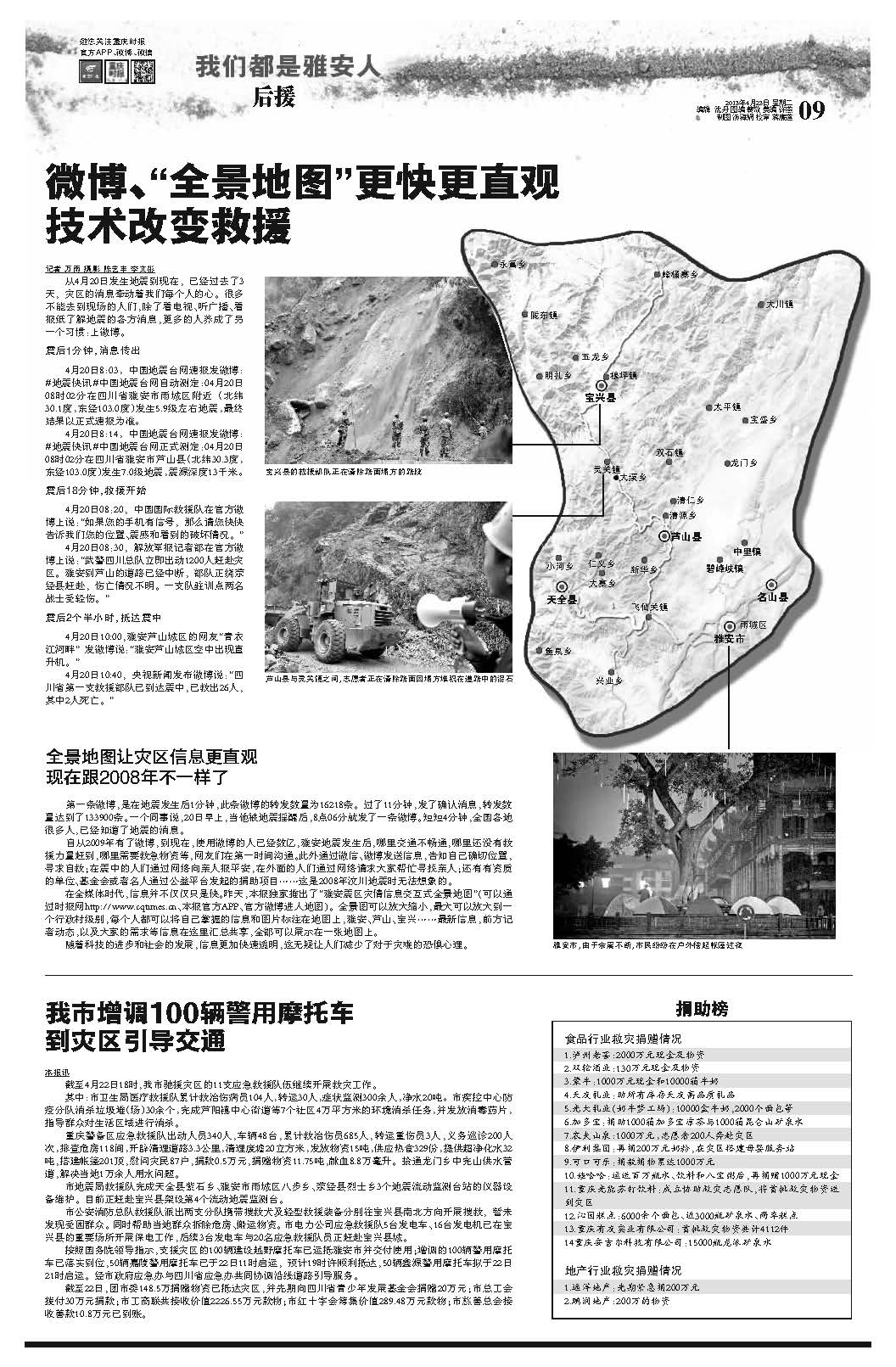
The Chongqing Times newspaper today has a special section on the earthquake that occurred in the city of Ya’an (雅安) in Sichuan province last weekend. The special section, entitled “We are all Ya’an people now”, looks at the state of affairs 72 hours after the earthquake with the observation that “The destroyed area is calm and collected as it was before“. In eight pages of in-depth coverage, we see the extent of the destruction, how the survivors are being looked after, and how some people are trying their best to get on with their lives. One page in this special section outlines the findings of a journalist who went to take pictures of damaged homes, and found himself looking at a myriad destroyed stoves and pots as a cruel metaphor for the immense destruction wrought on people’s lives and livelihoods by the earthquake. Seeing all this destruction, there were two occasions when he wept.

The day after the earthquake struck last weekend, a journalist from The Chongqing Times (重庆时报) was in Longmen township (龙门乡), Lushan county (芦山县) in Sichuan province in the area that was the epicenter of the quake. At a village deep in the mountains he was taking pictures and walking from house to house, looking for dwellings that had escaped complete destruction. Yet he found none – all were destroyed. He met an old woman sitting on an embankment who told him that all the cooking stoves and pots in the village had been destroyed; now how would they cook food and boil water?

The journalist was struck by this, and decided to go and inspect the kitchens of every destroyed house if perhaps any of the stoves and pots had survived. In the first broken structure he entered, the kitchen area and everything in it were utterly wrecked; the same went for the second and third house he saw. “The more pictures I took”, he wrote afterwards, “the angrier I became:

I couldn’t help but curse the heavens above for being so heartless as to rob all these people of their means of preparing their food.

This was the first time that the journalist wept in Ya’an. Yet later he did find one house with its pots and stove still intact, even though there was a large crack in the floor. He retrieved the pots, and saw to it that they were used for preparing food.

A few days later the journalist witnessed another mournful scene by the side of a cooking pot. In Lingguan township (灵关镇), Baoxing county (宝兴县), he saw women preparing food in a few large cooking pots while some men were stoking the fires with wood. All the people here, the journalist noticed, had tears in their eyes. The reason for this, he was told, was that the people had seen a television news report that proclaimed that everyone in the disaster area were eating good meals of fish and meat and were doing just fine.

Yet this was far from the truth for the people standing next to the cooking pots: none of the leaders had come to visit them, and they had not much to eat. The journalist overheard an old man telling his wife that he had returned once to their destroyed home to retrieve some dried meat and mushrooms, but had ended up giving the food to a volunteer working in the area.

In Baoxing as well the journalist went to look through the homes in the area, and found that from the outside some of them appear to have been left untouched by the earthquake. Yet inside they were all devastated; in none of them could you cook a meal. All this signified, the journalist concluded, that the sweat and labor of two generations have been wiped out.

“We are all Ya’an people now”:

Links and sources
Chongqing Times (重庆时报): 如果你为一口锅哭泣
 
Posted in Front Page of the Day | Tagged | Comments Off on Weeping over broken pots in Ya’an

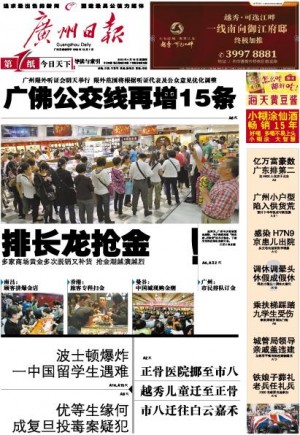
Gold rush in Guangzhou

Guangzhou Ribao 18AprThe global price of gold has tanked, and Guangzhou’s gold market is booming.

The front page of the Guangzhou Daily (广州日报) today has images of long queues that formed the last few weeks in the city of people seeking to part with loads of cash for cheap gold.

From a peak of US$1,900 in August 2011, the price of gold has been on a gradual decline, and Monday this week saw a precipitous drop of 9% in a single day. Starting from Saturday and persisting through yesterday, a veritable gold rush has engulfed Guangzhou as the price of gold jewelry fell to 358 yuan per gram. Many stores in the city even sold clean out of gold. The head branch of the Dongshan General Merchandise store in the city yesterday sold 12 million yuan’s worth of pure gold, while its branch in Huadiwan set a new single day record for pure gold sales of 15 million yuan. The largest single purchase was when one customer bought 2,000 grams of gold for 1,75 million yuan.

Journalists from Guangzhou Daily noticed that people were waiting in long queues to purchase the stuff, and after parting with their cash, some happily brandished their spoils. One such was 70-year-old grandma Kong, who flashed the five bracelets, three rings, one set of large solid gold bars and a pendant she had just purchased for 70,000 yuan. Even gold jewelry items that usually sell much slower flew off the shelves in the last few days, and many stores ran out of stock. Yet customers were happy to pay in advance, even though (as some of the gold merchandisers told the Guangzhou Daily), most of the sellers in Guangzhou dropped their prices by only 12%, less than the 16% drop in the global price of gold last week.

Links and sources
Christian Science Monitor: Gold price: biggest tumble in 30 years
Guangzhou Daily (广州日报): 我为金狂

Posted in Business and the Economy, Front Page of the Day, Urban Culture and Cities | Tagged | Comments Off on Gold rush in Guangzhou

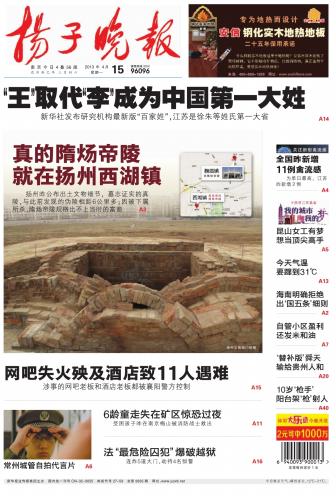
Chengguan makes video to “clear up misunderstandings” of his profession

Yangzi Wanbao 15AprThis is probably not going the get the hated chengguan any love, but one of their number has made a short video in the style of a popular recent television advertisement to try and “clear up some misunderstandings” surrounding his profession. His video probably did nothing of the sort, but you can’t fault him for ripping off another television advertisement to try and stem some of the overwhelming negative press his profession generates. Or perhaps you can.  

China’s urban law enforcement officers, known as chengguan, don’t have a very good reputation. Regularly in the news for abusing and assaulting street vendors or blind beggars, the chengguan have been a feature of urban security for noncriminal administrative concerns such as noise control, parking and sanitation ever since 1997.

Yet theirs is a thankless job, for obvious reasons. But now one member of their ilk has had enough of all the “misunderstandings”. In the city of Changzhou in Jiangsu province, one chengguan by the name Jiang Yifan (蒋佚凡) enlisted a few of his friends and colleagues to produce a video of 1 minute and forty seconds. The front page of the Yangzi Evening News (扬子晚报) from Jiangsu province today reports on Jiang’s video, which can be viewed here. Described as a mild-mannered (文质彬彬) man, Jiang got tired of all the jokes and jibes that ensued whenever he told anyone about his profession. The style of the video is a straight-up copy of a recent advertisement from the cosmetics firm Jumei.com that became popular on Chinese television (see the Baidu Baike page here to view the video of this ad). With a series of slow motion scenes and phrases that appear in bold on the screen, the Jumei ad was all about triumphing in adversity, self-confidently overcoming obstacles to succeed in your own way. Hence the chengguan ad follows the same formula of slow motion scenes and commentary, which are the following (screen text in italics):

  • Jiang and a colleague seem to accost vendors on the street with pointing arms and stern discussion – All you ever see are my extremely strict words
  • A bowl of instant noodles is steaming on his desk, his wife is on the phone, he’s working overtime – But you don’t see all my tears and grievances
  • A female vendor is cooking snacks on the street – You have your livelihood
  • Jiang and his colleague are standing in front of the female vendor and writing stuff in their notebooks – …and I have my duty
  • Other people on the street are laughing and pointing – You can be disdainful of my job
  • Street scenes of traffic and buildings –  But we can show you who is really making the city pretty
  • Close-up images of Jiang working on a computer – Being a chengguan is destined to be controversial
  • Jiang stands watch on the street – We are questioned and mocked wherever we go
  • Jiang looks at himself in the mirror while putting on his uniform – But despite all this, even if no-one understands
  • Jiang pushes open a door to face directly into the camera – We will march courageously onward
  • Jiang looks sternly into the camera – I am a chengguan, and I can speak for myself

And all the while there’s dramatic music playing for effect. How’s that for a little chengguan pushback?

As Jiang himself points out to Yangzi Evening News, every day the chengguan are faced with numerous contradictions, and they will be blamed for whatever they do. People swear at them, and accuse them of meddling in other people’s business. What’s a poor chengguan to do?

Links and sources
Yangzi Evening News (扬子晚报): 常州80后城管自演自拍宣传片 “为自己代言”化解市民误解

Posted in Front Page of the Day, Urban Culture and Cities | Tagged , | Comments Off on Chengguan makes video to “clear up misunderstandings” of his profession

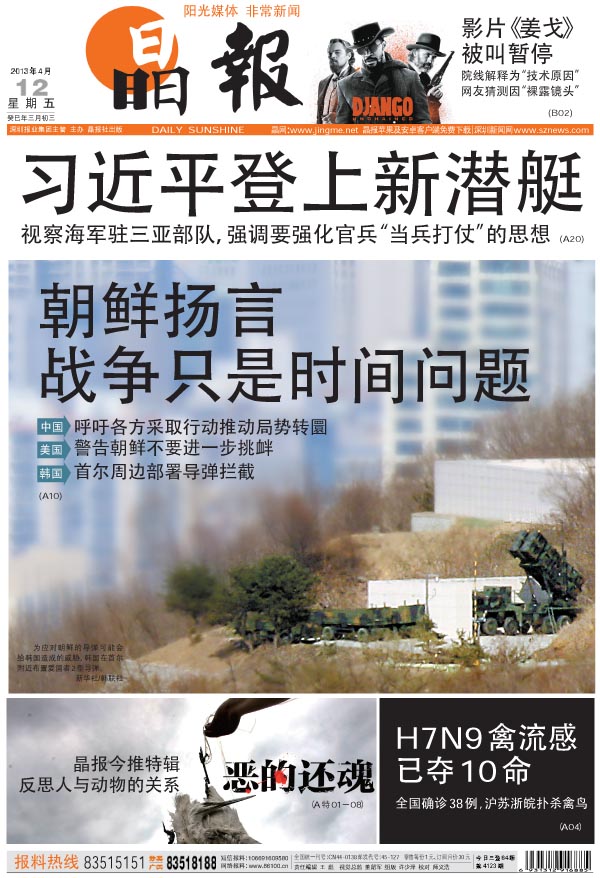
“Don’t let your stomach become an animal graveyard”

The newspaper Daily Sunshine (晶报) from Shenzhen in Guangdong province today includes a special section entitled “Evil returns from the grave” (恶的还魂) (or perhaps another translation could be “The recycling of evil”) as a “reflection on the relationship between animals and humans”. The largest part of the newspaper’s front page is taken up by a Xi Jinping headline and a large image on the ongoing standoff on the Korean peninsula. The top corner of the front page refers to the sudden cancelling of the Tarantino film Django Unchained.

In light of all the animal massacres that have been so prominent in China news of late, the Daily Sunshine‘s reflection on this matter is – unsurprisingly – quite morbid, yet it also contains a message of hope.

The opening sentences of the special section sets the scene as follows:

Looking over a series of shocking, ghastly pictures [e.g. of dead pigs, ducks or swans?] causes one to shiver from the very bottom of the soul. What kind of evil is this that transforms cities into slaughterhouses for wild animals? What kind of brutality is this that transforms out stomachs into cemeteries? 

Is it ignorance that makes our stomachs into slaughterhouses for animals?, the newspaper asks. A third of all the animal species in the world are on the verge of extinction, it continues, yet are we but helpless in the face of this massacre? Will we let this tragedy play itself out until the bitter end? In Shenzhen, the Daily Mirror consoles itself, people are taking action. Volunteers are joining groups like the Cat Network (猫网) and the Bird Watching Society, and people are restricting their appetites and spreading awareness of animal preservation.

As part of its special section, Daily Sunshine includes an article about an undercover reporter that was sent to a Hakka restaurant in Shenzhen suspected of serving various kinds of wild meat. Indeed, outside the restaurant the journalist saw cages filled with wild mountain fowl and exotic birds, snakes, tortoises, porcupines, etc. Another article ”exposes” the cruel practice of people going up the mountains to catch wild birds for fun and them eating them.

With all this the newspaper admonishes its readers: ”Don’t let your stomach become an animal graveyard”.

Links and sources
Daily Sunshine (晶报): 恶的还魂; 暗访残酷的杀戮曝光 猎鸟从未停

Posted in Front Page of the Day, Wildlife, Nature and the Environment | Tagged | Comments Off on “Don’t let your stomach become an animal graveyard”

The Danwei Bulletin

The Danwei Bulletin

The Danwei Bulletin ImageThe Danwei Bulletin is a new weekly report produced by Danwei and published on the FT’s China Confidential website and sent to premium subscribers. The Danwei Bulletin is a briefing of company and market news collected from the Chinese news and social media before the information appears in English language reporting.

A brief summary of each week’s report can be viewed on the China Confidential website, and the full edition is available on subscription. For more information on The Danwei Bulletin or about our custom media monitoring and research services, please contact jeremy@danwei.com.

Stay ahead of the news
The examples below illustrate how the Danwei Bulletin readers get the scoop on business stories long before they hit the international media.

Gold Price
April 25 – Danwei Bulletin
Despite gold prices dropping in the last week, demand in China remains strong
Chinese social media websites were buzzing with reports of mainland Chinese visiting Hong Kong to buy gold. One photo that was widely shared shows a branch of the jeweler Chow Tai Fook with shelves completely empty after a visit by goldbug mainlanders.

May 3 – South China Morning Post 
Chinese mothers beat Wall Street to force gold price rebound
Attempts by Wall Street funds to drive down bullion value through short selling thwarted by Asian mothers swooping in to buy for weddings.

May 9 – Bloomberg
At least 30 tons of gold were sold between April 29 and May 2 in Hong Kong, up more than 50 percent from last year, according to estimates by the city’s Chinese Gold & Silver Exchange Society.

Nongfu Bottled Water – major bottled water and beverage brand
April 3 – Danwei Bulletin
Bottled Water – Scandals continue
Wang Hai, a veteran Chinese anti-fraud activist, has suggested that there may be quality problems with Nongfu Spring tea beverages… Nongfu… has been on the defense recently, fending off charges that its water sources are polluted

May 3 – CCTV English – China Central Television News
Via Twitter
Nongfu Spring, China’s leading bottled water, pulled from shelves in Beijing as it failed national standards.

May 4 – Shanghai Daily
Industry body seeking Beijing ban for Nongfu Spring water
The Bottled Water Sales Association of Beijing published a notice yesterday saying that Nongfu Spring water was not only in violation of national standards but also guilty of false advertising and misleading customers.
Posted in Business and the Economy, Consumer Culture, Internet and Media | Tagged , | Comments Off on The Danwei Bulletin