Redefining the Great Wall

JDM100918wall.jpg

Not the Changcheng

As China seeks to expand the influence of its culture abroad, more attention is being given to the importance of translation. Not just in the most obvious contexts – the embarrassment of mechanical translations and errors caused by ignorance, or the mind-bending officialese found in state organs – but more subtle issues involving specific aspects of Chinese culture. Do existing translations fail to capture all of the nuances of certain cultural phenomena? Or worse, are they misleading enough to actively obstruct the successful spread of Chinese culture worldwide?

Zhao Qizheng, former director of the State Council Information Office, has argued that Peking Opera should really be called “Jingju” so it is not confused with the European art form, and the traditional form of stand-up comedy sometimes called “crosstalk” is just as often referred to in English as “xiangsheng.” The dragon is another example: the true majesty and benevolence of the Chinese variety is obscured by the malevolence of the western mythical creature that also goes by that name. The issue also crops up in relation to government buzzwords, but in those situations, there often is considerable debate among the Chinese public over the proper interpretation of certain terms.

But it’s not just concepts from art or politics that are contested. Even something as concrete as the Great Wall is a victim of misleading English, argues Pei Yu (裴钰), a columnist who writes about the tourism industry.

Pei’s article, published in the China Youth Daily as part of a series of columns on cultural tourism, discusses the need for proper protection of the Great Wall as a monument of world cultural heritage. He asserts that the current English translation harms the cause of cultural heritage preservation because it represents only one small aspect of an integrated cultural heritage experience.

Pei’s piece concludes by recommending an unorthodox (and to my mind, at least equally misleading) replacement translation for “Great Wall.” Although he does not suggest using the romanization “Changcheng” (长城), for the sake of clarity, that is the term used in the translation below in place of the usual English rendition.

Continue reading →

Posted in Tourism | Tagged , , , | Comments Off on Redefining the Great Wall

Government officials fired after deadly demolition action in Jiangxi

f43b97c5-a2d5-4ede-860b-768e3b65a612_normal.jpg

Daily Sunshine, September 19, 2010

On September 10th, a standoff between a local law enforcement team and a rural family in Yihuang, Jiangxi Province went awry, leading to three villagers setting themselves aflame. Two were badly injured and one was pronounced dead at hospital.

The incident was believed to be triggered by a dispute over demolition compensation. In the aftermath, on September 16th, two female family members of the deceased were prevented from boarding an airliner from Nanchang to Beijing by Yihuang officials and were forced to take refuge at a woman’s bathroom before the media intervened. The two claimed that they were on a trip to petition to the higher-level government.

Today, Shenzhen-based newspaper Daily Sunshine reported that multiple government officials, including a vice county mayor, have been discharged from their position to accept police questioning. The big image on the front page shows Zhong Rujiu, sister of one of the self-immolators, being taken away by the police in a school bus.

Update:

Global Voices has an excellent summary of how microblogs (mostly on Sina’s Weibo platform) spread news of the affair: Yihuang Self-Immolation Incident and the Power of Microblogging. See also:

ESWN: Microblogs Rescue Petitioners

China Digital Times: Latest Directives from The Ministry of Truth

Links and Sources
Posted in Front Page of the Day | Tagged , , , | Comments Off on Government officials fired after deadly demolition action in Jiangxi

Beijing newsstands will resume selling SIM cards after a hiatus

A01917C.jpg

The Beijing News, September 17th, 2010

Selling of prepaid mobile SIM cards at Beijing’s newsstands was called off temporarily following the implementation of a real-name policy on September 1st. The policy requires mobile users to present their ID cards or, in case of foreigners, passports for mobile subscription purchases.

This is going to change soon. According to The Beijing News, newsstands will resume selling prepaid Unicom SIMs starting on September 20th after signing contracts with the carrier, which will hold stand owners accountable for checking buyer IDs. Selling of SIMs of the other two major carriers, China Mobile and China Telecom, will also resume, although the exact date has not been specified yet.

Links and Sources
Posted in Front Page of the Day | Tagged , , | Comments Off on Beijing newsstands will resume selling SIM cards after a hiatus

Nike China marketing director detained in connection to soccer scandal

orientalguardian.jpg

Oriental Guardian, September 16, 2010

China’s ongoing anti-corruption campaign has led to a series of arrests of sports officials, including Xie Yalong, the former vice president of the Chinese Football Association who was taken away by police on September 6th. The stakes were raised again yesterday when the media broke the story that Nike China’s marketing director Li Tong, a former ace huddler and US green card holder, had been taken into police custody in Shenyang for questioning.

The newspaper speculated that the Li’s detention has to do with a ten-year Chinese Super League sponsorship contract for which Nike paid US$200 million. By comparison, CSL’s former sponsor, Adidas, disbursed US$500 million for a six-year tenure. The low price has given rise to speculations of bribery and corruption.

Links and Sources
Posted in Front Page of the Day | Tagged , , | Comments Off on Nike China marketing director detained in connection to soccer scandal

New rules on dress and speech for teachers in Jiangsu

JDM100915xdkb.jpg

Modern Express, September 15, 2010

Teachers in Jiangsu dress too sexily and have a bad habit of talking out of turn, reports the Modern Express.

Today’s edition features a look at the Fifteen Etiquette Recommendations for Nanjing Primary and Secondary School Teachers, issued by the Nanjing government yesterday:

Laziness is no excuse for wrinkled clothing;

Clothing that reveals the breasts, shoulders, back, midriff, or thigh should not be worn;

Outer clothing may not be too thin or translucent;

Scoop necklines cannot be worn;

Skirts may not be too short;

Clothing that wraps the body too tight is inadvisable.

These are encapsulated in “six don’ts”: Don’t wear dirty, skimpy, translucent, revealing, short, or tight clothing.

According to the paper, the new guidelines are the idea of municipal Political Consultative Conference member Bi Darong, who once caught a glimpse of lingerie on campus:

Once, while picking up her child after school let out, she saw a teacher bending down to tie a student’s shoelaces. Her neckline was low, and you could see her underwear through her collar. “I thought it wasn’t too tasteful. If what a teacher wears is too revealing, it will have a negative effect on the children.” Although the teacher was caring for the student, her clothing was not appropriate for her professional image. As a result, at this year’s municipal legislative sessions, Bi put forward a proposal recommending that the Nanjing Bureau of Education revise the existing draft Etiquette Standard to include more detailed standards for professional attire and appearance that educators could use as a reference.

Some of the requirements, in brief:

The requirements for teachers’ appearance state that whether in the classroom or outside in the campus, teachers should be radiant and energetic and should appear happy and full of self-confidence. They may not wear heavy makeup or oversize jewelry, may not have long fingernails, and may not dye their hair in strange colors. Demeanor requirements are quite high as well: when sitting, hands should be clasped or placed atop each other, and legs should be together or crossed. When standing, legs should be straight and together, the abdomen held in, and the hands crossed in front of the body. The head should be erect. When walking, no noise should be made and footsteps should be steady. Refined conduct is requested in the classroom; pacing is discouraged. However, the rules against lecturing while seated and open or disguised corporal punishment remain unchanged.

Yesterday, the Modern Express reported on an official government notice barring teachers from speaking out of turn. The notice was circulated Bureau of Education of Pizhou, a county-level city under the jurisdiction of Xuzhou, Jiangsu Province:

Continue reading →

Posted in Front Page of the Day | Tagged , , | Comments Off on New rules on dress and speech for teachers in Jiangsu

Super Mario Bros super cover

JDM100914dfwb.jpg

Oriental Guardian, September 14, 2010

The crew of a Chinese fishing boat who had been detained in Japan following a collision with Japanese coast guard that occurred in disputed waters on September 7 was released yesterday. Although the pilot of the boat is still in custody, many Chinese newspapers chose to feature the homecoming on today’s front page.

The Oriental Guardian made no mention of the issue on its front page. Instead, its layout celebrates the 25th anniversary of Super Mario Bros, the phenomenally popular video game released in 1985 for the Nintendo Entertainment System. (Although the headline says that Mario himself is 25, the character, created by Shigeru Miyamoto, debuted several years earlier.)

Guo Xiaosong, features director for the Oriental Guardian, posted a microblog updated explaining that the paper had originally wanted to run the cover yesterday, the game’s actual 25th anniversary, but it was pushed aside by the news of crosstalk performer Guo Degang’s first performance since his tiff with the Beijing media last month.

JDM100914mario.jpg

One commenter noted that the configuration at right (a layout from the game itself) would have made a much cooler cover.

Guo replied apologetically, “It really ought to have gone up that way, but there was the pressure of the ad, and it ultimately was too crowded.”

Links and Sources
Posted in Front Page of the Day | Tagged , , | Comments Off on Super Mario Bros super cover

Men’s Health magazine repackages 1Q84

AXL100824menshealth.jpg

Men’s Health‘s 1Q84 reincarnation

Ever thought about what the relationship between a commercially successful magazine such as Men’s Health (男人健康) and Haruki Murakami’s latest work 1Q84 is? No? Well someone at Men’s Health have, because their August issue came with a photographic version of the 1Q84 story - with fashion models and singers posing as the central characters: Aomame (青豆), Tengo (天吾) and Fukaeri (ふかえり or 深田绘里子).

Anomame is played by Sitar Tan (谭维维), a finalist of Super Girls 2006, and Murakami’s quintessential male lead is played by Liao Fan (廖凡), an actor trained at the Shanghai Academy of Drama, and who starred in 2008’s Ocean Flame (一半海水一半火焰) adapted from Wang Shuo’s (王朔) novel.

This version is a massive plot spoiler and most of the scenes are acted out with high drama. Obviously there are differences, the most obvious one being that this version accentuates the fashion angle.

AXL1009131q84.jpg
Links and Sources
Posted in Magazines | Tagged , , , , | Comments Off on Men’s Health magazine repackages 1Q84

Han Han on the Diaoyu Islands incident

diaoyu.jpg

China’s balls? (Wikipedia)

Han Han, China’s bad boy novelist, editor, blogger and race car driver recently posted his thoughts on the unfolding Diaoyu Islands spat between China and Japan.

Protect illegal characters

by Han Han/ translated by Julian Smisek

A friend asked me how I haven’t commented on the Diaoyu Islands incident, and suggested I take a few shots at Japan. I told him that while I myself may not have my own land to stand on, I care a lot about issues of territory. I first read about the incident on an online forum, and quite righteously posted, “Protect the Diaoyu Islands.” However, this resulted in the forum telling me that my attempted sentence contained illegal content, and suggested that I change it. After puzzling over this for a while, I changed the sentence to read, “Protect the Senkaku Islands [the Japanese name for the Diaoyu Islands],” and the message was published without a hitch.

Continue reading →

Posted in Nationalism | Tagged , , | Comments Off on Han Han on the Diaoyu Islands incident

Leave an online message for your favorite Politburo member

AXL100913xjb.jpg

The Beijing News, September 13, 2010

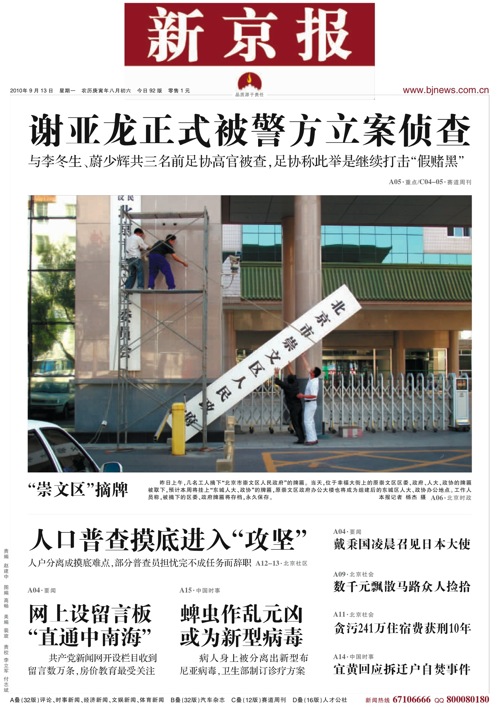
Today Xie Yalong (谢亚龙) is all over the news: the former head of the Chinese Football Association is being officially investigated for bribery and match-fixing. The main picture details the removal of the People’s Government sign for Chongwen District in Beijing (崇文区), after merging of the districts were announced earlier in the year.

Other news include another initiative to direct the people’s messages straight to the government’s senior leaders. This time it’s an initiative to leave messages on the CPC section of People’s Net.

From The Beijing News report:

This reporter clicked through to People’s Net, then clicked on CPC main news section from the navigation bar. Near the bottom, there is a sign saying ‘Direct to Zhongnanhai’ which I clicked through.

On the right are photos of the nine members of the Politburo, and underneath their photos there is button to click for leaving messages… This function is also available for other secretaries.

At 10.50pm yesterday, this reporter saw that netizens had left up to 16,000 messages for General Secretary Hu Jintao and 11,000 for Premier Wen Jiabao. The main content of the messages consist of anti-corruption, high housing prices, education reform and medical reform.

The report includes a direct link to the messaging service: People’s Net.

Links and Sources
Posted in Front Page of the Day | Tagged , , , | Comments Off on Leave an online message for your favorite Politburo member

Wen Jiabao’s Shenzhen speech and political reform in China

does wen have a point s.jpg

But does he have a point?

The latest Sinica podcast is up: Showdown in Shenzhen featuring host Kaiser Kuo, Australian journalist John Garnaut and yours truly.

The podcast covers two topics: the suspension of a plan to destroy and redevelop Beijing’s historic Drum and Bell Tower area, and the implications for political reform of a recent speech Wen Jiabao gave in Shenzhen which some analysts have interpreted as a sign of an ideological rift in the Communist Party and or that Wen Jiabao is pushing a reformist agenda.

Below is a selected reading list covering the two topics we discuss in the podcast.

Links and Sources
Posted in Danwei FM, Government | Tagged , , , | Comments Off on Wen Jiabao’s Shenzhen speech and political reform in China