Bringing the Bohai Sea to Xinjiang

JDM101108water.png

Water takes the express route to Xinjiang

The South-North Water Transfer Project (南水北调工程) is a major infrastructure project designed to bring water resources from the Yangtze River in the south to the Yellow River in the north. The project is not without controversy, but water scarcity in the northern part of the country has kept it moving forward for decades.

A new proposal to divert seawater to Xinjiang promises to be an even thornier issue. Here’s a summary of the project from Xinjiang Daily’s report on a conference held on November 5:

The summit’s basic ideas on the subject of “Moving Seawater West; Bringing Bohai to Xinjiang” were as follows: At the northwest shore of the Bohai Sea, raise the seawater to a height of 1,200 meters above sea level and send it to the southeast part of Inner Mongolia Autonomous Region. From there, skirt the foothills of the Mazong mountains and enter Xinjiang. The tentative plan is intended to fill salt flats, saltwater lakes, and structural basins with large quantities of seawater to form man-made seawater rivers and lakes, thereby suppressing the desert. At the same time, a large quantity of seawater will naturally evaporate under the abundant sunlight of the northwest, becoming moist air that will humidify the northern climate and provide a source of increased rainfall, thereby achieving the goals of controlling the country’s deserts and dust storms and completely transforming the poor ecological environment of the northern and western regions.

Yaxin Online provides more information from the experts involved:

“Taking advantage of Xinjiang’s geography, high in the east and low in the west, along with existing rivers, the seawater will flow naturally once it has been brought to Xinjiang. And power plants can even be set up in areas with large drops in terrain as a hedge against early investment costs.” Huo Youguang, a professor at Xi’an Jiaotong University’s Center for Environment and Modern Agriculture Engineering and one of the authors of the plan to move seawater west, said it would advance the cause of Xinjiang ecology, particularly in the development of the coal chemical industry.

According to Huo, water taken from the Bohai Sea near Tianjin would be sent through sets of pipes to an elevation of 1,280 meters above sea level. One ton of water raised 200 meters requires 1 kWh of energy, or 6.4 kWh for the full 1,280 meters. Then, using anti-seepage canals and small-scale step-up works (such as reservoir ponds to increase elevation) to extend the natural flow distance, the water will reach the Shulei River near Yumen, Gansu, by way of Huangqihai Lake. Then, using the westward flow of the Shulei River, it will flow naturally into the eastern border of the Tarim Basin at Lop Nur.

…

“The biggest questions in the Moving Seawater West project are whether the water can be used, and how to resolve the issue of cost,” said Yang Kailin of the China Institute of Water Conservancy and Hydro-Electric Power. He said semi-permeable membranes would be used to remove the salt, a method that has the advantage of conserving energy. Producing the same quantity of water by distillation requires 40 times the power….Yang said that there is currently no “bottleneck” for desalinating water in China. The project can employ reinforced plastic piping that is impervious to corrosion by seawater. Using 8-meter pipe, the cost for sending a ton of water to Xinjiang would be around 8 RMB.

The first stage of the project is expected to require 62.8 billion RMB (56.7 billion for construction), and one expert predicted that it could be realized within six years.

Oddly enough, commentators in overseas forums were discussing the project earlier this year using phrasing quite similar to that found in today’s articles. There were some notable differences, however. Writing for the Hong Kong daily Ming Pao in March, columnist Zhang Li concluded:

This massive engineering project will require forty years to complete, at which point it will transform the ecology of China, vastly improving the living conditions for the Chinese people and bringing prosperity to their descendants. Reportedly, comprehensive talks on the plan are now in progress.

Update (2010.11.16): Probe International is reporting that some Chinese scientists have cast doubt on the feasibility of the project.

Links and Sources
Posted in Environmental problems | Tagged , , , | Comments Off on Bringing the Bohai Sea to Xinjiang

Ai Weiwei’s river crab banquet

ai--1.jpg

Artist and activist Ai Weiwei was placed under house arrest in Beijing on Friday, apparently to prevent him going to Shanghai to host his “River Crab Banquet” – a party to mourn the demolition of his Shanghai studio.

Michael Wines in The New York Times:

Mr. Ai said he built the studio only after Shanghai officials, on a campaign to burnish the city’s cultural credentials, implored him to. But in July, they ordered the finished building demolished at the command of anonymous higher-ups…

… At the planned goodbye party … Mr. Ai planned to serve river crabs — a sly reference to the Mandarin word hexie, which means both river crab and harmonious. Among critics of China’s censorship regime, hexie has become a buzzword for opposition to the government’s call to create a harmonious society, free from dissent.

Although Ai remained trapped in Beijing, his river crab party went on in Shanghai with hundreds of guests, some of whom attended despite braved intimidation from various authorities.

Tessa Thorniley attended and came back with photos, and comments on the event from Ai himself (whom she spoke via telephone) and from a variety of guests. (There is a bigger gallery of Thorniley’s photos here.)

Ai Weiwei

I saw the pictures on Twitter, and my friends and my assistant called me about it. I was excited about the turn-out and I’m sorry I could not make it.

The event has been a success. Almost everyone who came was called or threatened by the police, but they still came, which showed a lot of courage. Something like this has never happened before, so it’s encouraging for the future, and many of the people today were young people, so that’s a good sign too.

I spent the day being interviewed by over 50 media outlets, although only one of them was domestic – the Global Times English edition. I think the government has ended up making a fool of itself. The banquet would have been a low profile event if they had not gone and put me under house arrest. That created huge media attention.

ai__2.jpg

I was surprised the police did not intervene today, but perhaps it is because Shanghai cares more about its international image than Beijing. When the Beijing police put me under house arrest, that put a lot of pressure on the Shanghai government. In the end, they must have decided not to make things any worse and shut it down because then it

would have got a lot more attention in the foreign media. Because David Cameron [the UK prime minister] is coming next week, the BBC have been broadcasting the event, so the Shanghai government has been smart to keep it low key.

As for what happens to the complex, I have been quite firm that I will not donate it or sell it, since the government has decided it is illegal. The government actually wants to buy it from me, but I have invested eight million yuan and the government has not explained to me why I am allowed to sell it to them if it is illegal. The complex is a good piece of art. Actually my friend has offered me his land to build an identical complex once this one is torn down.

Reporters have asked me why I do not leave China, since the trouble would then stop. I agreed with them that if I left China I would have it easier, but I will not leave just because of the trouble.

You Yuping, 19, the nephew of You Jingyou, an activist in Xiamen who

was jailed in April for one year for reporting that a local woman had died after being gang-raped in February 2008, and that some participants were local officials.

I study animation in Fuzhou and I traveled up from there for the event. I’m very excited to be a part of this event and I’m glad that I’m part of the group that advocates social progress in China, and I’m happy to meet all the different people here. I was influenced by my uncle in high school to get interested in knowing something about the pursuit of freedom.

My parents worry about me, and they do not want me to be so active. I know how to protect myself for now, not to be too radical, although I was summoned by the police for the two-year anniversary of the Sichuan earthquake this year, partly because I was using Twitter, and partly because of my uncle. My parents have never criticised my uncle though.

In my art school the majority of the students and teachers do not have a very high political awareness, although some of the teachers like Ai Weiwei’s work. Recently there has been a definite increase in control at the university. I know someone who was summoned by the police after he was spotted talking to a foreigner in the town. Also the students all have to study Mao and Deng thought. I think I’m different from my classmates, but I hate it when people are apathetic and say there is nothing we can do. I have not thought yet about relationships and marriage, but I think when the time comes I will have to leave and go abroad. I do not want to do that here in China.

Continue reading →

Posted in Art | Tagged , , | Comments Off on Ai Weiwei’s river crab banquet

Dissidents and their activities

JDM101030lxbs.jpg

Liu Xiaobo: The Man and his Deeds

“Who is Liu Xiaobo?” asks the English translation of an unflattering article about the most recent Nobel Peace Prize laureate.

The Chinese title of the article is 刘晓波其人其事, or something like “Liu Xiaobo: The Man and His Deeds.”

This also happens to be the title of a book published in September 1989 to inform the reading public of Liu’s outrageous words and criminal activities. From the preface:

To help readers better understand Liu Xiaobo’s negative example, we have put together this pamphlet, Liu Xiaobo: The Man and His Deeds. The book is divided into three sections. The first section contains writing that exposes and criticizes Liu Xiaobo and his activities. Most of these pieces have been previous published in newspapers and magazines. The second section is a profile of Liu. The piece was published before the student movement and unrest, and although it contains language that overly flatters, admires, and praises Liu, the reader can still glimpse within it the threads of Liu’s character and ideas. The third section is an appendix that includes extracts of Liu Xiaobo’s reactionary remarks, a selection of his writings, and an interview that he gave to a Hong Kong journalist. These texts were all published openly, and some of them appeared in overseas periodicals. Each piece that has been included in the present volume is accompanied by an editors’ note to provide the reader with background information.

Master poet Tao Yuanming of the Eastern Jin wrote these lines: “Share in remarkable writing, and study together the unclear points.” Writings by Liu Xiaobo selected for this volume could be called the remarkable anti-communist writings of a reactionary mad-man. We share them with the reader in the hopes of studying and criticizing them together, so that this poisonous weed can be uprooted and turned into fertilizer to grow and solidify the ground of our socialist spiritual civilization.

Beginning with Liu-specific excerpts of Beijing Mayor Chen Xitong’s report on the 6-4 incident, the book (the text of which is widely available online) blasts Liu’s scholarship and commentary, including his views on the controversial TV drama River Elegy (河殇), colonialism, the role of intellectuals, and Achesonian “democratic individualism.”

JDM101030elites.jpg

Exiled “Elite” and Their Activities

The third appendix contains the full text of Liu’s 1988 interview with Hong Kong’s Liberation Monthly, which is the source of the widely-quoted line about 300 years of colonialism (as well as the expensive bottle of wine mentioned in the recent critical article).

The China Youth Publishing House, which published the book, followed up a few years later with a volume recording the misdeeds of a collection of well-known public figures who fled the country in the wake of the events of 1989. Here’s the cover blurb from Exiled “Elite” and Their Activities (亡命“精英”其人其事), published in May 1991:

The surging of the tide inevitably brings sunken sludge to the surface. In late Spring 1989, a gang of “elites” burst out blowing smoke and stirring up trouble, and for a time, a dark fog of chaos enshrouded the sacred land. But just as Mount Qing cannot block the river’s inevitable eastward flow, before long those “elites” became fugitives.

Yan Jiaqi, Wan Runnan, Liu Binyan, Su Shaozhi, Wuer Kaixi, Chai Ling, Feng Congde, Yue Wu — what are these “earth-shaking” individuals up to now? Have they realized their errors and mended their ways? Or are they still obstinately following their own lonely path?

Like the Liu Xiaobo book, Exiled “Elite” is a compilation of interviews, news reports, and essays that attempts to let the subjects defeat themselves with their own words.

JDM101030hongzhis.jpg

Li Hongzhi: The Man and His Deeds

The book also includes, in an appendix, the text of Gao Xingjian’s 6·4-themed play, Fugitives (逃亡). Although the book, with a print run of around 20,000 copies, was not a best-seller, it still made the text available to readers in the days before contraband information could circulate freely on the Internet.

Today, perhaps because the full text of “Charter 08” is easily obtainable online, an attack on Liu Xiaobo does not need to include it as an appendix. Or maybe the authors of the latest look at the man and his deeds are worried about possible side-effects: a thread on the online forum Tianya discussing the two books contains a comment that reads, “I’ve got a copy. And that was the book that pushed my thinking in a ‘reactionary’ direction.”

Judging from a roundup of other biographies that employ “the man and his deeds” (其人其事) in the title, the formula appears to be intended to pull back the curtain on the wickedness of the man and the awful deeds he has done.

Here’s a selection:

  • Bernie Madoff (麦道夫其人其事): Madoff: The Man and His Deeds is the title used for a translation of Adam LeBor’s The Believers.
  • Sergey Nechayev (圣徒抑或恶魔? 涅恰耶夫其人其事): The subtitle to Dong Xiao’s 2008 biography of the 19th-Century radial Russian anarchist, Saint or Demon? is “Nechayev: The Man and His Deeds”.
  • The 14th Dalai Lama (事实与真相――十四世达赖喇嘛丹增嘉措其人其事): The full title of this 2003 biography by Tang Jiawei, Facts and the Truth: The 14th Dalai Lama Tenzin Gyatso and His Activities, combines “deeds” with another element frequently employed in the titles of for exposés: “Truth” (真相).
  • Li Hongzhi (李洪志其人其事): The dastardly cult leader is given the full treatment, including a cover caricature, in this volume put out by the People’s Fine Arts Publishing House in 1999.
Links and Sources
Posted in Books | Tagged , , , | Comments Off on Dissidents and their activities

Goings-on in Urumqi

JDM101105xjdshb.jpg

Xinjiang Metropolis Daily, November 5, 2010

Like many of today’s newspapers, the Xinjiang Metropolis Daily features the latest developments in the “360 vs. QQ” affair (also known by the shorthand “3Q”; see yesterday’s front page).

Topping the front page is a headline about a report concerning a development plan for Urumqi, the capital of the autonomous region. Party secretary Zhang Chunxian spoke in favor of making the city a “bright pearl of the western region.”

As shown in the front-page image, the pearl was waterlogged last night from the first snow (mixed with rain) of the season.

Today’s human interest story involves a six-year-long spat between neighbors. In 2004, Mrs. Yan, now seventy years old, had her second-floor apartment broken into. She blamed a sign and rain awning belonging to her downstairs neighbors, the Chen family, for providing the thief with ready access to her balcony. In the years that followed, the neighbors traded lawsuits over the awning, an iron cage that Mrs. Yang put up, and property damage on both sides. Now both neighbors have removed their respective additions.

Mrs. Yang has hung up a banner heralding the decision: “Fully carry out the Three Represents; Build a Harmonious Society.” A nice thought, but will that banner kick off a new argument?

Links and Sources
Posted in Front Page of the Day | Tagged , , | Comments Off on Goings-on in Urumqi

Shosholoza on the Shanghai Metro

Kliptown Youth Program gumboot dancers on the Shanghai subway sing Shosholoza, a much-loved traditional South African song sung by migrant workers on trains bound for Johannesburg where they would dig for gold for paltry wages. Found via the African Boots Twitter feed.

Posted in Featured Video | Tagged , , | Comments Off on Shosholoza on the Shanghai Metro

Tencent threatens its users with an ultimatum

On October 29, New Express reported (Danwei translated):

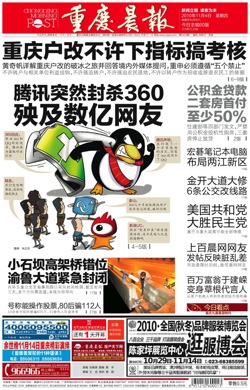
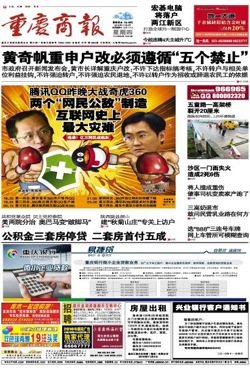
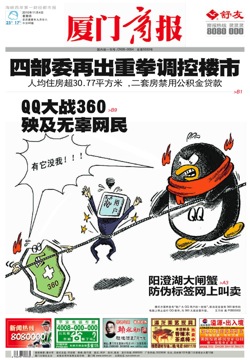
Chinese malware remover provider 360 had been in feud with other Internet juggernauts including Tencent, Baidu and Kingsoft. Their war was escalated when 360 singled out Tencent and accused it of secretly spying on competitors through its QQ, the most popular instant messenger application among Mainland internet users.

Last night, the war escalated as Tencent declared that its users - all 600 million - cannot use 360 if they want to use the messaging service, QQ. A selection of media has reported on this on their front page, showing the two giants sacrificing their users for largely what is a corporate fight. Tencent’s PR said that the move “could not be helped” and there was a lengthy press conference covering their decision.

Circulating on Sina microblogs today was a picture of PR rep Liu Chang (刘畅) who shed tears during a press conference as she said that the decision took all night and that Tencent workers hadn’t slept at all.

Links and Sources
Posted in Front Page of the Day | Tagged , , , | Comments Off on Tencent threatens its users with an ultimatum

Coked up bankers of Hong Kong

-1.png

Tessa Thorniley reports from Hong Kong for Danwei on the city’s drugged up financial industry.

On a Friday night in Lan Kwai Fong, a 29-year-old stockbroker knocks back a shot of sake and tries to work out how many people in his bank take drugs.

It is a question that has been rippling through the Hong Kong banking community since the death, in June, of Neil McCormick, the 36-year-old head of Asian equity derivatives at UBS on the island.

McCormick had returned to the UK for a wedding when, after snorting cocaine at a friend’s home in Holland Park, London, he plunged from the balcony to his death.

While none of his friends suggested that Hong Kong had turned him into a drug user, other bankers who spoke to Danwei on condition of anonymity suggested that cocaine use on the island is ubiquitous.

“What happened to Neil is obviously terribly sad, but it is not that surprising,” says one. “The financial community here is buried in white powder.”

“On the evening of the last day of the 2009 financial year, I know of a team of accountants responsible for calculating traders’ profits at a US investment bank in Hong Kong who snorted cocaine at their desks through the night until 9am in order to continue working,” she adds.

After another shot of sake, the young stockbroker, born in Hong Kong but educated in the UK, has his answer. “I would say around 65 per cent of the people who work with me have a recreational drug habit,” he says.

Continue reading →

Posted in Crime, Financial crisis | Tagged , , , , , , , , | Comments Off on Coked up bankers of Hong Kong

Bubonic plague in China

Recent research points to China as the origin of Europe’s medieval bubonic plagues. Malcolm Moore and Gao Hang reviewed the research and spoke to Dr Yu Dongzheng, director of animal to human infectious diseases at the National Centre for Disease Control about the plague in China.

nuremberg-chronicles-danceofdeath.jpg

On Sunday, a team of scientists published a paper suggesting that the plagues that ravaged Europe, Africa and the United States in the 6th, 14th and 19th centuries originated in China.

Writing in the Nature Genetics journal, the team (which included Chinese scientists) assembled a “family tree” of Yersinia Pestis, the bacterium which has now been shown to be responsible for bubonic and pneumonic plague, which is usually carried by rats.

The scientists compared the genetic structure of 282 strains of the bacterium, isolated from locations around the world, including China, the US, India, and the former Soviet Union. They looked at how the different strains had mutated over time, and then mapped those timelines against the historical records of plague outbreaks.

The plague of Justinian (named after the Byzantine emperor ruling at the time) broke out in Constantinople in the 6th century after apparently arriving on grain boats from Egypt. The Black Death, which broke out in 1346, may have killed a third of Europe’s population. A third pandemic, which broke out in Yunnan in 1855, killed more than 12 million people in India and China alone.

All three pandemics had a common ancestor, a strain of Y. Pestis that evolved in China between 2,603 years and 28,646 years ago (it’s difficult to be exact on the timing, and the scientists said they had given themselves a cautious range of dates).

“What we know is that the bacterium evolved in China, and has been in China all this time, and seems most likely to have come out from China,” said Mark Achtman, the professor at University College Cork who led the team.

The team also speculates that Zheng He, the 14th century Chinese admiral, may have taken the plague to East Africa in the rats that lived aboard his treasure ships. The scientists mapped the stopping points on Zheng’s voyages and compared them to known plague outbreaks in those areas.

Continue reading →

Posted in Health care and pharmaceuticals | Tagged , , , , | Comments Off on Bubonic plague in China

Focus on Qamdo

JDM101103xzshb.jpg

Tibet Business Daily, November 3, 2010

Today’s Tibet Business Daily declares that due to heavy snowfall, the Namtso Lake scenic area is closed. Meanwhile in Lhasa, a test run of a newly refurbished canal ended up flooding city streets because autumn leaves had not been cleared from the waterway.

Inside, the newspaper continues a feature it has been running since October 11 on the 60th anniversary of the Liberation of Qamdo. The battle, fought in 1950 over a Tibetan border town, set the stage for the Seventeen Point Agreement the following year.

Though the Tibet Business Daily does not refer to the campaign as the “peaceful liberation” of Qamdo (as Xinhua’s English-language reporting does), it notes in the title of today’s installment that “The Battle of Qamdo Opened the Door to the Peaceful Liberation of Tibet.”

Links and Sources
Posted in Front Page of the Day | Tagged , , | Comments Off on Focus on Qamdo

Cute little Japanese devils

A compilation of cartoon images of “Riben Guizi” (Japanese devil), a Chinese insult that Japanese computer nerds are trying to turn “into a beautiful young girl”, to “let Chinese people full of hostility become fans of anime beautiful young girl”. For more, see ChinaHush.

Posted in Featured Video | Tagged , , , | Comments Off on Cute little Japanese devils