Shenzhen bans “skew weeing”

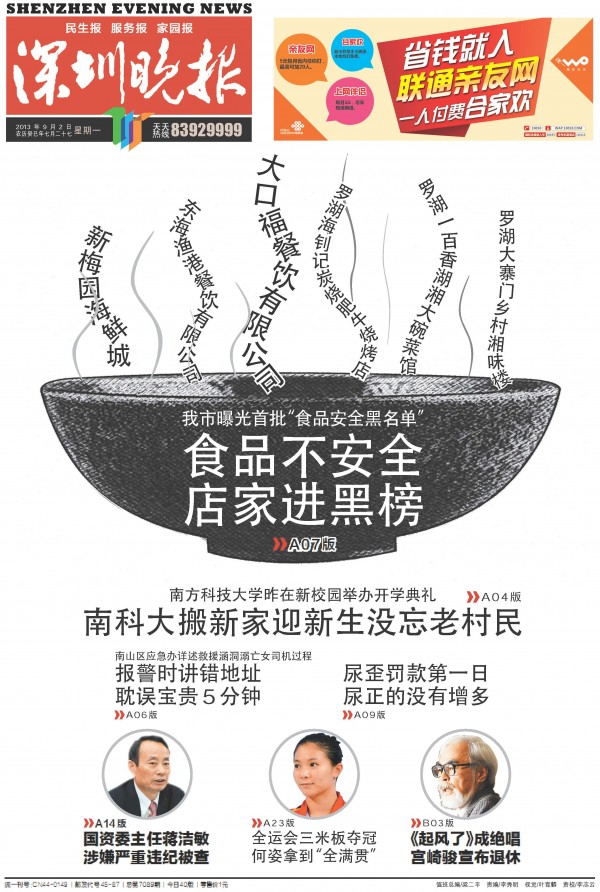
Shenzen Wanbao 2SepErrant weeing will no longer be tolerated in Shenzhen. From yesterday, new regulations made any instance of uncivilized behavior in public bathrooms in the city liable to a 100 yuan fine. As Shenzhen Evening Newsreports today, however, enforcing straight weeing is much easier said than done.

Yesterday 1 September was the first day in which new regulations on the use of public toilets came into effect in the city of Shenzhen in Guangdong province. The new rules are targeted at errant weeing (i.e. urine that ends up around instead of inside the urinal), spitting, smoking, littering, graffiti and other instances of uncivilized behavior in bathrooms, which will be liable to a fine of 100 yuan. The errant weeing violation described above have been jokingly referred to online as the “Skew Weeing Penalty” 尿歪罚款.

So in light of the new regulations, a journalist from Shenzhen Evening News yesterday went to a public bathroom in Shenzhen to see how the new rules are being enforced. As the journalist reports today, not only did the great number of “uncivilized actions” fall far short of his expectations, there was no-one in sight to hand out 100 yuan fines to the offenders. Worse, following questions from the journalist, no-one visiting the bathrooms even knew there were new rules in place. One of the cleaners laughed when she spoke to the journalist, pointing out that enforcing rules within public bathrooms is rather problematic.

Rather surprisingly, the journalist writes that “Skew Weeing” is not a problem in the female toilet. OK. Instead, littering is the biggest problem in the female toilet, as some women tend to throw discarded toilet paper on the floor. The journalist noticed this very thing in the public toilet in Shenzhen, where a pile of toilet paper would pile up on the floor every three minutes, even though the rubbish bin is only five steps away.

The situation is of course much worse in the men’s toilet, where all the uncivilized actions mentioned above can be observed. Many men don’t wash their hands after using the toilet, and throw rubbish and cigarette butts into the urinals. Skew weeing is very common, especially among men aged 40 and above (perhaps they might be a marketing target for the new “pee straight funnels” that the Nanfang reported on today?).

Following his investigations, however, the journalist reports that those mostly responsible for the uncivilized behavior are not locals from Shenzhen, but outsiders who “are not used to using toilets that can flush”.

Links and sources
Shenzhen Evening News (深圳晚报): 多数市民不知尿歪要罚百元
The Nanfang: NEW SHENZHEN “PEE STRAIGHT” FUNNELS AIM TO HELP YOU AVOID COSTLY FINE
Posted in Consumer Culture, Front Page of the Day, Health and Medicine, Urban Culture and Cities | Tagged | Comments Off on Shenzhen bans “skew weeing”

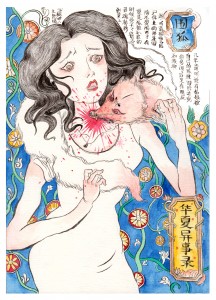
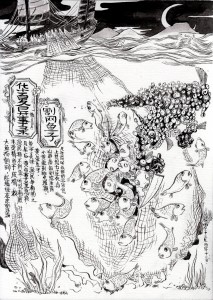
Satan Lucky’s Floating World

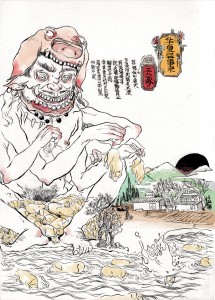
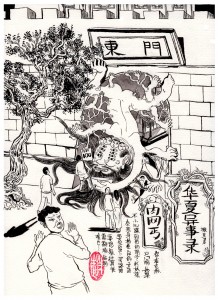
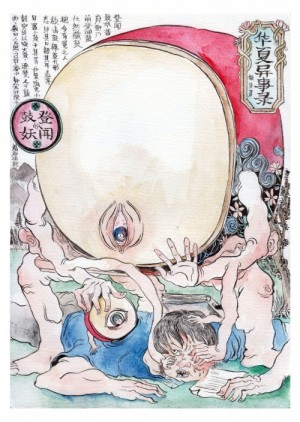
Drum GoblinSatan Lucky is the pen name of cartoonist and illustrator based in Beijing. He publishes some of his work on Weibo. His style is based on Ukiyo-e — literally “pictures of the floating world”, the traditional Japanese style of woodblock prints and paintings of nature, history, scenes from the theater and of geishas and other urban decadences.
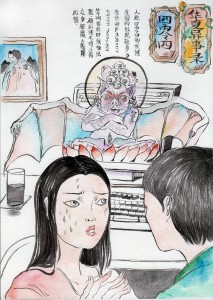
Some of Satan Lucky’s cartoons depict fantastic beats that seem to have no connection with contemporary reality, while others can be read as critical commentary In the gallery below, for example, 404 (the error number most Web browsers indicate when trying to access a blocked site in China) is depicted as a beast that sits on the computer, blocking access to Youtube and Facebook, while Flesh Net Beggar refers to the way in which resourceful people can avoid paying fines to the Flesh Net Beggar and “jump over” the Great Firewall.  

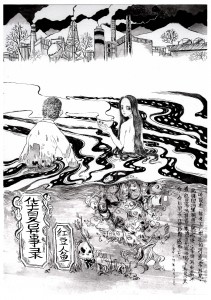
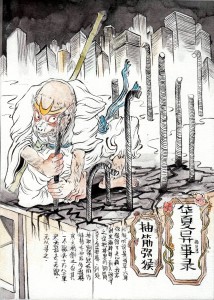
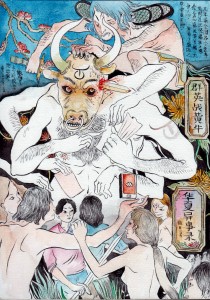
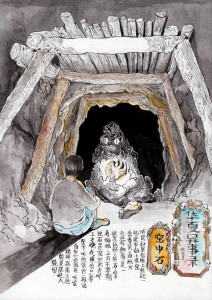
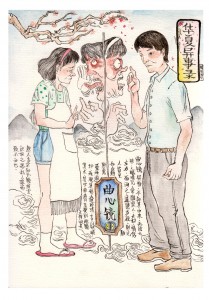
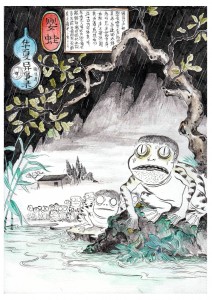
In Red Bean Mermaid, a mermaid tempts men into the red-dyed river outside a chemical factory into the water, and Throwing Pigs is a reference to the 6,000 plus dead pigs that floated down Shanghai’s Huangpu river in March this year. The Crooked Heart Mirror ”cannot be seen with human eyes but accompanies people wherever they go,” according to Satan, is an allusion to the different values on either side of China’s generation gap (代沟) and the problems that this phenomenon has created. Meanwhile, the Baby-Frog, with its terrible wail, is a comment on the forced abortions and infanticide that have tarnished China’s one-child policy. The Ti Ru Cow (or substitute milk cow) produces poisonous milk. Masses Fight the Ox alludes to the public frustration with huangniu (literally “ox”, but actually refers to ticket scalpers) who monopolise the supply of tickets for everything from train journeys to football matches.Tendon-pulling macaque refers to the problem of shoddy building standards hidden behind the gleaming façades of some of China’s new constructions. Stories in the Kiln features the ghosts of miners who died in a mining disaster, who require nothing more than an audience to be reincarnated.

Danwei asked Satan Lucky a few questions about his life and work and we present the answers together with some of his works, published here with his permission. A further selection of his work can be viewed here.


When did you start drawing cartoons, and when did you incorporate social and political themes into your work? Have there been any particular turning points in your career?
I first studied drawing when I was a teenager, but it was not until I was in university that I actually started doing anything creative. Even then, it was still not until I had gotten a job that I began to draw cartoons involving social and political themes. As for any turning points, it’s not quite like that. When you think for yourself, you want to express something with a link to the time that you are living in.

Why have you chosen to paint in a Japanese style?
I’m a member of the post-80s generation, so I grew up watching Japanese cartoons. Ukiyo-e has had a real effect on me. Naturally, this has had a considerable impact on my work. Still, I’ve also been inspired by Chinese styles, such as Jiezieyuan (芥子园). My work is not just affected by Japanese drawing. (editor’s note: Gaiziyuan, translated as “Manual of the Mustard Seed Garden,” is the famous early Qing painting manual which served as a guide to many late Imperial and early Republican painters, among them Qi Baishi.)

Why did you choose the name ‘Satan’?
I didn’t put a whole lot of thought into it. I was bit of a fool when I was younger, and I thought it was a very cool name. But now I can’t be bothered to change it because people I know from art circles recognize me by it. Anyway, in the end it’s just a nickname.

You have said that “cartoons and writing are both forms of expression”. What do you think are the similarities and differences between them?
From my perspective, they are of equal standing as tools for expression. But for the public, they are not quite on par with each other.

Why does so much of your work focus on ghosts and goblins? Is it because you want to use them as analogies for what you really want to describe?
I can’t say for certain. Ghosts are evocative of strange goings-on. Indeed, this is why people from ancient times created the concept of ghosts in the first place. But I don’t draw in order to explain things of the ordinary and unknown. I just draw these cartoons to keep carrying on with my passion.

There are so many political cartoonists who are active on Weibo, how do you feel about this situation?
It’s great that there are so many cartoonists. They use their own pen to express their ideas – what’s bad about that? Drawing political cartoons is first and foremost a mode of employment. I don’t have a particularly strong opinion about that. Each one of them is brightening up social media.

Is cartoon-drawing your principal source of income?
I make most of my money through my cartoons, but I don’t have a contract – I work as a freelancer.

Posted in Crime and Corruption, Health and Medicine, Internet and Media, Music, Books and Art, School and Education, Sex, Drugs and Vice, Traditions, Urban Culture and Cities, Wildlife, Nature and the Environment | Tagged , | Comments Off on Satan Lucky’s Floating World

Bo Xilai outshone by “people’s judge” Zhai Shuquan

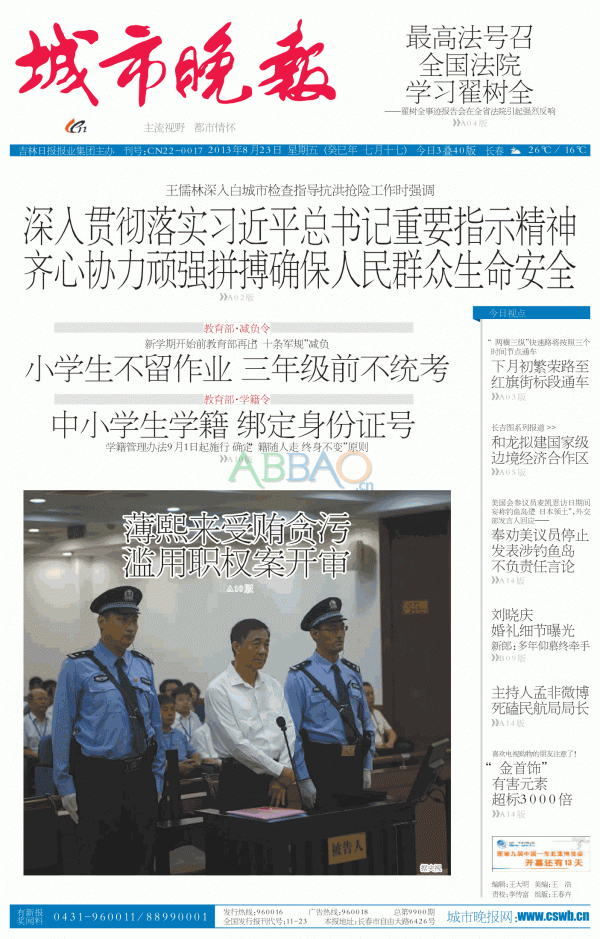
City Evening News Augus 23rd 2013Yesterday, August 22nd, Bo Xilai’s trial got underway in Jinan, Shandong Province. Accused of accepting bribes, corruption, and abuse of office, Bo gave a spirited defence of himself while frequent posts on the court’s official Weibo feed sparked animated discussions of the case in the international press corps. The same vivacity has not appeared in today’s domestic coverage of the case. Nonetheless, a speech made by Zhou Qiang, Chief Justice of the Supreme People’s Court, has also made headlines today. Zhou announced that Zhai Shuquan, who hails from rural Nong’an County in Jilin province, should be held up as a “model” and a “people’s judge” for his incorruptible comportment and his toughness on corruption regardless of who is in the dock.
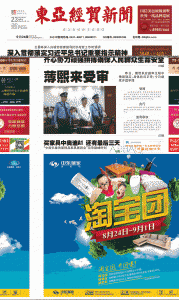
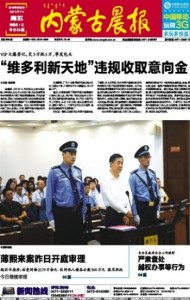
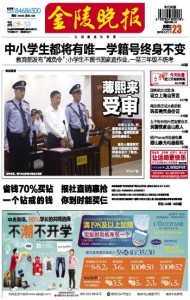
Danwei reported back at the end of July that many papers were forced to fill their reporting on Bo’s indictment with a People’s Daily (人民日报) editorial and copy from Xinhua (新华社). This time, it appears that editors at China’s newspapers have been given a fractionally longer leash in their reporting. The Nanjing-based Jinling Evening News (金陵晚报) lists the accusations laid out by the public prosecutor against Bo: taking bribes from Xu Ming, embezzling public funds, and obstructing police investigations. Coverage in this paper also reported that Bo denied the charges, and appeared to be in good physical and mental condition. The report also commented that there was an orderly atmosphere inside the courtroom. There was hardly a mention of the two issues that the Western media coverage of the trial has concentrated on so far: the court’s decision to publish updates via Weibo, and the three-fingered gesture that Bo was apparently making (this was captured on all four front pages that Danwei looked at but was not mentioned in any of the articles). There was also no mention of the small-scale protests launched by Bo Xilai’s supporters in Jinan.

Reporting in the Inner Mongolia Morning Post (内蒙晨报) is almost exactly the same as coverage in the Jinling Evening News, indicating that despite not acknowledging the source of the report, Xinhua may actually have dictated reporting. For the Jilin-based City Evening News (城市晚报), this is the case as their rreporting was limited to Xinhua copy. The East Asia Economic News (东亚精满新闻), also based in Jilin, laid out the charges against Bo on its front page along with a note to turn to page 5 for further reporting. However, upon turning to page 5, we discovered that the Bo story had been replaced by one titled, “Pregnant mothers’ endorsement of breast feeding is our greatest encouragement.”

While the headline coverage of the Bo Xilai trial has been predictably underwhelming,  several papers reported that yesterday, on the same day that Bo’s trial got underway, the Supreme People’s Court in Beijing called for judges throughout China to study the example of one Zhai Shuquan. Zhai is a deputy judge at the Nong’an County People’s Court outside of Changchun.

According to the East Asia Economic News, 200 judges gathered yesterday at the Jilin Provincial Higher Court to watch remarks made by Supreme Court Chief Justice Zhou Qiang. Zhou said that Zhai Shuquan embodied the Communist Party’s people-orientated, pragmatic and upstanding style. Zhou added that Zhai is a model for judges and policemen throughout China. Following the screening, many of the justices made statements praising Zhai.  Zhang Deyou of the Changchun Intermediary People’s Court told the City Evening News, “I will study Zhai Shuquan’s indifference to material gains as well as his noble and incorruptible character. I value to the highest of highs the honor and dignity of this people’s judge.” Similarly, Chief Justice Wang Changsong of the Jilin Province Upper People’s Court told the East Asia Economic News, “All judges and policemen throughout this province will seek to emulate Zhai Shuqian in striving to be fair and incorruptible men of the law.”

What the reports on “Study from Zhai Shuquan” fail to mention is exactly why this unassuming judge from rural Jilin is being held up as an example to emulate for judges and justices from across China. There is an oblique reference in the East Asia Economic News coverage: several times, the incorruptible Zhai is described as “down to earth” (朴实) even after coming to the bright lights of Beijing, a stark contrast with Bo Xilai and his characterization as a man who lived the high life thanks to his corrupt activities. While there is no mention of Zhai Shuquan in the international media, an English-language wire story in the Chinese state media sheds further light as to the reasons behind Zhai’s “modelization” The report says. “Zhai has helped to defuse many conflicts and helped maintain social stability in Nong’an County in northeast China, gaining popularity from the public.” On a day when the divisive Bo Xilai appeared in the dock, it is unlikely that the story of Zhai Shuquan is a mere coincidence.

Sources and Links
Jinling Evening News (金陵晚报): 薄熙来否认受贿指控
Inner Mongolia Morning Post (内蒙晨报) 薄熙来案昨日开庭审理
East Asia Economic News (东亚经贸新闻) 全国法官要向翟树全学习; 孕妈妈对母乳喂养的认同是对我们最大的鼓励
City Evening News (城市晚报): 最高法号召全国法院学习翟树全
People’s Daily Online English Edition (人民网英文版): Chief Justice calls for integrity among judicial officials

Posted in Crime and Corruption, Front Page of the Day | Tagged , | Comments Off on Bo Xilai outshone by “people’s judge” Zhai Shuquan

China’s two greatest Internet rumor mongers and “black PR” philanderers arrested

Page_bAlthough the entire foreign press corps and many Chinese Internet users are focused on the trial of Bo Xilai right now, many newspapers and websites are devoting space to a news story and propaganda campaign about online “rumor mongering”. Two suspected rumor mongers have been arrested.

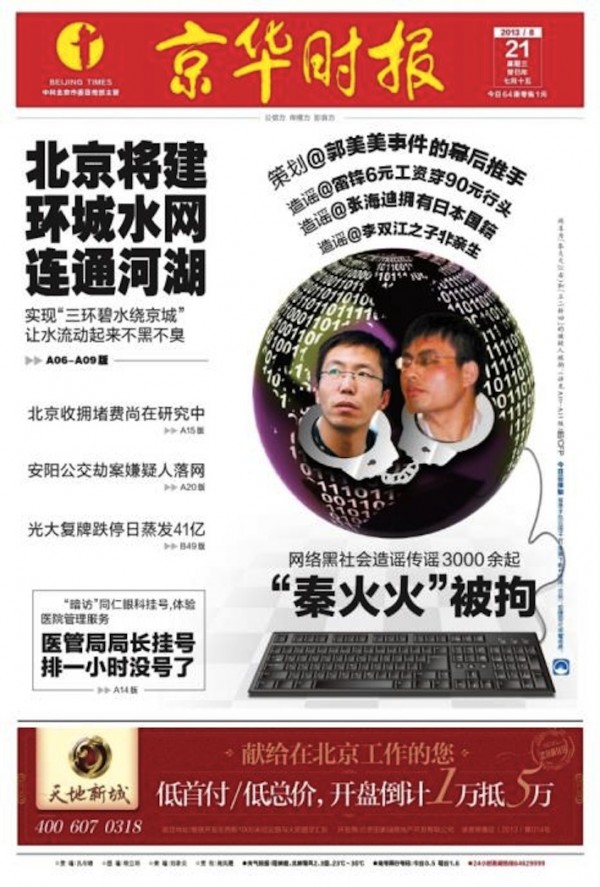
The front page of yesterday’s Beijing Times 京华时报 carries a headline screaming “Qin Huohuo detained”, leading on to a page ten story entitled “Qin Huohuo’s online black society rumor mongering brought under control”. Qin Huohuo 秦火火 (real name Qin Zhihui 秦志晖) and Lierchaisi 立二拆四 (real name Yang Xiuyu 杨秀宇) are influential web figures detained on Tuesday by Beijing police on criminal charges of “starting quarrels and provoking trouble” and “illegal operation of a business” as part of a “prologue” to a broader State Public Security Bureau crackdown on illegal online activity.

Qin and Yang have since March 2010 headed a lucrative “black PR” business called Beijing Erma Interactive Marketing and Planning Company 北京尔玛互动营销策划有限公司 (no website for which could be found), one of the over 15,000 Chinese “water army” (shuijun 水军) companies paid by other companies to artificially generate grassroots online activity for their benefit. Erma’s client services include web marketing, creating online scandals or events, damaging the reputations of rivals or competitors, deleting negative comments from online forums, and generally creating and spreading rumors. All this is done in cooperation with online “opinion leaders” with large numbers of social media followers, who are be paid to re-post or forward particulars news or stories.

The most sensational claim in the article is that Erma was responsible for manufacturing the Guo Meimei scandal, which “was actually a plot that was planned by Internet marketers and internet water armies”.

The story of the infamous Guo Meimei will likely be familiar to you. On 20 June 2011, Guo Meimei 郭美美(real name Guo Meiling 郭美玲) posted photographs to Sina Weibo showing off her luxurious lifestyle, while claiming to work for Red Cross China, unleashing netizen contempt at the corrupt Chinese elite. On 21 June, Red Cross China declared that Guo Meimei had no connections with them, and Sina apologised for an error in their authentication system that enabled her to claim association on her profile. But netizens continued to attack the Red Cross and started suggesting Guo Meimei was the mistress of the President of Red Cross China, Guo Changjiang 郭长江, who showered her with lavish gifts bought with Red Cross donations. This scandal singlehandedly devastated the reputation of the Red Cross in China and caused charitable giving in China to plummet. The article states that the rumors spread about the Red Cross and Guo Changjiang were false and part of a deliberate campaign run by Erma, backing up uncorroborated claims made in the China Daily in 2011.

Beijing authorities state that Qin and Yang confessed that this was done to demonstrate the capabilities and increase the reputation and profitability of Erma, as well amplify Qin and Yang’s own online profiles. The report reveals that Erma and particularly Qin are serial online rumourmongers and the source for a raft of scandalous but unfounded allegations that went viral in China, for instance: payment of 30 million Euros compensation to the family of the Italian national Assunta Liguori killed in the ‘7-23’ Wenzhou train crash; Chairperson of the China Disabled Persons’ Federation Zhang Haidi 张海迪 possessing Japanese nationality; and, famous PLA soprano Li Shuangjiang 李双江 not being the paternal father of his son.

The nature of the rumours Erma successfully made viral is testament to Qin’s explanation of industry strategy: you need to “rock” netizens and make them feel as if they are acting as judges of an “unjust society” – only by venting against society and the system can netizens unburden their own resentment of reality and destroy overnight public reputations built over a lifetime.

Most of these rumors are traceable back to their source, but water army companies operate openly on the Chinese Internet and seem to be tolerated if they keep out of political trouble. Indications are that Qin crossed the line in April this year when he published a much-forwarded post attacking Chinese Communist Party propaganda role model Lei Feng 雷锋 as being corrupt and profligate, with contentious if hilarious phrases as: “In 1959, Lei Feng would have needed 90 yuan to afford his high-grade leather jacket, woolen pants, and black leather boots, but his monthly pay was only 6 yuan!” Qin was apparently reported by netizens to the Beijing Public Security Bureau for “making rumors slanderous to the image of Lei Feng”.

The latter half of the article is devoted to revealing how Qin and Yang would use “erotic tricks” to generate online hype for women wishing to become famous. Erma were the masterminds behind the shower video that propelled racy model Gan Lulu 干露露 to explosive popularity and a burgeoning career, as well as the viral social media campaign that shot the famously desperate and deluded “Sister Phoenix” Luo Yufeng 罗玉凤 to fame. Yang was previously the self-proclaimed “sugar daddy” (gandie 干爹) of famous model Yang Zilu 杨紫璐, and claimed to be behind the 2012 “sugar daddy gate” incident, when Yang Zilu incited popular anger and had her Weibo account shut down after claiming that her “sugar daddy” was spending 8.88 million yuan to fly her to the London Olympics on a private jet. Yang Xiuyu is also accused by dancer and model Wang Yuenan 王月楠 of cheating her out of sexual favors and 5000 yuan in return for promised publicity.

While the article deploys extremely severe language to censure Qin and Yang and is very much on the side of the authorities, if what the report claims is true then it reveals the enormous extent to which consumer perceptions can be distorted by deliberate manipulation of grassroots discourse on the Chinese Internet. Interestingly, most of the juicy details mentioned above were omitted from the English language reportingon this incident in the Global Times 环球时报.

Sources
Beijing Times (京华时报): “秦火火”网络黑社会造谣被端
China Daily (中国日报): Rich 20-year-old’s antics damage Red Cross name
Global Times (环球时报): Two arrested in web rumor crackdown

Posted in Front Page of the Day, Internet and Media | Tagged | Comments Off on China’s two greatest Internet rumor mongers and “black PR” philanderers arrested

Xue Manzi: How Chinese social media can be a force for good

nanguodushibaop1

Update August 25:

Soon after this was published, Xue Manzi ran into trouble with the police. See this Shanghaiist story: Chinese-American investor Charles Xue arrested in Beijing in ‘prostitution’ sting.

It seems that other social media figures are also being targeted by police. On August 25, Daily Telegraph correspondent Malcom Moore tweeted the following:

Zhou Lubao, the whistleblower who exposed the luxury watch of the mayor of Lanzhou, has also been arrested. Night of the long knives?

Link to original tweet

Original story:

Contrary to what some media outlets may have you believe, it’s not all economic doom, societal gloom, and underhand politics in China. The front page yesterday of the Hainan-based Southern Metropolis Dailyfeatured a headline for a page three story entitled “13-year-old girl collecting bottles to help her grandmother moves whole country’s netizens”.

The girl in question is Wu Xiaodie, from Jiuzhou village within the Haikou metropolis of Hainan province. Her family is very poor, her mother left when she was a baby, her father works as a laborer outside the city, and her paternal grandparents raised her. But Xiaodie’s grandmother needs medical treatment to remove a chest tumour and her father’s meager wages are not enough to afford it. So to try and save enough money, Xiaodie collected discarded bottles to exchange for small change at recycling depots. Her story was first reported on 15 August by the Hainan-focused HiNews website, complete with photos of her sifting through piles of trash searching for bottles.

On the morning of 17 August, the Southern Metropolis Daily, HiNews, and CCTV News all published calls on their official Weibo accounts to assist Xiaodie by donating through a special telephone hotline, with the appeal being reposted over 10,000 times, including by large media outlets such as the People’s Daily and Yangcheng Evening News.

However, the big break for Xiaodie came at 7 pm on 17 August, when famous angel investor and 2013 Danwei Model Weibo Worker Xue Manzi posted a public service project to raise donations for Xiaodie’s cause on the Sina Weibo Micro-Charity webpage under the title “13 year old girl collects bottles to help her grandmother cure her illness”. The fundraising goal was set at 100,000 yuan. By the evening n 18 August, donations had reached a total of 37,928 yuan. One day later the figure stood at over 80,000 yuan and briskly rising, with almost one thousand people having made donations.

Xue posted on Weibo that he had personally donated 10,000 yuan, commenting that high-key fundraising efforts are necessary “because only if it is high-key will you attract the attention of the whole society”. Health services company iKang have already agreed to subsidize the transportation of Xiaochen’s grandmother to the Guangzhou Sanjia Hospital for examination and treatment, and the project will be implemented and supervised by the China Siyuan Foundation for Poverty Alleviation.

In a country noted for its lack of charitable giving and still reeling from the Guo Meimei embezzlement scandal, Xue is leading the charge to buck this trend. He is one of the most prominent users of the Micro-Charity site, being listed as the fourth most generous giver on its ranking table. Micro-Charity was launched by Sina Weibo in 2011 and is basically a platform for crowdsourcing donations to charitable projects, which can be proposed by any of Weibo’s million or so ‘verified’ personal or organisational accounts. It shot to prominence when Xue coordinated a massive campaign, which raised 1,000,000 yuan in just three days to pay for the stem cell therapy needed by a popular micro-blogger with leukaemia, Lu Ruoqing.

The rapid success of the Xiaodie Micro-Charity project is particularly powerful testament to the influence wielded by Weibo celebrities such as Xue on the Micro-Charity website, probably as a result of the trust they generate for a cause in which they act as guarantor and are thus accountable for. A similar Micro-Charity appeal launched by Xue in June to raise money for a 12-year old girl collecting bottles to pay for her mother’s medical costs also easily surpassed its 100,000 yuan objective. Whereas two separate fundraising projects in April and June for the same family forced to collect bottles to pay the medical expenses of their three-year-old child with leukaemia, but launched by a far more minor Weibo personality, failed to get much more than a quarter of the way to their far more modest targets.

Having amassed a considerable fortune through property investment and co-founding telecommunications giant Unitech Telecom, Xue first made a name for himself on Weibo by spearheading an online campaign drawing attention to the issue of child trafficking in China. He subsequently garnered a reputation as an angel investor by inviting netizens to pitch projects and opportunities to him over Weibo, of which he invests in as many as fifty per month. Lately he has been increasingly prolific in his social media philanthropy and vocal in his advocacy for charitable giving by the broader Chinese population.

Links and Sources:
Southern Metropolis Daily (南国都市报): 海口旧州13岁女孩吴小蝶捡瓶子救奶奶引全国关注
HiNews (南海网): 海口:奶奶胸口长瘤 13岁孙女捡瓶子帮其治病
China Current: China’s philanthropy in the age of Weibo
China Daily: Sina Weibo launches new charity platform
China Daily Europe: A micro-blog tale of survival
China Digital Times: Name of the week: Guo Meimei
Wall Street Journal: In China, philanthropy gains cachet

Posted in Front Page of the Day, Internet and Media | Tagged , | Comments Off on Xue Manzi: How Chinese social media can be a force for good

Danwei Model Workers 2013

Danwei Model Workers Badge 2013 FINAL

Almost eight years ago in December 2005, Danwei published the first Model Worker Awards, with the following note:

Blogs went mainstream this year. Proof, if needed, is that The Economist now uses the noun and verb ‘blog’ without explanation.

So it seems fitting to look back on the year in China blogs, with a small virtual award ceremony. Hence the first, and perhaps only, Danwei Model Worker awards, for the best China-related blogs of 2005… No democracy was used in the production of this list.

The winning Model Worker of 2005 was Roland Soong’s ESWN blog, which set the standard for finding, translating and archiving key documents from the Chinese Internet from 2003 until 2012, when Soong ceased updating frequently. Back then, most of the websites on our list were personal blogs. Now, many of the best websites about China are produced by a group of people who have funding or institutional support, and Danwei itself is a for profit research business. But our aim with the Model Workers Awards of 2013 remains to support and encourage English language niche publishing, self-publishing and plain old blogging about China. We believe that the more voices, opinions and diversity of reporting about China, the better.

But there are now so many websites about China that this year, we decided to be more selective than in the last. We have not included websites that have not updated since July 2013, and we have aimed to keep the list short and punchy rather than comprehensive. For the first time the Model Workers list now also includes proper sections for podcasts as well as for Weibo.

The main part of the Model Workers does not include our own websites, those of our parent company the Financial Times, or the China sections of large media companies except where the site is presented as a blog, or as representing the personal views of contributors. But we have included a list of links to good China pages in large media organizations, and another list of links to English language urban life guides about Chinese cities.

Links to all previous editions of the Danwei Model Worker awards are available at the bottom of this page. This year’s Model Workers were decided by Danwei full time comrades Jeremy Goldkorn, Joel Martinsen, Eric Mu, Barry Van Wyk, and our summer intern comrades Alex Ye, Hans Gaebler, Johan van de Ven and Neil Thomas. Continue reading →

Posted in Internet and Media | Tagged , | Comments Off on Danwei Model Workers 2013

Chengguan go easy on man who constructed Beijing’s “most awesome illegal building”

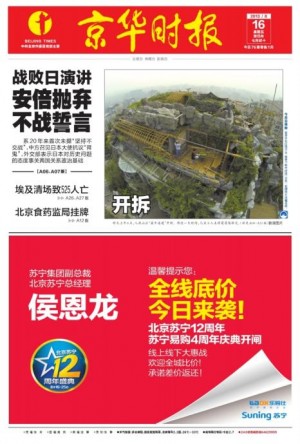
Beijing Times front page aug 16The news has been dominated in recent days with stories relating to the somehow sudden discovery of a three-story villa covered in shrubbery sitting atop a 26-story building in western Beijing. Now, as construction (or rather, deconstruction) workers set about removing grapevines from atop the villa, the Beijing Times reports that the chengguan, China’s notoriously thuggish “urban management officers”, have adopted a softer approach to the man behind Beijing’s “most awesome illegal building”. Danwei readers will remember the chengguan for their recent killing of a melon vendor in Hunan. This time, according to the Beijing Times’ feature report, “the chengguan will not issue a fine as the villa owner has already commenced demolition.”
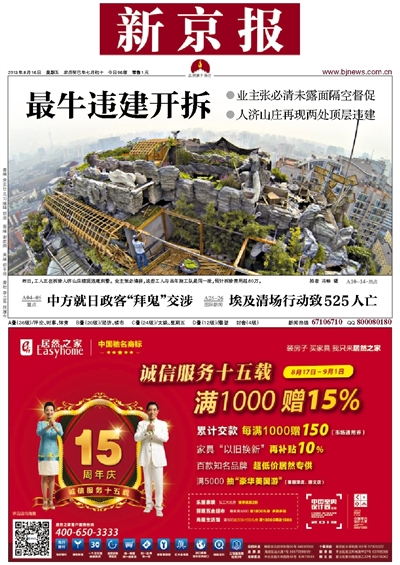
Rather than dealing with rooftop villa owner Zhang Biqing in the same manner that their counterparts in Hunan addressed the problems caused by the melon seller Deng Jiazheng, the Haidian district chengguan first phoned Zhang to tell him that his illegal building posed a serious threat to public security and also represented a dangerous fire hazard. They concluded their phone call by telling him that he must thoroughly and hastily demolish the “rooftop villa”, allowing him a 15-day window to complete this task. Zhang agreed to begin demolition, perhaps aware that he had done quite well in avoiding any chengguan visits in the five or six years since he first began piecing together his villa. A spokesperson for the chengguan said that Zhang Biqing would not face a fine or forcible demolition even if workers take more than 15 days to complete the task given that the process had already gotten underway. While it is not unheard of for people to return home from work to find the dreaded “拆” daubed upon their place of residence, the chengguan’s lenience in dealing with this extravagant violation of planning laws speaks to the privileges enjoyed by wealthy urbanites in China.

Beijing Times aug 16 front pageBut while the Haidian chengguan have finally got round to dealing with the “rooftop villa” after several years of frequent complaints from Zhang’s neighbours, an investigation by reporters from theBeijing News has revealed two other haphazard rooftop constructions in the ironically-named Renji Mountain Village neighbourhood where Zhang Biqing’s monstrosity is located. Walking along a corridor on the 26th floor of Building 1, the “27thfloor” appears in all its magnificence, “strewn with all kinds of decorations,” according to reporters. They were not able to make it up to the even more precarious 28th floor because it was undergoing refurbishment. Over on Building 2, journalists were blocked from entering the apartment leading to the 27th and 28th floors, which were constructed in 2006 on what was once a public balcony. According to reports, the owner even built a rock-climbing wall atop the extension, causing local residents to worry that the building may finally have become top-heavy. When asked by reporters for a comment, the Haidian chengguan spokesperson said only that investigations are being carried out.
While the chengguan have been reluctant to deal with the illegal construction in this western Beijing neighbourhood, Renji Mountain Village has become a meeting point for residents from across Beijing who have had to put up with illegal construction work across the hallway. Ms. Liu, who came from Pingyuanli in Beijing’s Xicheng district, said of Zhang Biqing’s illegal building, “It really is a marvellous villa, atmospheric and luxurious. The illegal building in my neighbourhood pales in comparison.” Letting out a sigh, Liu said that the construction of an illegal extension in her building meant that water often leaked into her apartment so much that it looked similar to the famous Water Curtain Cave. She said, “We’ve gone to property management and the chengguan about this, but nothing has ever been done about it.”

Sources and Links
Beijing Times (京华时报) 城管称因业主开始自拆不罚款
Beijing News (新京报) “最牛违建”小区又现两违建

Posted in Crime and Corruption, Front Page of the Day, Urban Culture and Cities | Tagged , | Comments Off on Chengguan go easy on man who constructed Beijing’s “most awesome illegal building”

“Cash and gifts” will get your child into the right class

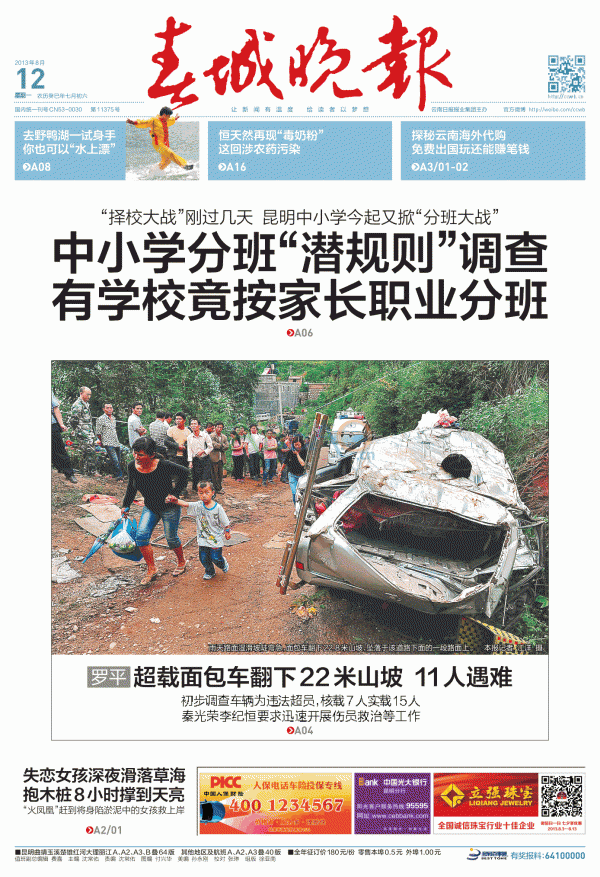
ChunChengWanbaoP1

Last year the New York Times published an exposé on the culture of corruption in the Chinese schools admissions system, with rich parents able to buy their children into the best schools. But less well documented is that parents with children in primary and middle schools can actually pay to have their children placed in the better classes of the year-group. Despite official bans to the contrary, many schools disproportionately favor particular classes within a student year-group, lavishing it with better teachers and resources in order to boost test scores in an attempt to make the school more attractive to parents (and boosting bribes payable for admission). In this process some students get a much better shot at getting into leading high schools and universities.

The front page of yesterday’s Yunnan-based Spring City Evening News 春城晚报 carries the headline “Investigating the ‘unwritten rules’ of primary and middle school class allocation: some schools even allocate classes based on parental occupation”. The page-six feature article laments that no sooner had the ‘school admissions war’ in Kunming finished, than the ‘class placement war’ has begun.

According to Provincial Education Office regulations, schools must evenly distribute teaching resources and use computers to randomly assign students into classes. Testing and competition results should not be used in class placement decisions.

While the majority of households with primary school-aged children that were surveyed by the newspaper believed that their children’s schools did not streamline students into ‘focus classes’ 重点班 and ‘ordinary classes’ 普通班, the reporters uncovered many cases of parents and schools not playing by the book.

Some spoke of a tacit understanding between parents and teachers of the ‘unwritten rule’ 潜规则 that cash or gifts could be used to ensure one’s child was placed in the best classes and thus had a better chance of achieving high test scores.

Other primary schools conduct face-to-face interviews with new students to determine their abilities at counting, writing, singing, dancing, and reciting poems. Students are graded and then sometimes allocated into streamlined classes accordingly.

It is reported that there are also many schools in Kunming that place students into classes based upon the educational background and occupations of their parents, concentrating the children of high-achieving parents into certain classes and the children of low-achieving parents into others. One school even interviews parents to filter students for admission based upon the cultural level and educational principles of the parents.

The situation is reflected in the views of a parent interviewed by the newspaper, identified as Mr Li, “Nowadays most families have only one child, who wouldn’t want to make sure their child is in the best class? …A good teacher has one crucial element, which is that you need to look at their teaching record, for example how many of their students are accepted into [the best middle schools in Kunming]. This one point is very important, otherwise what good is anything else?”

Links and Sources
Spring City Evening News (春城晚报): 有学校竟按父母学历职业分班
New York Times: A Chinese education, for a price
Danwei: Opening the door to American universities with lies

Posted in Front Page of the Day, School and Education | Tagged | Comments Off on “Cash and gifts” will get your child into the right class

The branded sex toy business – Zhang Xiaoyu

zxyad3

The BBC recently published a story titled Opening a sex shop in China, glossed as such:

In China, sex is not a frequent topic of conversation, but one 23-year-old graduate in China is hoping to change that.

Ma Jiajia is not like other young entrepreneurs in the country.

Her foray into the world of business has involved opening a sex shop – a venture that comes with its own risks and rewards.

In February 2004, nearly ten years ago, Danwei published a story titled Emily Meng owns a sex shop. This is the first line:

The G Spot is owned and managed by a twenty something Chinese woman named Emily Meng.

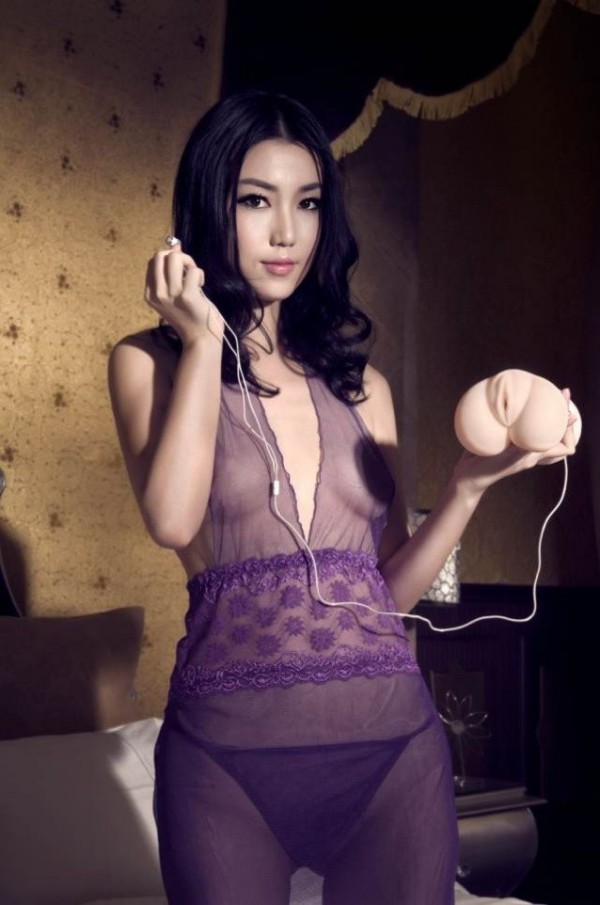
So a twenty-something woman opening a sex toy store in Beijing is not exactly new. On the other hand, this is probably a first for China: On May 15, Chinese nude model Zhang Xiaoyu 张筱雨 announced to her 450,000 Weibo followers the launch of her branded simulation sex toy, somewhat obliquely titled the ‘Zhang Xiaoyu reverse mould device’ (张筱雨倒模名器). The device is a small-scale model of Zhang’s back, buttocks and thighs with a prominent vibrating simulation vagina, coming in a pack complete with lubricant and nude photographs of Zhang.

The product page on the official Zhang Xiaoyu website claims the device is the “only one in the world’ to offer a “4D new orgasm experience” that literally “surpasses reality”. The device is capable of simulating vaginal muscle contractions, boasts of its lifelike texture, and comes with a prerecorded soundtrack of Zhang’s moans and cries of pleasure, which will “shout you to a pleasurable penetration”. It declares itself to be the “most realistic sex experience in the world” and allows you to “have sex with Zhang Xiaoyu to your heart’s content”.

The device has an original retail price of 783 Yuan, but can generally be bought through licensed distributors for 580 Yuan. It has average reviews of five out of five stars from almost 200 evidently satisfied customers on online adult retailer Xmeise.com. Zhang’s website is definitely NSFW, but it is professional and informative, giving the impression of a highly organised and well-crafted business.

Even though adult merchandise branded under the names of Japanese sex stars has been available in China for many years, Zhang makes the claim that this is the first time a sex toy has been endorsed by a Mainland Chinese celebrity. Zhang claims to be “China’s top nude model” in a country where pornography (as opposed to erotica) is illegal. Born in Heilongjiang in 1985, she is a 2007 biological sciences graduate of Beihua University. She began her career in erotica by modelling for the “art photography” 摄影艺术 website METCN.com in 2007. Her work there was so popular that by 2008 she was the most searched “beautiful girl” 美女 on Baidu, with her name attracting almost 800,000 hits per day.

Zhang’s website selling the new device boasts that she has “been the subject of fantasies by countless zhainan (宅男: men who stay at home all day on the Internet, usually without prospects or a female companion), making her the popular conception of a female goddess”. The main banner feature on her website shows her visiting an orphanage to teach calligraphy. Her website also prominently claims that the device is compliant with European Union production standards, and has a whole page dedicated to listing its authorised merchants, complete with a stern warning from Zhang’s lawyers insisting that any rights infringements will be prosecuted.

According to sources collated by a Danwei feature article on the 2012 Guangzhou Sexpo, the Chinese sex toy industry is worth over US$2billion, accounting for up to 80% of global sex toy manufacturing and supporting over 1,000 firms. There are an estimated 200,000 adult shops (成人用品店) around the country; the first one opened in Beijing’s Wangfujing shopping district in 1993.

Links and Sources
Zhang Xiaoyu Reverse Mould Device Official Website: 张筱雨倒模名器官方网, Weibo advertisement
BBC: Opening a Sex Shop in China
Danwei Media: Guys and Dolls – Scenes from the Guangzhou Sexpo, Emily Meng owns a sex shop, A Beijing sex shop makes a revolution, Sex shops and the Red Light Revolution
Baidu Encyclopedia (百度百科): Zhang Xiaoyu 张筱雨, Muzi Mei 木子美
Wikipedia: Zhang Xiaoyu, Muzi Mei
Global Times (环球时报): Sex made in China, Migrants hanker for happy ending
People’s Daily (人民日报): Nation becomes world’s biggest sex-toy producer
The Australian: China awakens to sexual revolution
Business Insider: The incredible story of China’s sexual revolution
CNN Opinion: China’s biggest problem? Too many men
Huffington Post: China’s body image shifts from cultural to sexual revolution

Posted in Sexuality | Tagged | Comments Off on The branded sex toy business – Zhang Xiaoyu

“Temperature warriors” take on China’s heat wave

Nanhu Evening Post August 9th Front Page

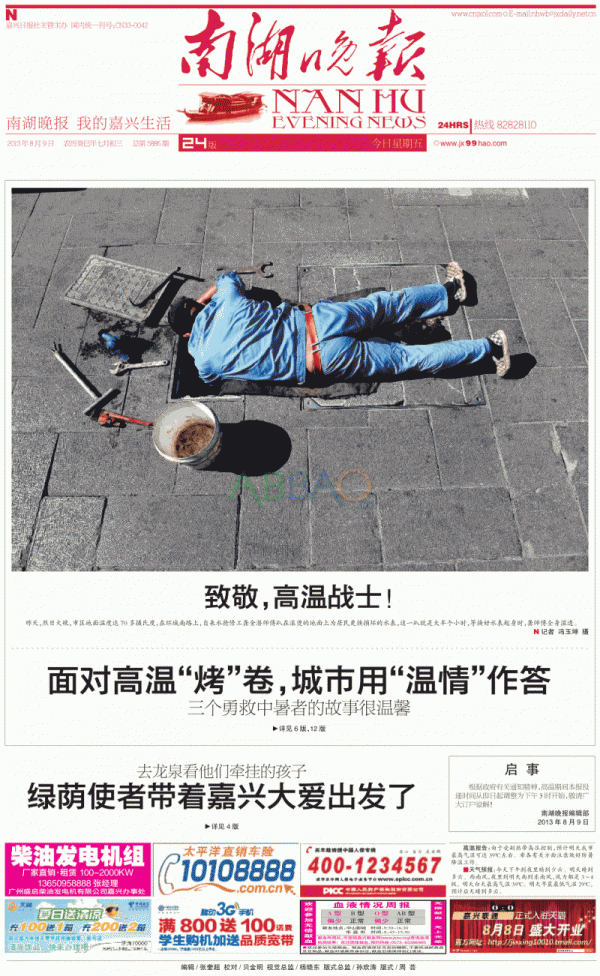
The front page of the Nanhu Evening News tells us today that “The news that everyone is paying attention to right now is the heat.” This has been the case for the past few weeks. As we covered on Danwei, newspapers in Shanghai recently wondered if the summer of 2013 might end up being even worse than the heatwave of 1934. Now, the Zhejiang, Jiaxing-based Nanhu Evening News has given a face to the fight against the heatwave facing China. The front page of this newspaper is dominated by a photograph of a man in a boiler suit with his arms dangling down a manhole. The headline below demands that people “Pay respect to the temperature warrior.”

This caption of this photograph reads, “Yesterday, beneath the searing midday sun, the ground temperature in central Jiaxing reached more than 70° centigrade. On the south ring road, a water service repairman named Gong Jinqian lay on the scorching ground, fixing a broken water meter for local residents. He spent more than half an our on the furnace-like ground until the meter was fixed, and when he got up, his entire body was drenched.”

Gong Jinqian may have been the most photogenic hero in Jiaxing yesterday, but he was not alone in his bravery. Chu Tianrong saw an old lady faint due to the heat and came to her rescue, taking her back home and arranging for a doctor to visit her there. After a 16-year-old girl fainted in the Lindai Library in the Pinghu district of Jiaxing, Ye Xiao went to her aid, calling the local police station and fanning the girl with her cap until officers arrived.

In Jiaxing, people responded to the heat not only with individual acts of heroism but also with kindness. A further story relating to the heat in the Nanhu Evening News begins, “The persisting heat is testing our people and it is testing the city, but it is also testing people’s care for one another, and our sense of civilization here in Jiaxing.” But in the face of an examination in Shanghai which saw people wilt and eggs fry, Jiaxing has, by the judgement of its own journalists, passed with flying colors. Volunteers have been going door to door to offer their services in heat mitigation, while a series of “Compassion Benches” have been set up to give people a rest, and especially prominent have been Environmental Protection Department workers who unflinchingly kept working under the boiling sun. One, Hu Dengyu, only sought shelter at the Jianguo Road Environmental Protection Workers Compassionate Rest Point after toiling in the heat for four hours without the slightest break.

Having spent ten years working for the Environmental Protection Department and with his skin tanned the colour of soy sauce, Hu thought he had seen it all, but confessed that this heat wave was too much even for folk as hardy as himself to manage. “Thank you so so much for this Compassionate Rest Point”, Hu said. The Jianguo Road rest point is far from the only one: a further 34 have been set up around Jiaxing. Here, workers like Hu can cool off in summer, warm up in winter, rest their feet and quench their thirst.

The story of Hu Dengyu and the Environmental Protection Workers Compassionate Rest Points is only one of the tales of heat-inspired compassion mentioned in the Nanhu Evening News. There is also the story of a couple in their 80s who came to look after 91 year-old Mrs Li, who has no close family in Jiaxing. Then there is Xu Weiping, Party Secretary of a housing community in Jiaxing, who opened up the community’s Elderly People’s Activity Room so that two street sweepers may be able to sleep in air-conditioned comfort. Finally, there are the people, young and old, of the Muhe community who spent over an hour carrying water around to make sure the trees in their neighbourhood would not go thirsty in the scorching heat. In the face of some of the highest temperatures in recent memory, says the Nanhu Evening News, Jiaxing has passed the test of civilization thanks to local heroism and compassion.

Sources and Links
Nanhu Evening News (南湖晚报): 致敬,高温战士

Posted in Front Page of the Day, Urban Culture and Cities | Tagged | Comments Off on “Temperature warriors” take on China’s heat wave