 This article is by Chris Marquis, Associate Professor at the Harvard Business School and Zoe Yang, Research Associate at the Harvard Business School. You can find more of their work on Civil China.
Food safety is one of the most serious and sensitive recurring issues in China. Food safety scandals have become PR nightmares for companies. Even companies that have well-regarded products, such as Nongfu Spring, can stumble when discovery of a defect evolves into a crisis of public opinion. By examining these events, we can observe the complicated relationships among different companies, media, and local and central governments that inform how scandals play out.
When the Beijing Times (京华时报) reported on April 10 that Nongfu mineral water didn’t meet national quality standards[1], many people didn’t believe the news. As media in China is known to be heavily influenced by government and private interests, public opinion is moderated by two sets of pressures: the high likelihood of corporate wrongdoing in a country rife with food safety problems, and the equally high likelihood of being misled by media outlets that often have ulterior motives. In this particular case, these pressures were highlighted by Nongfu’s unusual corporate response to the accusations. Unlike many other companies, which immediately admit wrongdoing and exhibit public repentance for food safety scandals, Nongfu called a defiant press conference and sued the Beijing Times for defamation[2]. Netizens who supported Nongfu saw the scandal as a case of “black PR:” after the press conference, it was revealed that Beijing Times actually owns a mineral water company[3]. Nongfu supporters immediately saw this connection as evidence of misrepresentation, conflicts of interest, and flat-out corruption on the part of Beijing Times. Whether or not there is truth to these claims, the online conversation indicates that what became known as Nongfu’s “Qualitygate” was more than just a typical food safety scandal.
In our mapping of the Nongfu company image on Weibo through narratives of sentiments and post volume changes over time, we revealed useful lessons on how a scandal can erode a company’s positive image, how a company can fight against negative allegations, and finally, to what extent reputational damages can be counteracted. One key finding was that pre-scandal stature matters: Nongfu’s popularity allowed the company to mitigate fallout to some extent. However, these same features also lead to increased scrutiny and copycats, both of which generated negative attention for the company as well. The Nongfu case illustrates the complexity of managing corporate reputation in the Weibo age.
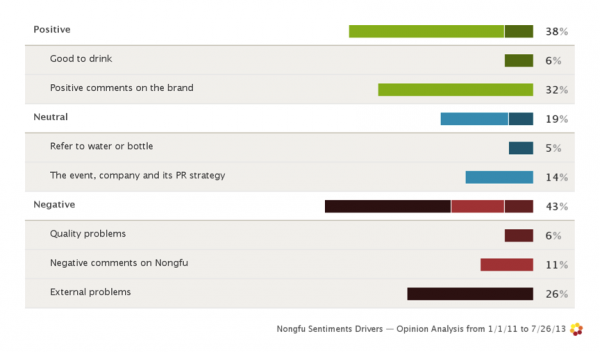
We used the Crimson Hexagon Forsight analytical platform to perform text analysis on Weibo posts including the term 农夫山泉 from 1/1/2011 to 26/7/2013. We trained the program by dividing posts into positive, neutral, and negative categories. We also wanted to know what types of opinions drove the sentiments, so we trained the program to further divide posts into subcategories:
POSITIVE
Good to drink: the slogan “Nongfu Spring: a little bit sweet” has been so successful that a lot of people express loyalty to Nongfu mineral water because of its taste.
Positive comments on the brand: people speak highly of the company and brand, especially during the quality scandal.
NEUTRAL
Refer to water or bottle: Nongfu commands such a large market share (20%) that people use Nongfu as the generic reference for water. Also, the bottle is famous for its firm quality, and people reference using it as a container.
The event, company and its PR strategy: posts and reposts of news about Qualitygate, the investigative report on the company and deeper analysis of its crisis PR strategy.
NEGATIVE
Quality problems: posts about Nongfu’s quality problems, caused by water origin and different regional and national standards.
Negative comments about Nongfu: other than quality issues, there are also a lot of people who believe the Beijing Times and dislike Nongfu for its combative response to the scandal. Some express negative comments on the company due to its PR behavior and perceived dishonesty in addressing the quality standards question.
External problems: Negative comments outside the company’s control that nonetheless violate the brand’s image, such as fake Nongfu with smelly water and bottles not completely full, and the increasing price of bottled water due to inflation.
Tracking Weibo sentiment since 2011
During our entire observation timespan, people have had more negative perceptions of Nongfu Spring water than positive, but as we discuss in more detail below, most of the negative sentiment has been driven by forces beyond the company’s control. In terms of the quality crisis, we find that sentiment supporting the company exceeded those blaming Nongfu, indicating that the company was able to effectively counteract the scandal.
Graph 1: Summary of sentiment from 1/1/2011 to 26/7/2013
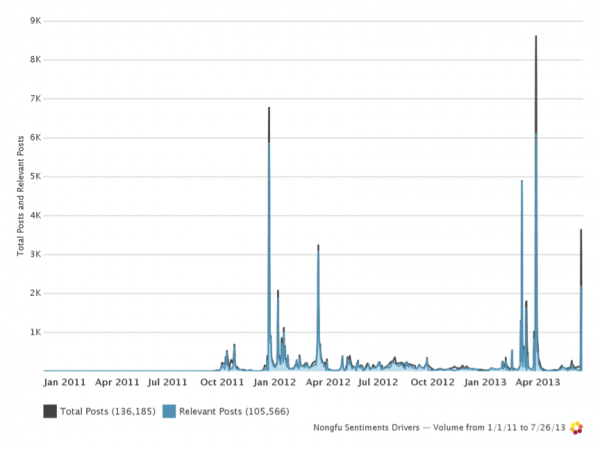
Here is the changing volume of usage from 2011 till now. We can see two spiking periods in the beginning of 2012 and April 2013, the latter of which marks Qualitygate.
Graph 2: Volume of posts from 1/1/2011 to 26/7/2013
Nongfu in 2011 and 2012: Weibo sentiment reflects the strength of the brand
Analysis of Weibo sentiment in 2011 and 2012 shows Nongfu’s strong brand reputation and stature in China. Beyond a high volume of approving posts, even neutral posts frequently use Nongfu as shorthand for bottled water, reflecting the company’s market strength. However, ironically, because Nongfu is so well known, its name and brand also catches flack for external events.
In 2011, relevant posts about Nongfu were 53% positive and 33% negative. Many positive comments are actually related to their implementation of SAP, an enterprise software used to manage business operations and customer relations. Nongfu was among the very first companies applying this advanced software in China, thus drawing a lot of attention from netizens and sparking a fierce SAP vs. Oracle debate. Though the posts didn’t explicitly praise Nongfu, the event generates positive PR for the company just by associating the company with competitive advanced technologies. The following anecdote about Nongfu’s implementation was highly reblogged:
#SAP中国商业同略会#农夫山泉介绍的HANA应用实例,在他们的实际应用当中,处理一个亿级数据的报表,Oracle需要27.363秒,而HANA的处理是102毫秒,他说,“大家一定要等等Oracle,因为它非常慢”。引来现场笑声一片。
[#SAP China Business Council# Nongfu Spring describes HANA application examples in their practical application: to process one hundred million data reports, Oracle needed 27.363 seconds, while HANA needed 102 milliseconds. He said, “everyone be patient with Oracle, because it is very slow.” Drew laughter from the audience.]
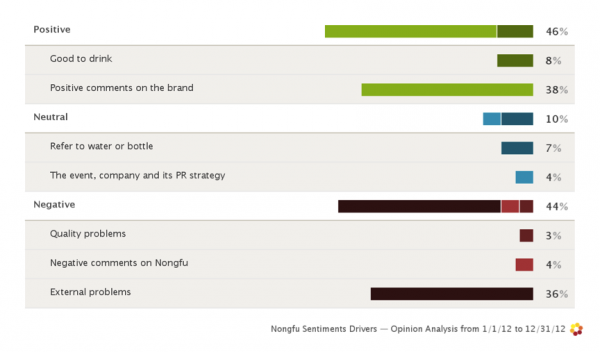
The beginning of 2012 witnessed the first major spike. In volume, when compared to 2011, negative posts (44%) increased to an amount comparable to positive ones (46%). Yet, even these negative events reflect Nongfu’s stature as a leading Chinese brand.
Graph 3: Opinion analysis in the year 2012
In January, actress Ma Yili commented on a post about the amazingly high consumer prices on Hainan, a common destination during Spring Festival. The original post used Nongfu’s prices in Sanya as one example of local businesses ripping off tourists, and thanks to Ma’s reblog, the post quickly went viral (and became misattributed to Ma herself).
@睡不着的广大: 房费8800元一夜,早餐300元+20%服务费,出租起步价400,农夫山泉要6.5一瓶!一人一天均花10000元,比去欧美都贵。Commented and reblogged by actress @马伊琍:两个助手自己出去吃饭要了西红柿鸡蛋和墨鱼,结帐八百。
[Hotel room costs 8,800 yuan for one night, breakfast is 300 yuan plus 20% service charge, taxi starts with 400 yuan, even one bottle of Nongfu Spring costs 6.5 yuan! The daily expenses for one person is ten thousand yuan, more expensive than Europe and the US][Ma Yili: Check for tomato fried eggs and cuttlefish: eight hundred.]
Posts about a Nongfu copycat also resulted in a negative post spike in April 2012:
【注意啦,分辨假农夫山泉!】左边的是假的,水里一股橡胶味,条形码旁边有不乱丢标识的是假的。外出旅游大家注意了,农夫山泉有点悬!扩散~[话筒]
[Attention! Recognize fake Nongfu Spring! The left is fake, the water smells like rubber and the bottle doesn’t say “don’t litter.”]
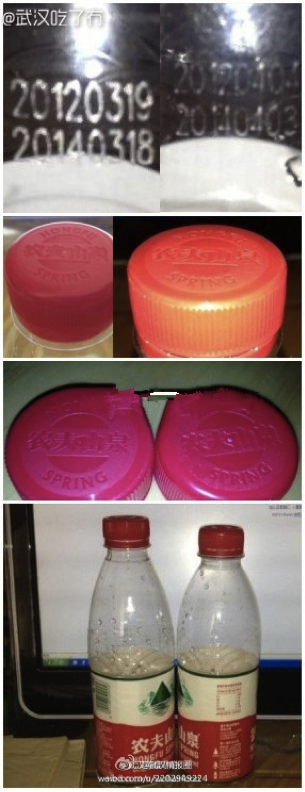
These events, though negatively associated with Nongfu on Weibo, actually reflect the company’s stature. The brand is so ubiquitous that in the Hainan incident, it was used as a benchmark product to show inflated prices. The copycat incident is certainly harmful in that fakes steal market share and cause consumers to be wary of the real thing, but on the other hand, also speaks to the strength of Nongfu’s brand.
2013 Nongfu Qualitygate: Debate brings both negative and positive effects
In 2013, Nongfu experienced a bona fide scandal with Qualitygate, during which opinion about the company became more negative than ever.
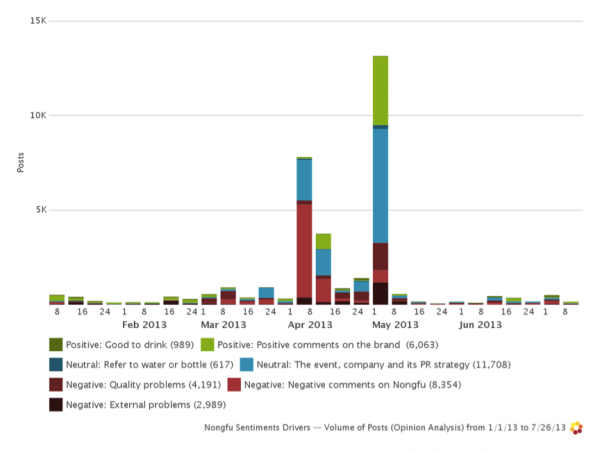
The two spikes shown in the chart below can be understood as the initial expose by the Beijing Times in April, and Nongfu’s response in May. Negative reports about Nongfu water actually began as early as March, when 21st Century Business Herald (21CBH), an online version of a business newspaper owned by the Southern Media Group, reported that some bottled Nongfu water had unknown substances inside. Then, 21CBHreported that the water originates from Danjiangkou, Hubei, which is covered with household garbage. However, Nongfu claimed on Weibo that their products meet national standards for drinking water and that the garbage doesn’t affect their water resources.
Graph 4: Weekly Opinion analysis trend from 2013-01-01 to 2013-07-26
At that time there were only several posts about this topic:
@21世纪网 消息,消费者李女士投诉,其公司购买的多瓶农夫山泉380ml饮用水中出现黑色不明物。发现水中的黑色不明物后,李女士曾与农夫山泉联系,但是企业坚称产品合格拒绝解释让其气愤。
[@21century website reports, consumer Ms. Li complained that many 380ml Nongfu Spring bottles her company bought had an unknown black substance inside. After finding this, she tried to contact Nongfu. But the company insisted on the quality of their brands and refused explanation, which made her angry.]
By the end of March, there were more and more negative posts about Nongfu:
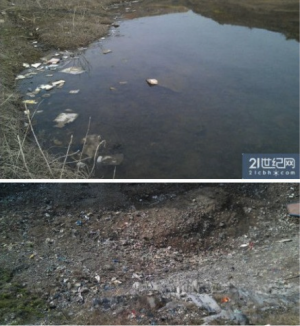
【农夫山泉水源地被曝垃圾遍布】有媒体报道称,农夫山泉四个水源地之一的湖北丹江口,取水点周围遍是各种各样的生活垃圾,其中不乏大量疑似医用废弃药瓶。通常农夫山泉用焚烧的方式来处理这些垃圾。农夫山泉表示,不整洁区域对取水质量并无影响。http://t.cn/zTPUsEr 农夫山泉,真的有点儿甜吗?
[Water source of Nongfu Spring is revealed to be surrounded by waste: it’s reported that in Danjiangkou of Hubei, one of Nongfu’s water sources, household garbage is everywhere, including medical waste. Normally, Nongfu burns this garbage. Nongfu says this waste has no effect on its water quality. Nongfu Spring, are you really a little bit sweet?]
The question of Nongfu’s quality finally gained large-scale traction when the Beijing Times, a newspaper operating under People’s Daily, released a series of reports from April 10 to May 2 questioning Nongfu’s quality standards:
@新浪财经:【农夫山泉被指标准不如自来水 曾参与新标制定】农夫山泉最近有点烦,今年3月其被曝喝出黑色不明物、棕色漂浮物以及“水源地垃圾围城”等消息,近日,又有消息称农夫山泉生产产品标准倒退。昨天,有业内人士接受记者采访时表示,农夫山泉瓶装水的生产标准还不如自来水。
[@Sina Business: The standard for Nongfu Spring is lower than tap water. The company was once engaged in drafting new standards, but Nongfu Spring has been in a little bit of trouble recently. In March it was revealed that black unknown substances were found in its bottles and brown floating things and garbage around its water sources etc. These days it’s said the standard for Nongfu Spring has regressed. Yesterday, a company insider told journalists that the production standard for Nongfu bottled water is lower than tap water.]
Nongfu fights back
These news posts and their reposts comprise the “negative comments on Nongfu”, which rose to 80% on April 12. So far, this is a standard story of how the public responds to a food safety exposé. However, public opinion surprisingly reversed after Nongfu held a press conference on May 6 [4] . During the raucous press conference, Zhong Shanshan, chairman of Nongfu, debated several journalists from the Beijing Times. One journalist interrupted Zhong’s speech several times and was eventually kicked out of the conference by security guards. Zhong’s performance was confident, patient, and even generous at times, such as when he made a point of granting two questions to Beijing Times while other outlets were limited to one. The journalists, in comparison, came off as rude.
Zhong started the conference by pointing out the Beijing Times had devoted over 70 pages of newspaper space in 28 days to attacking his company. By claiming the coverage was excessive, he was strongly hinting that the exposé was really a vendetta. On that day, positive posts accounted for 47% and negative only 12%. During the conference, Zhong announced that Nongfu would be leaving the Beijing market and apologized to Nongfu’s Beijing customers. Even though the company had been ordered to suspend production pending investigation in Beijing, Zhong portrayed Nongfu as victim to a hostile climate. The controversial decision received sympathy as well as contempt.
Different reactions after this press conference:
@beautyCheng:靠!!!后备箱里的全扔么?[怒] //@长头发神经病想抽你:我操 我昨天还愤怒的饮用了一瓶 //@Vitaye格子:一直喝农夫山泉呢//@4A苏小四: 啊,不会吧 //@王宁_wing:啊,一直在买他们的桶装水喝啊。。。。6.3元4升的那种。转发微博@凤凰网:【农夫山泉宣布:退出北京市场!】农夫山泉董事长:农夫山泉将停止向北京市场供货,他们对不起北京10万消费者,他们无法在这样的环境下生产。农夫山泉选择在北京市场退出。发布会直播:http://t.cn/zTTvAUL
[@beautyCheng:Shit! ! ! Should I throw all of them away? [Angry] / / @长头发神经病想抽你: Fuck! I drank one bottle furiously yesterday./ / @ Vitaye格子: I have been drinking it all the time./ / @ 4A苏小四: oh, no! / / @王宁_wing: ah, I have been buying their bottled water to drink. . . . Forward microblogging @ Phoenix: [Nongfu Spring announced its exit from the Beijing market!] Chairman of Nongfu Spring: Nongfu Spring will stop supplying their products to the Beijing market. They apologized to their 100,000 consumers in Beijing, stating that they can not produce under such circumstances. Nongfu Spring has chosen to exit the market in Beijing.]
农夫山泉显然是被黑了![怒][怒][怒]真是太可恶了,可惜附近的农夫山泉都停卖了,想继续喝都没得喝了. //@天闲_airline:http://t.cn/zTTSYCt 看这个新闻发布会就知道真相了,农夫山泉可以放心!
[Apparently Nongfu Spring was slandered! [Angry] [angry] [angry] It’s really hateful, and unfortunately Nongfu Spring nearby has stopped selling . I can’t drink it when I want to. / / @天闲_airline: http://t.cn/zTTSYCt watch this press conference and you will know the truth, Nongfu Spring is safe!]
During the conference, a Zhejiang media outlet also questioned the background and motives of the Beijing Times’ insider source, drawing unexpected scrutiny to the paper itself. If not a decisive win for Nongfu, the conference, and Zhong’s shrewd positioning of his company as a victim, clearly managed to raise netizens’ doubts. The following day, May 7, news broke on Weibo that the Beijing Times was a “water-selling newspaper,” linking to a 2005 article in People’s Daily about De Yi Yuan brand mineral water, which is owned by Beijing Times, being the sole water supplier for the Beijing International Marathon [5]. Following this news, many people turned strongly in favor of Nongfu, believing that there were ulterior motives behind the original report in the Beijing Times.
@莫须我:就这个新闻发布会上看,《京华时报》毫无底线,理屈词穷,完败!农夫山泉完胜!作为消费者,去买两桶农夫山泉表示支持!一个好的企业不要怕不良媒体讹诈,最好的方式就是公开面对质疑,公开辩论,有理不在声高。
[@莫须我: In my view on this press conference, there is no moral bottom for “Beijing Times“, acknowledge defeat! Nongfu Springs wins! As a consumer, I’m going to buy two barrels of Nongfu Springs in support! A good company shouldn’t fear blackmail from bad media, the best solution is to openly face the challenge, have open debate, use reason rather than arrogance.]
四问京华时报 !1,贵报出品的“德溢源”牌桶装水,真正是地下水、自来水,怎么就变成“特供天然矿泉水”了?2,该水的品质比较农夫山泉如何?3,党委可以办企业吗?4,报纸可以卖水,农夫山泉是否可以办报?
[Four questions for Beijing Times! 1, The newspaper produced “De Yi Yuan” brand bottled water, which is really groundwater, tap water, so how did it become “special natural mineral water”? 2, How does it compare with Nongfu Springs water? 3, Can the Party sideline business? 4, If a newspaper can sell water, can Nongfu sell newspapers?]
The accusations against Beijing Times are at best speculative, but they nonetheless had a powerful influence on the course of Qualitygate, showing that netizens are primed to believe the worst when it comes to even a whiff of corruption. With this revelation, posts surrounding Qualitygate reached a climax, and buzz died down shortly thereafter. In China, it seems, it takes a corruption scandal to trump a food scandal.
Conclusion
In the aftermath of Qualitygate, people seem only more confused and unclear which side to believe. Neither party is backing down: Beijing Times has continued to attack Nongfu, and Nongfu is pursuing a 60 million yuan defamation suit, claiming the paper’s allegations caused serious reputational damage.
But can money really make up for lost reputation? Nongfu isn’t counting on it. The company continues to be aggressively proactive in rebuilding its public image after the fallout. The company recently launched a PR campaign on Weibo called “seek out and witness the origin waters of Nongfu,” in which more than a hundred media outlets and their readers were invited to visit Thousand-Island Lake. The lake is one of Nongfu’s springs, but also a famous scenic destination. Attendees were selected from a Weibo lottery and treated to an all-expenses-paid trip featuring luxury hotels and lavish meals. As a result of this campaign, positive Weibo posts spiked in June. Even though these posts may not be completely “real,” the campaign unquestionably succeeded in changing the tone and course of discussion.
In the period following the press conference, public sentiments about the company have been mainly positive. Nongfu’s decisive actions following the scandal, from Chairman Zhong’s confident showing at the press conference to the Weibo image rehabilitation campaign, show that the company knows how to wage a media war. It’s also likely that Nongfu’s pre-scandal popularity, which may have acted as a lightning rod for investigative journalists in the first place, also helped it manage online discussions and overcome negative allegations. Specifically, it’s hard to imagine Qualitygate’s turning point, the press conference, drawing such widespread attention if Nongfu wasn’t already so popular. Finally, the revelation of Beijing Times’ own connections with a commercial bottled water company turned out to be especially fortuitous – perhaps too neatly so? By playing into people’s mistrust of government media, the company was able to cast itself as a victim, injecting doubt into the allegations and even winning some supporters. The company may yet suffer, but it will survive.
About the authors:
Chris Marquis (孟睿思) is an Associate Professor at Harvard Business School. His teaching, research and consulting focus on corporate environmental and social strategies. More information on his research can be found at www.chrismarquis.com.
Zoe Yang (杨一婧) is a Research Associate at Harvard Business School. She previously worked as a qualitative analyst at McKinsey & Company before moving to China to learn traditional Chinese cooking.
Marquis and Yang recently established the website www.civilchina.com as a forum to provide research and commentary on social, environmental and civil society issues in China.
End notes:
1. http://www.chinadaily.com.cn/china/2013-05/07/content_16480678.htm
2. http://shanghaiist.com/2013/05/07/nongfu_spring_to_sue_beijing_times_over_water_quality_expose.php
3. http://bbs.hupu.com/5559834.html
4. http://video.sina.com.cn/p/finance/20130506/230662392145.html?opsubject_id=top1
5. http://www.people.com.cn/GB/paper1787/14405/1281140.html
Danwei previously published a piece by these two authors, please see: Chinese Dream? American Dream?

 EnfoDesk, a Chinese market research company, published a report on China’s mobile phone banking sector. According to the report, bank transactions conducted via mobile phones in Q4 of 2013 reached just over 370 billion yuan, 35.90% higher than the previous quarter.
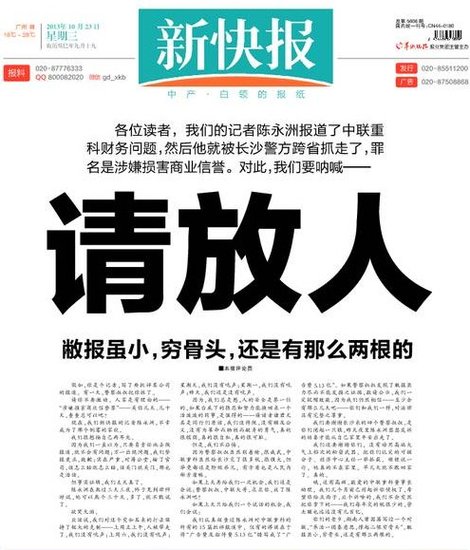 Guangzhou-based New Express ran a front page story today with a massive headline reading RELEASE HIM (请放人). The article requests the Changsha police authorities to release Chen Yongzhou (陈永洲), a journalist working for the newspaper who was arrested on October 19 at work. Changsha police officers had crossed provincial borders from Hunan to nab Chen in Guangzhou, an alarming development for the city’s feisty journalists.
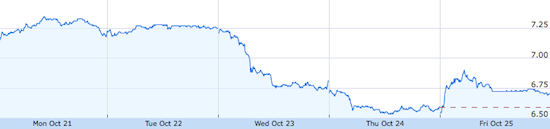
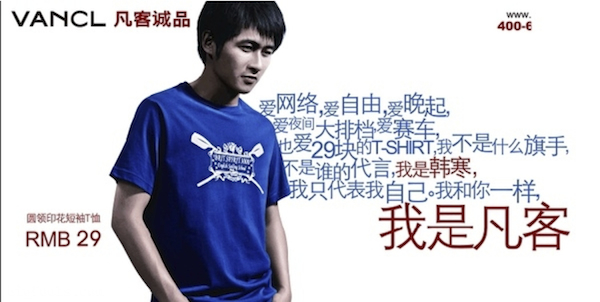
 An article published by China Business News (第一财经日报) on October 17 claims to provide a glimpse into search giant Baidu’s ambitions to enter the Internet financial industry. The article quotes a source “close to the matter” who says that Baidu plans to launch three services soon, namely a credit service that provides loans to small and micro enterprises, a big data analysis service that caters to big financial institutions, and a wealth management service. The source says that the wealth management service will promise higher return rates than popular online money market fund
 WooYun.org, a Chinese Internet security forum that publishes information about security loopholes, recently issued a
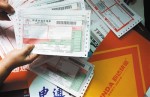 Economic Information Daily 经济参考报, a business newspaper managed by Xinhua News Agency, published an investigative story on the business of selling names, addresses and contact information extracted from the addresses of senders and recipients on courier packages packages. Courier (kuaidi 快递)services have become indispensable for companies in China when delivering physical deliveries both within and between Chinese cities, with typical delivery fees under ten yuan even for deliveries between cities as far as Guangzhou and Beijing.
 Better late than never: new regulations in force from today in Guangzhou require all
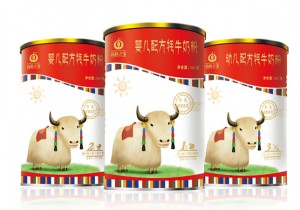 On October 14, Caixin’s New Century weekly magazine 财新《新世纪》周刊 published a cover story entitled “The milk formula war”. The article argues that the “milk formula national team” (奶粉国家队), as a campaign launched by the government to hype certain local infant formula companies was dubbed in the media, is just a gimmick from the Ministry of Industry and Information Technology. It was rumored that the government would pump funding into the “team” of six domestic companies, but in fact it transpired that the government would do no such thing, and was merely intending to send out positive signals about domestic formula brands.
 A Tom and Jerry style animated cartoon featuring a heroic goat who constantly saves his fellow goats from a wolf who has gastronomic designs over the members of Goatville, Pleasant Goat and Big Big Wolf (喜羊羊与灰太狼) seems an unlikely target for the culture-cleansing campaign that is underway on China Central Television (CCTV). However, the children’s cartoon series, long been lauded for its commercial success and potential to lead China’s soft power vanguard, and boost the less-than-robust Chinese animation industry, was criticized for “excessive violence and vulgar language” by CCTV’s seven o’clock Network News program on October 13.