
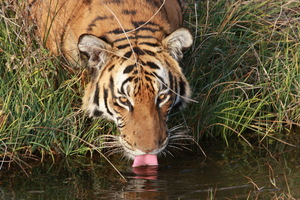
Kathy Lally in The Washington Post:
The tale of the magnificent Siberian tiger, and its unfinished fight for survival, should be a compelling one for the 500 conservationists and world leaders arriving for Prime Minister Vladimir Putin’s tiger summit this weekend.
The summit on the fate of the tiger has been convened in St. Petersburg as the singular chance to keep the world’s last 3,000 or so wild tigers from extinction, and the near-death experience of Russia’s big, beautiful animals informs how they can be saved elsewhere.
Beijing-based environment correspondent for The GuardianJonathan Watts was there, and had this to say:
Putin may be the tiger’s champion, but China will decide the species’ future
Premier Wen’s vague words at the tiger summit do little to inspire confidence in the country that drives a gruesome trade…
The Amur tiger population in Russia has bucked the global trend by making an impressive recovery from fewer than 30 in 1945 to about 500 today. It is evidence that the animal can recover if supported by political will and public awareness.
China, by contrast, has not only seen its own population of tigers decline precipitously in the past 50 years, its consumers have also boosted demand for illegally-poached tigers from overseas…
…Premier Wen was the only one of the five national leaders at the summit who did not deign to attend the “press conference” (where no questions were allowed). In the summit, he stressed the need for greater enforcement. “All countries should crack down on poaching and illegal trade of tigers,” he said. For conservationists, it was a disappointingly vague statement from the country that drives the main demand for tiger products.
There is one Chinese organization fighting for tigers: Save China’s Tigers, run by former Gucci executive Li Quan. One of the organization’s main activities is ‘rewilding’ tigers or training zoo-kept tigers for re-introduction into the wild. The training is currently taking place in South Africa.