
From SFGate.com:
“In keeping with her reputation as the enfant terrible of Chinese letters, Mian Mian, an ex-drug addict turned dance-party producer, strode into the Commonwealth Club last Friday night wearing black bondage boots and immediately wanted to light up.
“Why can’t you smoke anywhere in this fucking America?” the 33-year-old author of the best-selling novel “Candy” exclaimed before speeding out the door for a prereading cigarette.
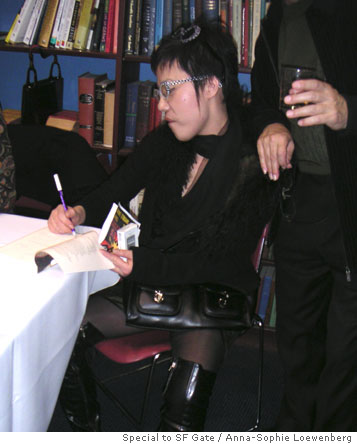
Dubbed China’s “poster child for spiritual pollution” by Chinese censors, who banned “Candy” in 2000, the novel is loosely based on Mian’s own life as a teenage drug addict on the streets of Shenzhen and Shanghai. It was also the first work of fiction by a female author to expose China’s underground of drugs, promiscuity and rock music.”
The whole article is here. There is more about Mian Mian on Danwei.org here. The SFGate story was written by Anna-Sophie Lowenberg, former editor at Beijing Scene and bassist of Beijing grrl punk band ‘Bieniu’. Below are some observations she emailed to me after a recent trip back to China:
“I have spent the past couple of weeks writing stories in Hong Kong and China. A lot has happened to the P.R.C. since I first moved to Beijing in 1996. With the impact of punk rock, the war in Iraq, entrance into the WTO and SARS, Shanghai is hard to recognize. Still, I woke up this morning to the sounds of Chinese grannies practicing Qi Gong and fan dancing.
Here are some of the big China changes I’ve noticed in the past couple of years:
Internet Cafes
It’s 8 AM, and I’m sitting next to a bunch of teenage boys who are smoking cigarettes and watching DVDs in a 24-hour Internet cafe. I used to pull my hair out trying to get a dial-up connection. Now, this is the cool place to hang out on a Friday night, boasting hundreds of computers with DSL connections, a snack bar, and mega-video games.
Hair
The afro-perm is in! Young Shanghainese also sport dreadlocks, corn-rows, and peroxide blonde hair.
TV
I turn on the tube to see flashy, highly produced Nike and Panasonic commercials. The CNBA is popular, and it’s all African and African-American players who are slam dunkin’.
Don’t worry, documentaries about Chairman Mao, The Long March, and government-sponsored news reports are still prime time entertainment.
Traffic Jams
Since SARS hit China last spring, everybody wants to buy their own car. Even China’s working and lower-middle class city dwellers would rather save their monthly paychecks and buy cars rather than risking inhaling deadly germs on the subway. I remember when everyone rode bicycles in Beijing, and the only cars I saw on the road were government officials and taxi cabs. Now traffic jams are so severe that it’s faster to walk or take the subway.
Hip-hop
Chinese breakdancing is on TV and hip-hop/R&B clubs are the best nightlife.
The Hong Kong, China Connection
Direct trains from Shanghai and Beijing to Hong Kong leave every other day. Chinese nationals will soon require only a passport to get to Hong Kong (no more lengthy visa process).
Hong Kong Hardcore
While I was in Hong Kong, I interviewed Cantonese political hardcore band King Lychee. After touring mainland China and seeing the vibrant punk movement in the P.R.C., they decided that Canto-pop is out, and Hong Kong hardcore is in. These 20-something tattooed and body-pierced boys completely inspired me with talk of their committment to anti-materialism and confronting racism in Hong Kong. With Pakistani, Chinese and Australian members, they describe themselves as “third culture kids” who consider Hong Kong home, but understand what it feels like to be an outsider, even in their own culture.
Goodbye to Mom and Pop
Chinese convenience chain stores modeled on 7/11 claim every street corner in Shanghai.They offer everything from warm milk tea and cold orange juice to 10 kinds of gum, and fresh-brewed tea eggs. I used to have three choices of canned drinks in China: water, Coca Cola, or a Chinese brand of 7-Up. I used to make phone calls and an actual human being would take my 10 RMB and make change. Now public phones in chain stores are the same heartless machines that take only coins in the U.S.
Cellphones
Food, transportation, and buying clothes in China costs half the price of the U.S., but Chinese cellphone bills are twice as expensive!
Shanghai Jews
My family fled Nazi Germany in 1933, and raised my father in Shanghai until 1937, when the Japanese invaded China. This week, I found my father’s childhood home in Shanghai on Route Vallon. All of the street names in Shanghai have changed since the Communist Liberation and Cultural Revolution, so Route Vallon is now Nanchang Lu. Still, many of the residents of my father’s old apartment building remember the Jews who used to live in the neighborhood.
I also had the chance to catch a “DVD Salon” in a Shanghai Art bar. The event featured short films by Fudan University undergrads, including a documentary about Chinese Jews who are the descendants of Jews in Shanghai.
Shopping Heaven
Airwalk, Nikes, Vans, Adidas, Etnies, Converse, Hello Kitty. Get it cheap, made real or fake, one thing is for sure, everything is MADE IN CHINA!
Some things haven’t changed:
Food
Good food is still considered of top importance in China. I’ve been eating traditional Shanghai fare: winter melon fried in duck yolks, steamed crab buns, chicken and cucumber wraps, pickled lotus-root in honey, fried pumpkin-puffs, and purple bean porridge.
What country are you from?
This is still the first and most important question every Chinese asks before carrying-on a conversation with a foreigner.
Free Refills
There may be a Starbucks on every corner, but Chinese still drink green tea
Shanghai Rides High on the Backs of China’s Countrymen
The standard of living may have changed in big cities like Beijing and Shanghai, but not without the blood, sweat, and tears of workers from the countryside, and the many impoverished provinces that claim most of China’s 1.2 billion population. I see workers walk through the glitzy shopping malls of Shanghai at 6 AM wearing tattered rags, hair unwashed, as they go to working building China’s new infrastructure for a monthly wage that is less that most Americans make in one day.”