Humiliating defeat leads to more agonizing on China’s national football team

Nanyang Wanbao 17Jun

Today is a baneful, humorless day for some of the newspapers that ran front page headlines on another humiliating defeat of 5-1 at home on Saturday for China’s football team against an under-strength team of youngsters from tiny Thailand. There’s hopeless despair, frantic questioning and anger at this latest flub, China’s third loss in a row. Although Chinese fans are quite used to China losing at football, the way the team capitulated against Thailand was (as the Oriental Guardian from Nanjing puts it today) “like a dagger deep into the heart of every Chinese football fan” (像一把尖刀深深地刺痛每一个球迷的心). Right at top of its front page, the Oriental Guardian today speculates on the reasons behind the sorry state of China’s national team, and asks “How many times do you still want to say sorry?” (The national team’s Weibo account said sorry after the 2-1 home loss to Uzbekistan on June 6).

The Nanyang Evening News from Henan today has only one word for the defeat: “Disgrace”. As the featured image illustrates, the newspaper’s front page today also has two other short descriptions for headline news: “Attitude” (态度) for the Snowden affair; and “Going separate ways” (分飞) for the Rupert and Wendi Murdoch divorce.

As we previously reported on Danwei, the Chinese football team (国足) last week arrived to a decidedly cold reception in the city of Hefei in Anhui province where the match against Thailand took take place this past Saturday. Not a single fan came to meet the team when they arrived at the hotel, but around 20,000 fans did go to the stadium in Hefei to see their team thrashed 5-1 by what was essentially a Thai youth team.

Qiumi 17JunThe sense of shame at the defeat is illustrated by the headline in today’s front page of the football-focused newspaper Sports Fans (球迷), which simply says “We look down in shame”. The front page of the Nanyang Evening News from Henan province today asks, “Where is the bottom of the national team’s failure?” Chinese fans have never had very high expectations for their national team, the paper says, but this performance was just beyond the pale.

This was clearly in accordance with the views of the fans who ventured out to the stadium in Hefei to watch their team be humiliated again. After the match there were angry scenes as the fans besieged the Chinese team bus and shouted slogans like “Camacho get out!” (卡马乔下课), “Disband the Chinese Football Association!” (足协解散) and “Disband the national team!” (国足解散)
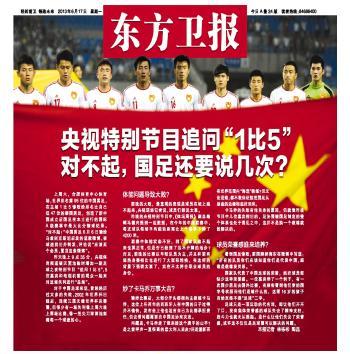
20130617A01_briefThe Oriental Guardian from Nanjing is one newspaper that today confronts the debacle head-on. In a thinly veiled attack on the national team’s seeming lack of passion, the newspaper’s front page displays an image of the players singing the national anthem before the game above an article (with a national flag in the background) discussing the side’s current predicament.

Essentially the Oriental Guardian posits three potential root causes of China’s football shame:

1. The team is not physically up to the task because the Chinese Super League is an inferior league

Some journalists observed after Saturday’s match that the players looked tired and not energetic enough. The newspaper quotes statistics cited by an expert on CCTV last night who claimed that on average, teams in China’s Super League are running 4,200 meters less per game compared to last season. This is part of a general problem with China’s local Super League in that it is not demanding enough of players and hence produces an inferior national team.

2. The coach is the problem

The Chinese team’s Spanish coach José Antonio Camacho has not had a happy two years in charge so far, and after the match accepted responsibility for the heavy defeat (although he said his staying or going is up to the Chinese Football Association). But even if the coach does resign, the Oriental Guardian asks, who on earth will want to grasp this hot potato? (谁来接这个烫手的山芋). And besides, there are so many problems in Chinese football that just changing the coach will likely not make much of a difference.

3. The players’ sense of honor is lacking

After watching the game, former player Hao Haidong (郝海东) – regarded as one of the best Chinese players ever – took to his Weibo to remind the players that they are playing for China, it doesn’t matter who the coach is. And clearly the horrible run of the team must be related to them having lost their sense of honor, but how did this happen? Maybe, Oriental Guardian says, this has to do with a lot more than just football.

Links and sources
Oriental Guardian (东方卫报) 对不起,国足还要说几次?
Nanyang Evening News (南阳晚报): 国足输球的底线在哪里
Sports Fans (球迷): 1:5揭开多少伤疤
Posted in Front Page of the Day | Tagged | Comments Off on Humiliating defeat leads to more agonizing on China’s national football team

No-one turns up to welcome China’s football team in Hefei

Shichang Xingbao 13Jun

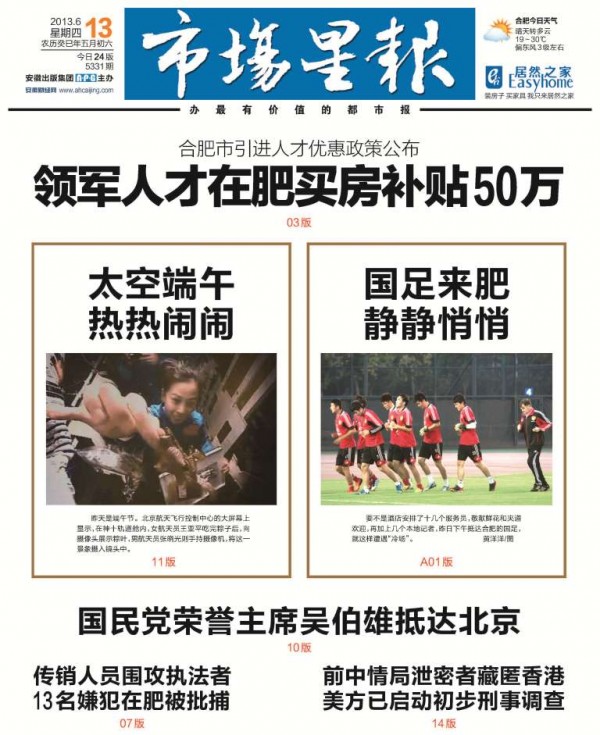
China’s national men’s football team is so unloved that the only reason the media report their arrival in a city in China is that no-one turns up to welcome them. Thus the team’s movements around the country is such a non-event that it’s actually newsworthy. This is indeed the case with the Star News (市场星报) from Hefei in Anhui province today, whose front page reports that the Chinese team “quietly” arrived at the Kaiyuan Hotel in Hefei yesterday with only a few attendants and journalists to welcome them; there was not a single member of the public in sight.

Instead of having to wade through a sea of adoring football fans on their way from the bus to the hotel, all the Chinese football team had to contend with were hotel attendants handing them flowers. It certainly hasn’t helped that the team is fresh off two home defeats: 1-2 to Uzbekistan on June 6 and 0-2 to Holland yesterday June 12. The team is now preparing for its next friendly against Thailand on June 15 at the Hefei Olympic Sports stadium.

If they are completely ignored by everyone else, the national team is at least given some special treatment by the hotel staff. A whole floor of the hotel has been closed off just for the team, and six types of fruit have been prepared for the team’s Spanish coach, José Antonio Camacho. Yet as Star News puts it, under Camacho the team has entered a steep decline (一落千丈). This may be a little unfair on Camacho, because when was the Chinese national team not in decline? Since taking over in August 2011, Camacho’s record as coach in all competitions and friendlies is won 7, drew 2, lost 10.

★

The top headline on the Star News front page is about new government policies to attracted talented professionals to Hefei. To the left of the story about the football team is a photo and story about Chinese astronauts on the Shenzhou 10 celebrating Dragon Boat Festival in space (more on that on English here).

Links and sources
Star News (市场星报): 端午节,国足抵肥“遇冷”

Posted in Front Page of the Day | Tagged | Comments Off on No-one turns up to welcome China’s football team in Hefei

The big, slick Buddha of Luoyang that looks like an entrepreneur

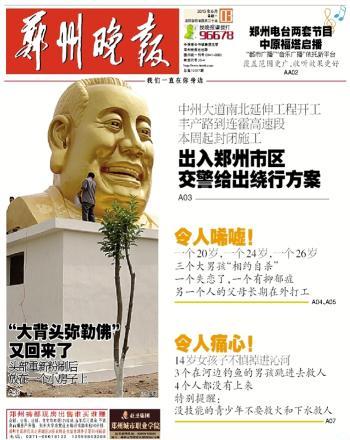
Zhengzhou Wanbao 3JunIn late April a strange golden Buddha statue was erected in an amusement park in Luoyang, Henan province. With protruding belly, big smile and long ears, the statue in various ways resembled many other Buddha statues. Yet right at the top of the statue there was a fashion statement that is rarely seen in Buddhist imagery: a slick and smooth combed-back hairstyle. This utterly incongruous modern addition was just too much for many Internet commentators.
In the eye of the storm of public outrage, the Buddha was suddenly removed after a few days. But as the front page of the Zhengzhou Evening News (郑州晚报) from Henan province reports today, the slick Buddha is back! And it’s likely that the reason for this is that the statue was in fact made in the image of some entrepreneur (although which one we don’t know) who likes to see a massive golden statue of himself made in the image of a golden Buddha.

On 22 April, a picture of a new big, slick golden Buddha statue (dubbed the “Big Maitreya with the swept-back hairstyle” 大背头弥勒佛 by Chinese Internet users) was uploaded to Weibo. In what appears to have been another case of “erect first and ask questions later”, this particularly smooth Buddha was then in the process of being erected in Hualong Amusement Park (洛阳华龙欢乐园) in Luoyang, Henan province.

At first sight the Buddha appears quite comely, with amiable eyes, big lips, and long earlobes. But at the very top of the statue you are confronted with an incongruous slick, combed-back hairstyle. As the Zhengzhou Evening News reports today, Chinese web commentators have roundly disapproved of the slick hairstyle, it’s just too cool. Following much criticism online, after a few days the Buddha was gone. Yet it was not so much removed as decapitated, because only the head was taken off and everything from the shoulders down remained in the original position. But at least the offending hairstyle was no longer visible.

That all changed again this past weekend, when the Buddha’s head was suddenly found to have been installed on top of a small house (what some observers thought may be a bathroom). So the Zhengzhou Evening News today joins a chorus of online observers asking, what gives?!

The answer to this question is the fact that the Buddha was in fact made in the image of some entrepreneur. Hualong Park revealed as much in their telephone conversations with Zhengzhou Evening News, adding that this particular entrepreneur was dedicated (敬业) and hardworking (勤劳) yet sincere, down to earth (朴实) and tolerant (包容). And to thank him for all these merits, the statue of the golden Buddha was made in his image to “inspire young people”. That, they said, is all there’s to it (仅此而已).

Yet who is this entrepreneur? Despite repeated attempts for more information, the newspaper’s questions were turned away with a polite refusal to discuss “company secrets”.

Links and sources
Zhengzhou Wanbao (郑州晚报): 洛阳“大背头弥勒佛”:我又回来了

Posted in Front Page of the Day | Tagged | Comments Off on The big, slick Buddha of Luoyang that looks like an entrepreneur

Wild woman found living in a cave in Gansu

Shenyang Wanbao 31May

The “White-Haired Girl” (白毛女) was one of the first films made in the People’s Republic of China. Originally a Chinese opera and later a ballet, the film depicts the miserable life endured by a peasant girl whose poor father is murdered by a rapacious landlord. The landlord then takes the girl as a concubine and mistreats her, but she escapes and lives alone in the mountains for many years, surviving on the offerings at a nearby temple. Years later the landlord comes to worship at the temple during a stormy night. In a flash of lightning he sees the girl – now a disheveled, white-haired figure – and is nearly scared to death by what he perceives to be a reincarnated goddess come to punish him for his misdeeds.

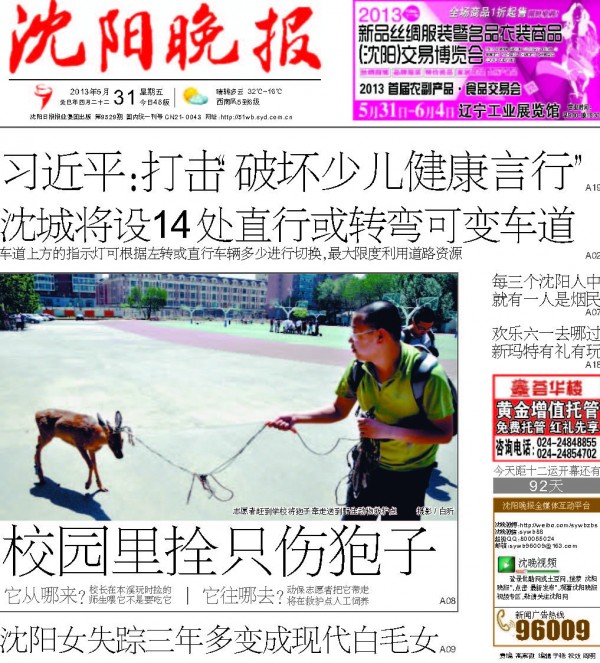
The front page of the Shenyang Evening News (沈阳晚报) from Liaoning province today recalls this legend of the white-haired girl in the mountains with a very real report on a “wild woman” that was found deep in the mountains of Gansu. Like the White-Haired girl, this woman’s tale is likewise infinitely sad and appalling.

Lying just to the east of Lanzhou (兰州), the capital of Gansu province, Yuzhong county (榆中县) is part of an arid, mountainous region. On May 20th, a villager from Yuzhong went up the mountains to tend his flock of sheep, but it suddenly began to rain heavily and he got lost. To try and get out of the downpour, he took shelter in a cavern. Yet to his amazement, the villager found that the cavern was in fact someone’s home. And then he saw her, dressed in shoddy clothing; with unkempt, dirty hair; a crooked waist and sunken eyes with a lifeless stare: an apparition of mere skin and bones, a “wild woman”.

Scared witless, the villager ran off and alerted the police, who came to collect the woman and begin to piece together her identity. She could (or would) no longer speak, and had been living in the mountain for more than a year already. It took the police some time to establish her identity and trace her history, but like all people who have fallen on hard times and plowed the depths of human misery, she was once someone’s friend, family member, and acquaintance.

On May 24th, Ms Li, who lives in Shenyang, received an unexpected phone call. At the other end was someone from the homeless shelter in the city, and when after three years Ms Li now suddenly heard that old familiar name again, she felt warped into a tumultuous previous era of her life.

It was three years ago when things started going wrong for her younger sister. Everything suddenly fell apart. In quick succession her sister lost her job, her husband and her family, and started exhibiting signs of mental illness. Then one day in 2010 she ran barefoot out of a hospital and disappeared without a trace. Her sister received no letters or any communication from her. She was reported missing, and her sister started to think that she had departed this world.

On May 30th, the “wild woman” sat with a journalist from Shenyang Evening News for what was an exceedingly awkward interview. Still unable or unwilling to utter a word, she sat there in her faded jeans, dilapidated clothing held together by red string, and bare feet bulging with callouses. Curled up in the corner with her head buried between her knees, she silently scribbled answers to her bewildered interviewer, relating in the most cryptic of words what had happened to her the last three years.

“I did manual labor”, she wrote, “I did farm work. I washed cars”. After running away from Shenyang, she had boarded a train to Dashiqiao (大石桥) county to the south-west of Shenyang, where she started doing some part-time work. Yet she stayed here for only a short while before starting a long roaming sojourn that would finally end in solitude in the mountains. Taking a train to Beijing, she then moved on to Changzhou (常州) and Suzhou (苏州) in Jiangsu province, before landing in Dezhou (德州) in Shandong province. From here, however, she went straight to Lanzhou, and sought out the lonely crevice deep in the mountains where she thought she would live out the rest of her days alone.

Links and sources
Shenyang Evening News (沈阳晚报): 兰州山洞里发现沈阳现代版白毛女

Posted in Front Page of the Day, Urban Culture and Cities | Tagged | Comments Off on Wild woman found living in a cave in Gansu

“I was here” graffiti all over Yunnan

Chuncheng Wanbao 28May

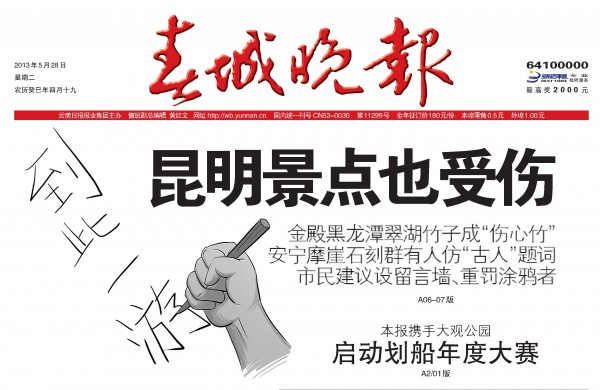
When a Chinese teenager named Ding Jinhao (丁锦昊) in Egypt last week was revealed to have defaced an ancient frieze with the graffito “I was here” (丁锦昊到此一游), there was widespread condemnation of the teen vandal who did so much to damage the image of Chinese tourists abroad. Yet after conducting its own survey of the scenic spots in the province of Yunnan, the Spring City Evening News today reports that “I was here” and other graffiti can in fact be seen all over Yunnan. Ancient buildings and parks have been scarred by innumerable “black hands”, and the paper says that poor Ding Jinhao has now been given all the blame for what many others do all the time in China itself. In fact, the “I was here” graffiti tradition goes back all the way to the Monkey King in the classic fable Journey to the West (西游记).

In Journey to the West , the Monkey King (Sun Wukong 孙悟空) is fooled by the Siddhartha Buddha with the challenge that if he can manage to leap out of the Buddha’s palm, the Monkey King can occupy the Celestial throne. The overconfident Monkey King accepts the challenge, jumps into the Buddha’s palm, and them does an almighty somersault, tumbling through the air for thousands of miles. Finally coming to rest at a place where five massive pillars reach out into the sky, the Monkey King promptly scratched the following characters into the middle pillar to prove he was there:

老孙到此一游 (“The Monkey King was here”)

The Monkey King then gave another almighty leap back where he came from, and landed back in the Buddha’s palm – or so he thought. To this great consternation, the Monkey King looked down at the bottom of the Buddha’s middle finger, where he saw the characters he himself had just carved: 老孙到此一游 (“The Monkey King was here”)

He had in fact never left the Buddha’s palm, and had merely defaced the latter’s middle finger.

Despite the classical origins of the “I was here” graffito, the Ding Jinhao incident came amid some soul-searching in China about the behavior of Chinese tourists overseas. On May 16, vice premier Wang Yang (汪洋) roundly condemned the “uncivilized behavior” of Chinese tourists which he believed was doing great harm to China’s image overseas. Wang’s comments were widely reported in English-language media, and he was somewhat simplistically translated as saying that some Chinese tourists lack “quality and breeding” (see for example AFP). Yet the words Wang actually used (see Chinese report here) were that familiar Chinese concept 素质 (suzhi, referring to a person’s level of development or refinement), and 修养 (xiuyang, another vague concept referring to a person’s cultivation of social mores and rules). Whole books have been written on these two concepts, and rendering them in English is somewhat open to interpretation.

What is certain, however, is that there is a problem with Chinese tourists, both those travelling internally in China as well as abroad. In light of Ding Jinhao’s infamous “I was here” graffito in the Luxor temple, the front page of the Spring City Evening News (春城晚报) from Yunnan province today reports on what it calls the scourge of “Chinese Style I was here”, which the paper says is all over the scenic areas in the beautiful province of Yunnan. Spring City Evening News yesterday dispatched reporters to a range of tourist destinations in Yunnan, including the Western Mountain (昆明西山) and Green Lake Park (翠湖公园) in Kunming, Tengchong county (腾冲县), Lijiang old town (丽江古城), and Three Pagoda Park (三塔公园) in the historic town of Dali (大理).

Green Lake Park in Kunming, the capital of Yunnan, has beautiful bamboo plants that have already reached the height of a three or four storey building. Yet as the newspaper reports, many of these bamboo plants have been given the “I was here” treatment, and as a result many have begun to wilt. As the newspaper puts it, the great pity is that these plants can’t run away, and have to submit to their fate of being scarred by the “I was here” vandals. In fact, there were broadly two types of engravings on the bamboo. The first and most common were the “I was here” variety, but then there were also so-and-so loves or hates so-and-so. And it seems that it’s not just children who are to blame; staff at the park told the reporter about fancy-clad women scratching messages on the bamboo as well.

In Tengchong county, some of the more remote historic buildings in the area have been scarred by the graffiti-scrawling “black hands”, who damaged the ancient wooden pillars of the buildings with a “thousand cuts”, as the paper puts it. In Three Pagoda Park (三塔公园) in Dali, vandals have “everywhere” scratched “I was here” and all kinds of other messages on the toilet doors, on the trees, and on the stones.

Links and sources
China Daily: Parents of teen vandal apologize after online rage
中国新闻网:汪洋:部分游客素质和修养不高 有损国人形象
Spring City Evening News (春城晚报): “中国式到此一游”昆明等地多个景区伤不起

Posted in Front Page of the Day, Traditions, Wildlife, Nature and the Environment | Tagged | Comments Off on “I was here” graffiti all over Yunnan

Beijing to add charging stations, e-taxis and subsidies

23 May BYD chart

This post is an extract from the Danwei Bulletin, a briefing of company and market news collected from the Chinese news and social media before the information appears in English language reporting and sent to premium subscribers of the FT’s China Confidential and Danwei. Please click here for more information.

✭

The Beijing municipal government has announced initiatives to install charge points for electric cars around the city and to promote electric vehicles for public transport and rental. 

The Beijing Science & Technology Commission (BSTC) launched an initiative this week to encourage the private use of electric cars, selecting twelve areas across the city to equip with charge points, parking spots, and rental offices, to grow to 20 major areas by 2015. Beijing will also add 2,000 electric taxis this year to the existing fleet of 750. Xu Xinchao, director of the BSTC’s New Energy and New Materials Department, mentioned Ecar (a leasing company under China Automotive News 中国汽车 报) and China Auto Rental as agencies that would be rental partners in the city’s electric car initiative. Zhan Jingjing, general manager of Ecar, told China Business News 第一财经日报 that the first batch of 15 E150 EV electric cars would be provided to customers in the pilot area of Tsinghua Science Park, which has been equipped with ten slow charging stations and one quick-charge point. The vehicles will rent for 49 yuan an hour or 99 yuan a day, Beijing Daily 北京日报 reported.

Lin Yi, director of E150 EV manufacturer New Energy Auto (a BAIC subsidiary), told the Legal Mirror 法制晚报 that the company will put at least 5,000 electric vehicles on the road this year, including more than 3,000 sales to the private sector.

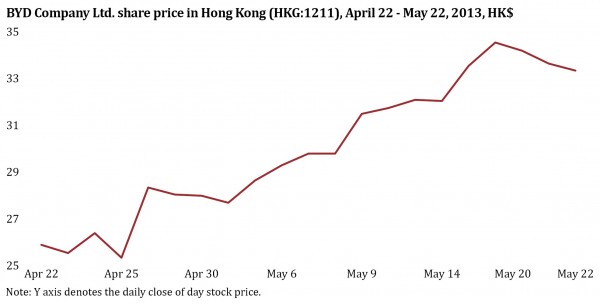
The new charging stations might go some way towards alleviating some of the teething problems facing China’s electric car industry. As the chart above illustrates, the stock price in Hong Kong of one of the companies set to profit from the new charging stations, namely BYD, has been on the up in the last month.

Companies and brands affected
BYD (比亚迪汽车 HKG:1211)
Beijing Automotive Industry Holding Co. Ltd. (BAIC 北汽汽车 Not listed)
New Energy Auto (新能源汽车 BAIC subsidiary)
Ecar (易卡先锋 Privately held. Note: also spelt as Yika in English media)
China Auto Rental (神州租车 Privately held)

Posted in Business and the Economy, Consumer Culture | Tagged , | Comments Off on Beijing to add charging stations, e-taxis and subsidies

Small Hubei community has been free from fireworks for eight years (and loving it)

Jingzhou Wanbao 22May

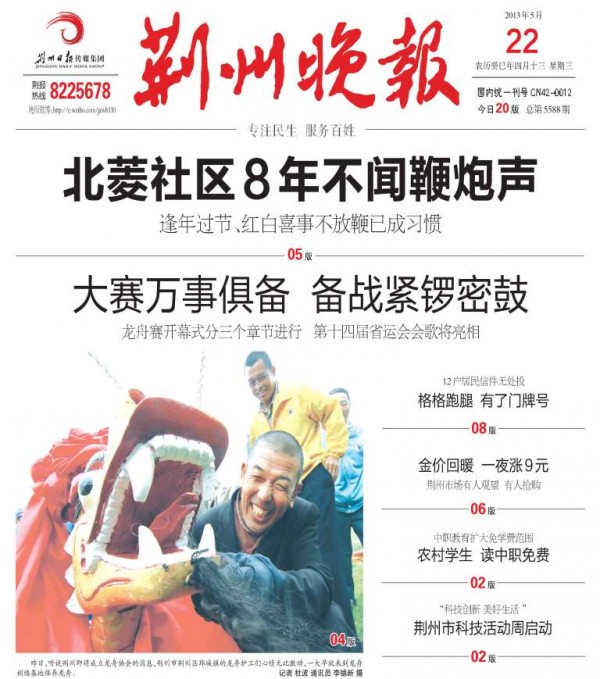
For eight years already now, a small workers’ residential community in Jingzhou, Hubei province has “quietly” been living a revolution. In 2005, errant fireworks caused a fire on a balcony in this community, and drawing the (painfully obvious yet in China excruciatingly absent) conclusion that fireworks on the whole just isn’t worth it, decided to ban the stuff altogether. As the front page of the Jingzhou Evening News reports today, for the last eight years Beiling has been living in a near nirvana-like state of calm and serenity. So can we all Learn from Beiling?

For eight now already, the small community of Beiling (北菱社区) in the district of Shashi (沙市区) in Jingzhou (荆州), Hubei province, has been fireworks-free, and the residents have not at all missed the noisy traditional accoutrements of every Spring Festival, wedding or funeral in China. In the estimation of its residents, Beiling has never been cleaner or more peaceful.

A reporter from Jingzhou Evening News (荆州晚报) yesterday ventured into the community of around 700 workers to get the lay of the land of this fireworks-free zone, and found the air nice and clean. At the main entrance of the community the reporter interviewed a few of the older residents who sat playing chess, and these informed him that eight years ago during the Spring Festival holiday, someone in Beiling was careless when shooting some fireworks and caused a fire on an apartment balcony. Fortunately no-one was injured, but at the time some of the residents were dismayed by the incessant cacophony from the crack of dawn to the middle of the night, and the “red carpet” of debris that would be left strewn everywhere every day.

So the community decided to henceforth ban all fireworks. And what was the result? A more peaceful environment, cleaner streets, less noise and ruckus, a greater sense of calm and security, and cleaner air. And not only this, as the residents informed the reporter, now during Spring Festival holidays people can leave their windows open and can freely engage with each other in all kinds of hearty activities without being disturbed. All the residents were in agreement that their community is so much better now.

The head of Beiling’s neighborhood committee put it succinctly: fireworks waste resources, pollute the environment, disturb everyone’s peace and are potentially dangerous – so why on earth would you have them?

So in the spirit of Learn from Daqing and Learn from Dazhai, it’s now time for China to Learn from Beiling.

Links and sources
Jingzhou Evening News (荆州晚报): 北菱社区8年不闻鞭炮声

Posted in Front Page of the Day | Tagged | Comments Off on Small Hubei community has been free from fireworks for eight years (and loving it)

Man finds his brother’s killer after 16 years

Guizhou Dushibao 21May

Sometimes the wheels of justice turn slowly. And sometimes you have to make them turn yourself. The Guizhou Metropolis Daily today has a front page headline that reads “He’s lying!” (他在扯谎), which was the phrase uttered by a man who heard his brother’s murderer proclaim his innocence. For 16 long years, Yang Shunming has been looking for the man who killed his brother, and by something of a fluke, he found him sitting at another table at a society dinner. The man had a new name, a new job, and dark secret. 

For the last sixteen years, Yang Shunming (杨顺明) has been searching for the man that killed his younger brother, Yang Shunxiang (杨顺祥). The man who did the vile deed, named Ren Yuefeng (任岳峰), back in 1997 hired Yang’s brother as manager of his girlfriend’s western restaurant in Yunnan province. After working at the restaurant for five months, Yang Shunxiang found out that Ren was using the restaurant to distribute fake cigarettes. Yang Shunming advised his brother to quit, which he did. But Ren was not happy and demanded compensation, which Yang Shunxiang refused. Ren and two of his friends then lured Yang Shunxiang to a remote place, and beat him to death. Ren then disappeared.

Upon this tragedy, Yang Shunming resolved to find the man who was responsible and bring him to justice. For the last 16 years he has been doing part time work while moving from place to place, looking for Ren. He searched through Yunnan province, up into Shanghai, and into Guizhou province. Miraculously, last week Yang was attending a society dinner in Guiyang (贵阳) in Guizhou province, when he spotted Ren sitting at another table in the same room. Yang observed him closely, surreptitiously took some pictures, and alerted the police – he was sure he had his man. Turns out that Ren was working under a different name as the head of the Guizhou branch of the China Planning Institute (策划研究院). Ren at first maintained his innocence, but later – and after Yang Shunming has shouted “you’re lying!” at him a few times – confessed.

Links and sources
Guizhou Metropolis Daily (贵州都市报): 他在扯谎!

Posted in Front Page of the Day | Tagged | Comments Off on Man finds his brother’s killer after 16 years

AQSIQ: Excessive lead detected in L’Occitane exfoliant

The Danwei Bulletin May 16, 2013

This post is an extract from the Danwei Bulletin, a briefing of company and market news collected from the Chinese news and social media before the information appears in English language reporting and sent to premium subscribers of the FT’s China Confidential and Danwei. Please click here for more information.

✭

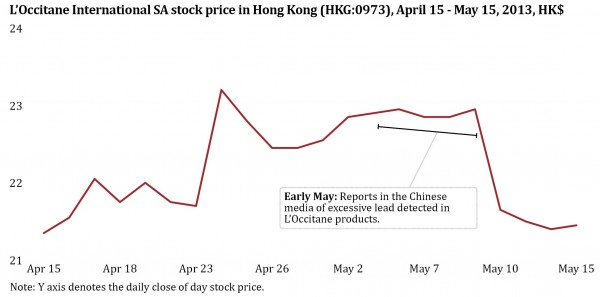
Chinese media last week reported that the Administration of Quality Supervision, Inspection and Quarantine (AQSIQ) announced that they had detected excessive amounts of lead in a foreign skin care product: “Almond Delicious Paste”, a skincare exfoliant product sold by the French company L’Occitane en Provence. L’Occitane is a Hong Kong-listed French company.

AQSIQ said that tested samples of “Almond Delicious Paste” contained lead in excess of the 0.04 mg/g standard. The test results were included in AQSIQ’s regular quarantine list. This issue of the list, published in early May but covering the month of March, included 156 imported food products and nine imported cosmetics products. L’Occitane’s high domestic profile made it the media focus in China. The company blamed the problem on the presence of naturally-occurring lead in kaolin, one of the product’s ingredients that a supplier had not properly analyzed. However, it also said that it had already recalled the product when it identified the problem in December 2012, and could not account for the source of the March 2013 imports.

Companies and brands affected
L’Occitane en Provence (HKG:0973)

Posted in Business and the Economy, Consumer Culture, Health and Medicine | Tagged , | Comments Off on AQSIQ: Excessive lead detected in L’Occitane exfoliant

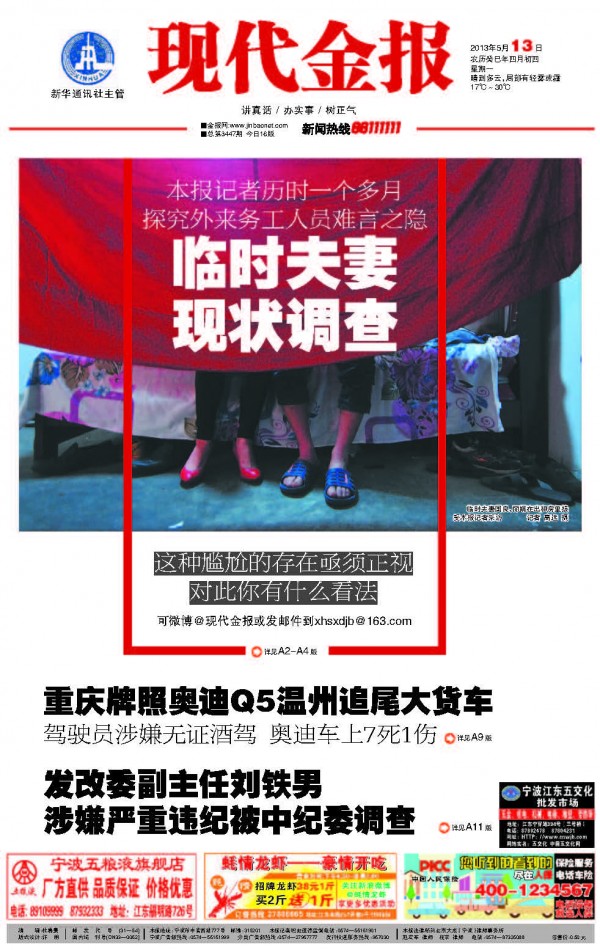
Migrant workers forming “temporary couples” in the cities

Xiandai Jinbao 13May

The millions of migrant workers in China have a tough life. Leaving their homes to find work and separated from their families almost all year round, they toil in the cities for little pay and reside in ramshackle lodgings. Yet this much we know about migrant workers, what we know less about is how these migrant workers deal with the loneliness and isolation of their long and difficult sojourns. After more than a month of research and interviews with migrant workers in the city of Ningbo, the Contemporary Gold (现代金报) newspaper from Zhejiang province today published a front page story on the phenomenon of migrant workers forming “temporary couples” (临时夫妻) in the cities.

The newspaper recounts the stories of a few individual migrant workers in Ningbo that have formed temporary bonds of love and support in the cities to help shoulder the difficult burden of urban life. The newspaper quotes statistics from the Ministry of Health that around 80% of migrant workers in China are in a sex-starved state. And not only this, they are alone in an unfamiliar location, with little money, and no-one to comfort them. So perhaps it’s not at all surprising that migrant workers are seeking to make temporary arrangements.

One of the stories that Contemporary Gold relates today is that of Old Shen and Xiaoyan, both married migrant workers, who found each other in Ningbo. Their tale illustrates just how some migrant workers are dealing with the difficult circumstances they face in the cities, and how they have to face the consequences of their decisions.

At this year’s Two Sessions in Beijing, Anhui NPC delegate Liu Li (刘丽) made mention of the phenomenon of “temporary couples” that migrant workers are forming in China’s cities. The Contemporary Gold (现代金报) newspaper from Zhejiang province today has a special investigative report on this phenomenon, the result of more than a month’s investigation among the migrant workers in the city of Ningbo. The newspaper cites data from 2011 that put the number of migrant workers in the city at 4.3 million, accounting for 43% of the city’s total registered population of 5.7 million.

Old Shen from Jiangsu province has been working as an electrician in Ningbo since 2000. He works alone in an office with no computer, only a desk. His wife and child originally came with him to Ningbo, but they eventually returned home because it was too expensive to keep them in the city. He used to visit once every year during Spring Festival, but that ceased as well when Old Shen opted to stay in Ningbo and work overtime.

Then one day Old Shen met Xiaoyan, a quiet fellow worker in the factory whose husband was working in Yunnan, when she asked him to go and fix the broken lamp in her rented room. They gradually became better acquainted and eventually were chatting every night. But Lao Shen was wary of falling in love with her.

Then during August last year, Xiaoyan caught a bad cold, and Old Shen took her to the hospital and stayed with her there for a day, and next day accompanies her back to her room. But then Xiaoyan would not let him leave. That night, they had sex for the first time. “It was like eating of the sweetest honey”, Old Shen was later to tell the journalist from Contemporary Gold. From then on, Old Shen spent three or four nights a week with Xiaoyan.

Yet Old Shen was deeply vexed by his infidelity. So during this year’s Spring Festival he decided to return home and tell his wife. The news was not at all well received by his family, and Old Shen and his wife eventually divorced.

Xiaoyan and her husband also divorced, and she and Old Shen are now living together in Ningbo. Yet they don’t want to get married, as they are not sure how long their relationship is fated to last.

Links and sources
Contemporary Gold (现代金报): 临时夫妻现状调查; 是什么促成了“临时夫妻”?

Posted in Front Page of the Day | Tagged | Comments Off on Migrant workers forming “temporary couples” in the cities