Full American dinner for Hu Jintao

AXL20110121xkb.jpg

New Express, January 21, 2011

Guangzhou’s New Express is just one of the newspapers highlighting the banquet attended by Hu Jintao on the 19th at the White House. The New Express has a picture gallery of food, the top chef and Michelle Obama’s red dress. They also listed the meal: d’anjou pear salad (芝士梨沙拉), Maine lobster (缅因大龙虾), ‘Dry Aged’ rib-eye steak and Buttermilk Crisp Onions (translated as steak with onions; 洋葱牛排), Old Fashioned Apple Pie (苹果派) and Vanilla ice cream (香草冰淇淋).

Elsewhere, the State media comments that in the US China joint statement the word “collaboration” is mentioned 51 times (合作), according to its Chinese translation.

The headline of the New Express reads that both US the China emphasize win-win in their approach.

A sub-headline reads that deputy provincial level officials will not be equipped with cars when they retire.

Links and Sources
Posted in Front Page of the Day | Tagged , , | Comments Off on Full American dinner for Hu Jintao

Beijing’s hidden ads in Taiwan media

China Times (mainland news pages) Jan. 18 edition.jpg

Image: Ralph Jennings

China is attacking Taiwan with a new war of words. But it’s not the ballistic, missile-rattling rhetoric of years past. Now it’s the sweet oily stuff of the post-2008 cross-Strait detente era: flattering words from Beijing, about Beijing, disguised in Taiwan’s media as straight hard news coverage.

So people in the industry say. In mid-January, Taiwan’s Apple Daily newspaper consultant Antonio Chiang issued a China advertorial warning to a democracy-building conference in Taipei, generating a flurry of Omigod-outrage media reports that went around the world.

Chiang, also a former Council for National Security official, called the practice a concern because Taiwan newspapers that take hidden ads from China would later be tempted to self-censor less flattering news about the other side to stay on Beijing’s payroll, the English-language Taipei Times reported.

A month earlier Taiwan journalism professors gathered to charge that China had deployed hidden ads in the local media since 2008, when two sides began to talk to each other in earnest after 60 years of official silence.

That same month veteran China Times reporter Dennis Huang quit over advertorials he claimed had been placed in his paper, the Taipei Times report said. The China Times owns Want Daily, a 2010 startup that covers China as if it’s a place as normal and nearby as south Taipei.

The media’s reliance on China comes as little surprise to those who follow the market’s gritty finances.

A friend at another large mainstream Taiwan daily told me half a year ago that his publisher regularly took pay from China in exchange for stories that promoted the place to the island’s visitors or investors. What the? I asked.

He laughed. His paper and all the rest are hurting for money as media are in most market economies. Layoffs swept the Taipei media in 2008 and 2009. One of Taiwan’s three English-language papers, the Taiwan News, closed last year.

Someone’s always murmuring that one of the four giant Chinese-language papers is next to fold, with publishers holding on just to save face or advance their political views through print. Taiwan also has a staggering six cable news channels, for a population of 23 million that’s often just as happy to find out what’s going on from Yahoo! or a magazine.

Most readers have their minds made up about China anyway.

Newspapers need income from somewhere, and the huge economy across the Strait make China a stable source.

Posted in Newspapers | Tagged , , , , | Comments Off on Beijing’s hidden ads in Taiwan media

Hu Jintao wears same tie when meeting Kim Jong-il and Harry Reid

hu kim 1 .jpg

Hu Jintao and Kim Jong-il, August 2010

This post was written by occasional Danwei contributor Spelunker

China’s President Hu Jintao wore the exact same tie today on Capitol Hill with Harry Reid that he wore back in August 2010 when meeting (and hugging) “dictator” Kim Jong-il in Changchun, China.

I have analyzed the photographic evidence from my home computer collection of Hu Jintao photos and can confirm that the tie he wore today on Capitol Hill shaking hands with the congressman who called him a dictator is exactly the same blue striped one that he wore when hugging a dictator from North Korea.

hu reid.jpg

Hu Jintao and Harry Reid, January 2011

The photos in Changchun were taken during Kim Jong-il’s second trip to China last year when he brought his son to Jilin province in late August. President Hu Jintao met Kim Jong-il in the parking lot of the Jilin provincial capital because Kim did not want to go all the way to Beijing.

The photos on Capitol Hill were taken from news articles that were published today as Hu left Washington DC to visit Chicago. It is clear from the photos taken today that the tie in question is indeed the same one that Hu wore back in August when meeting Kim in Changchun.

hu kim hug .jpg

The hug
Posted in Foreign affairs | Tagged , , , , , , | Comments Off on Hu Jintao wears same tie when meeting Kim Jong-il and Harry Reid

Hu Jintao sings Moscow Nights

A video from 2010 of Hu Jintao singing ‘Moscow Nights’.

Posted in Featured Video | Tagged | Comments Off on Hu Jintao sings Moscow Nights

People’s Daily covers Hu Jintao’s US trip

JDM110120rmrb.jpg

People’s Daily, January 20, 2011

President Hu Jintao is visiting the United States this week. Today’s People’s Daily devoted its entire front-page to coverage of Hu’s arrival.

Above the fold, Hu Jintao is received on the South Lawn of the White House, and then shakes hands with President Obama. At the bottom of the page, Hu warmly embraces an American child.

The upper right summarizes Hu’s five recommendations for the continued development of Sino-US relations (in Xinhua’s translation):

  1. Develop a political relationship of equality, mutual trust, and seeking common ground while reserving differences;
  2. Deepen comprehensive, cooperative, mutually beneficial, and win-win economic ties;
  3. Jointly meet challenges through global cooperation;
  4. Further their friendship with the extensive involvement of both peoples;
  5. Establish a high-level contact pattern featuring in-depth communication and candid dialogue.
Links and Sources
Posted in Front Page of the Day | Tagged , , | Comments Off on People’s Daily covers Hu Jintao’s US trip

Spring Festival travel fever begins; Ministry of Transport responds to “toll-fee incident”

AXL110119xjb.jpg

The Beijing News, January 19, 2011

Today’s Beijing News highlights the beginning of Spring Festival Rush (春运), where 2.853 billion train trips will be made by passengers will be traveling to and from their hometowns to spend the holiday, using various transport. Train tickets are also in short supply, which the Beijing News reported on.

The case of Shi Jianfeng has been in papers a lot lately. A reporter from the Beijing News tried to get a response from a high official in the Transport Ministry (交通部). First, the issue of Beijing traffic jams was addressed:

“Beijing’s traffic control via license plates, limitations on car purchase, and the policy of limiting cars from other provinces to enter the city, have all been recognized by high officials. These measures might used in other cities,” the deputy Minister for Transport Weng Mengyong (翁孟勇) said yesterday at the State Council Information Office press conference, in answer to this reporter’s questions.

Also, Weng Mengyong has noticed the measures that the Beijing Municipal Government took to solve traffic congestion: “I have obviously felt myself that these policies have had positive effects after being implemented.”

When this reporter asked about the incident of highways charging “sky-high tolls”, the deputy Minister responded: “It’s like this, without the policy of highway tolls, today’s achievements in China’s transport system wouldn’t have happened, neither would the current situation.” The deputy Minister said that the highway itself has social benefits, and the highway fees are connected to people’s lives so he understands the attention that people have paid to it.

The main picture on the page is the “China Experience” short film and billboard that was unveiled in New York’s Time Square.

Links and Sources
Posted in Front Page of the Day | Tagged , , , , | Comments Off on Spring Festival travel fever begins; Ministry of Transport responds to “toll-fee incident”

Hu Jintao on way to U.S.A. for state visit

Next Media Animation imagines Hu in Hooters as the high point of the state visit.

Posted in Featured Video | Comments Off on Hu Jintao on way to U.S.A. for state visit

Beijing’s most peaceful neighborhoods

JDM110118jhshb.jpg

Beijing Times, January 18, 2011

Beijing’s municipal congressional sessions are underway at the moment, and the city is at peace.

In fact, it’s so at peace that fifty communities have been given special awards for being the “most peaceful.” Today’s Beijing Times leads off with the story about the poll, which began on December 6, 2010.

By the conclusion at midnight on January 14, 2011, 2,574,899 votes had been placed online and by mobile phone. Ultimately, fifty communities stood out after the headed contest to occupy the Top 50 rankings and win the title of Most Peaceful Community. Longxiang in Aoyuncun and the Xinhua Agency community on Erlong Road received 82,352 and 71,211 votes, respectively, to win first and second place.

This year’s selection differed from years previous in that the public could vote on the nominees, rather than having the winners chosen by public security and other government departments. The paper (which sponsored the poll) spoke with Liu Tao, deputy director of the population management team at the city’s Public Security Bureau:

Reporter: What are the characteristics of the winning peaceful communities?

Liu Tao: Some of them are distinguished by using technology to create peace, others have strengthened the connections between residents and the floating population. They each have their own uniqueness. At the same time, these peaceful communities all satisfy the selection requirements: no break-ins have occurred in the past year, and local police enjoy at least a 95% approval rate among community residents.

The fifty winning communities were chosen from among 100 nominees.

In the front-page image, police inspect cases of fireworks to ensure that they are properly registered and licensed. The headline just below reports that a natural gas explosion in Jilin City yesterday killed three people and left 28 injured.

Links and Sources
Posted in Beijing, Front Page of the Day | Tagged , , , | Comments Off on Beijing’s most peaceful neighborhoods

Big Iron’s broken promises

JDM110118chunyuns.jpg

Promises from the Ministry of Railways

Spring Festival Rush (春运, chunyun): the two-week period when all of China goes home for the holidays. The mass migration taxes the country’s transportation network, particularly the railways.

In the run-up to the peak travel crunch each year, long lines and pushy scalpers hassle prospective travelers, and tickets always seem to be in short supply.

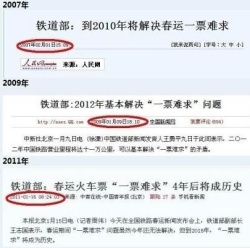
For several years now, the Ministry of Railways’ response has been to promise to end the problem, but as commentator Cao Lin shows in an op-ed for the Youth Times, these promises have not been kept. In fact, Cao argues, the promises can’t be kept: by continually promising a swift end to Spring Festival ticket shortages, the Ministry undermines its own credibility.

Solving the Ticket Shortage

by Cao Lin / YT

Every year at the Spring Festival rush, the voice of public opinion inevitably addresses the ticket shortage issue, and this year is no exception. Of course, it is no surprise that the Ministry of Railways offers up to a ticket-needy public its usual basket of words: in a few years, there won’t be a ticket shortage. In the face of public complaints, vice-minister Wang Zhiguo said at a Spring Festival Rush press conference a few days ago that while the ticket shortage is not solvable this year, by 2015 it would be history.

“History by 2015” obviously means that by 2015, buying tickets will no longer be a problem, and returning home for the Spring Festival will no longer be so difficult. For ticket-seekers standing futilely in line, suffering the winter cold, this promise was no ray of hope; rather, it brought only despair: ticket difficulties will not be resolved in the near future.

Why would such a promise bring despair to the public? Because the public hears the same promise practically every year. Only the time frame is different. Online, one can easily find the timetables issued by the Ministry of Railways. In 2007, Ministry spokesperson Wang Yongping said that the situation would be substantially resolved by 2010. But in 2009, Wang Yongping pushed the timetable to 2012, three years in the future, and said that by that year the situation would be basically resolved. After he was questioned, he stated resolutely, “there is a basis for this claim.” But now in 2011, the timetable has been pushed back again, to 2015. Running off the mouth like trains, do they really expect anyone to believe all of this?

Continue reading →

Posted in Transport | Tagged , , , | Comments Off on Big Iron’s broken promises

Toll judges fired and suspended

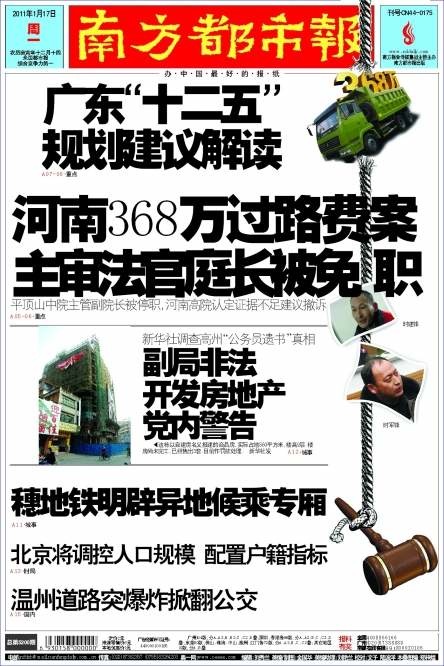
AXL110117nfdsb.jpg

Southern Metropolis Daily, January 17, 2010

Shi Jianfeng was sentenced to life in prison for evading toll charges 2,361 times when he drove on the Zhengzhou-Yaoshan highway. After internet uproar and a claim by his brother that it was actually him, the Pingdingshan Intermediate People’s Court issued a retrial. Today, media such as the Southern Metropolis Daily, points to Lou Yanwei, and Hou Xiaokong, both dismissed from their posts, and vice president of the court Ren Jianjun was suspended.

Links and Sources
Posted in Front Page of the Day | Tagged , | Comments Off on Toll judges fired and suspended