Chinese warships enter the western Pacific

Shenzhen Wanbao 29 Nov

Early yesterday morning, Chinese warships passed through the Miyako Strait (or the Gonggu Strait 宫古海峡 in Chinese) just south-west of Okinawa, heading out in the western Pacific for the purpose of carrying out “routine training exercises”. The front page of the Shenzhen Evening News (深圳晚报) from Guangdong province illustrates the eastward maneuvers with a large graphic showing the ships crossing a clear red line (running south-westwards to the right of Taiwan) from what should be Chinese waters into international waters. A handful of other newspapers have also put the warships on their front pages today.

As the Shenzhen Evening News reports, The Chinese vessels in question belong the East Sea Fleet, and include the destroyers Hangzhou and Ningbo, the corvettes Zhoushan and Ma’anshan, and the supply ship Poyang Lake. These are some of China’s most potent warships, and the purpose of this long-distance training exercise, according to the newspaper, is to make sure these ships are battle ready, and will be able to undertake longer missions and successfully see to the attendant supply requirements. There’s nothing strange about such long-distance patrols, the newspaper says, China has organized such patrols various times before and all naval powers undertake such patrols in international waters from time to time.

On the same day Japanese media reported that a number of Japanese vessels were sent out to shadow and monitor the Chinese convoy. According to the latest news reports, these ships have not reported any of the Chinese vessels coming close to Japanese waters.

Here’s a few other front pages from today with a maritime flavor:

Links and sources
Shenzhen Evening News (深圳晚报): 中国海军舰艇编队 进入西太平洋训练

Posted in Front Page of the Day | Tagged , , , | Comments Off on Chinese warships enter the western Pacific

Pandemonium on China’s stock market

Nanfangdushibao 28 Nov

There’s pandemonium on China’s newspaper front pages today: the stock market is falling even faster than the sliding temperatures. So there’s graphics of bears and plunging arrows galore. The Southern Metropolis Daily (南方都市报) from Guangdong chose today to dispense with any graphics and simply put the cold, hard truth writ large on its front page: “The weather is really cold, but the stock market is even colder”. There’s some fun stock market crash graphics to admire on various other papers though.

The Southern Metropolis Daily explains what all the fuss is about. Yesterday the Shanghai Stock Exchange Composite Index finally dropped below the psychological barrier of 2,000. Both of China’s stock markets (Shanghai and Shenzhen) opened low and went lower yesterday, with the Shanghai Stock Exchange Composite Index reaching a new low of 1990.34 (lower even than the 2009 low). The A-share stock market in China has now lost 9.47% in value this year, the highest rate of loss in the world.

Right next to this description of the drama unfolding on the stock market, the Southern Metropolis Dailyhas placed a prominent weather report on its front page with the following grim warning:

Cold wind, cold rain and cold air are causing the temperature to drop precipitously. Yesterday, 36 towns and counties in Guangdong put out warnings for very cold weather. Since the start of autumn, Guangzhou has yesterday also recorded the lowest temperatures of below ten degrees centigrade.

By its reckoning, China’s stock market is even colder than this. But really, ten degrees? Thats not cold at all.

Here’s how a few other papers today portrayed the pandemonium on the stock market, cartoon bears and all:


Links and sources
Southern Metropolis Daily (南方都市报): 1991.17A股跌回1时代; 9.9℃ 入秋以来广州昨天最冻人

Posted in Business and the Economy, Crime and Corruption, Front Page of the Day | Tagged , , , | Comments Off on Pandemonium on China’s stock market

Aircraft on the Liaoning and other stories from China’s newspapers today

Xinmin Wanbao 26 Nov

Most of the front pages of China’s newspapers today revelled in the display of aircraft landing on China’s new aircraft carrier. Scroll down to see a gallery.

But there was also much else on China’s front pages to enjoy today, such as China’s own 47 kg “Mike Tyson”; China’s best books of 2012; marine life off Shenzhen; a tirade against incorrect signposts in Shanghai; and the travails of a 14-year old girl working in her mother’s stead sweeping the streets of Wuhan – and no-one seems to mind.

Here are the latter stories’ front pages:

The Straits Times (海峡导报) from Fujian province today has the story of Xiong Chaozhong (熊朝忠), a former miner from Yunnan province now suddenly changed into “China’s Mike Tyson”. On the evening of the 24th of November, Xiong fought a “WBC Mini Lightweight World Boxing Gold Belt” bout in the 47.8 kg class against the Mexican fighter Javier Martinez in Kunming, Yunnan province. After 12 rounds of “bitter struggle,” as the Straits Times puts it, Xiong prevailed in this battle of the ultra lightweights.

The Daily Sunshine (晶报) from Shenzhen in Guangdong province today printed a list of its top ten books of the year so far. The list was chosen by a number of literary organizations in Guangdong, and this year Reversal of the Sun: Reflections on the Thoughts of Russian Intellectuals (倒转红轮:俄国知识分子的心路回溯)* by Jin Yan (金雁) (Amazon) came out on top.

Also on the Daily Sunshine front page today, the newspaper has a section on the “beautiful marine life” off the coast of Shenzhen under a headline asking, With such beautiful marine life, how can we have the heart to harm it? The article includes pictures and descriptions of various plants and animals.

The front page of the Shanghai Youth Daily is quite incensed today about a number of misleading and incorrect signposts that went up in the city recently without anyone seeming to know exactly where they came from. Naming and shaming every one of these fake signposts one by one, the newspaper launched its own investigation as to the source of what it clearly regards as irritating blemishes.

Lastly, the front page of the Wuhan Evening News (武汉晚报) from Hubei province today included a follow-up of the sad tale of Hu Linjiaxin (胡林家欣), a 14-year old girl from a rural area in Hubei who was found by the newspaper to be working as a street cleaner in Wuhan in the place of her mother, who was too busy with the responsibilities of the household. Wuhan Evening News originally published the story of Hu Linjiaxin on the 12th of November, and a number of other news agencies has since picked up on the story, with many readers all over China expressing their sympathy. Wuhan Evening News today printed a follow-up story about Hu Linjiaxin in which we hear that the girl’s classmates, teacher and parents all think there’s nothing strange about Hu working in her mother’s stead as many of her classmates also work to help out their parents. An “expert” from China’s Academy of Social Sciences compared Hu very favorably with the sad state of the “pampered and spoiled kids” that were born after 1995 and 2000.


Then there’s the military hardware. Here’s a few front pages today showing aircraft landing and taking off from the Liaoning, China’s first aircraft carrier:

* Our translation.


Links and sources
海峡导报 (Straits Times): 中国矿工变身“泰森”
晶报 (Daily Sunshine): 2012“年度十大好书”揭晓; 这样美丽的生命 我们怎忍心伤害
青年报 (Youth Daily): 这些山寨指路牌谁来“认领”?!
武汉晚报 (Wuhan Evening News): “不算新闻”引出更多孝行新闻

Posted in Business and the Economy, Front Page of the Day, Urban Culture and Cities | Tagged , , | Comments Off on Aircraft on the Liaoning and other stories from China’s newspapers today

Graduates in Inner Mongolia, the army wants you

Neimenggu Chenbao 23 Nov

You may be somewhat surprised to find that the main front page headline of the Inner Mongolia Morning Post (内蒙古晨报) today is not an item of breaking news but an army recruitment article aimed at university graduates. The front page announces that 4,884 students from the “whole area” has recently signed up for the army, yet the article is not about them but only about one young man who always wanted to join the army but, because he first attended university, was too old to sign up when he graduated. Yet we are told in the article that the army recruitment age was raised this year to allow graduates to join up, and all you need to do is read this newspaper to find out what an amazing offer the army is putting out. University graduates, the army wants you.

Here’s how the article – front page headline news – begins, setting the appropriate tone:

Get priority when applying for a job, for political checks on your background, for getting final approval as soldier, and for getting a good posting – apart from these four areas where you’ll get preferential treatment, you’ll also get priority for promotion, compensation for your tuition fees and student loan, and a subsidy for returning to school. When university students retire from the army they can still in the same year sign up for a master’s degree, and will get ten extra points on their overall score in the preliminary exam…

With such an offer, who can refuse?! Not surprisingly, the article tells us that “with this policy of preferential treatment, numerous students are signing up in a hot streak.”

To put it all in some perspective, we now meet Ma Shuai (马帅), whose tale of persevering to realize his dream of joining the army can serve as an example for everyone. “With this policy of preferential treatment,” he says, “I don’t have to worry about getting a job…Joining the army has always been my dream, but as it happened I attended university and narrowly decided not to join the army.” So Ma went to the University of Inner Mongolia (interestingly, he studied music), graduated in 2011, and went to Beijing to do part-time work.

But something was always gnawing at him, Ma says. From the “depths of his heart”, Ma just wanted to join the army. So he went back to his home town of Hohhot, but found to his dismay that he was already too old for the army, and his dream was “thoroughly smashed to pieces.”

But not for long: this year the policy was changed to allow university graduates up to the age of 24 to sign up. Now, Ma could (“like many others”) finally realize his dream to be just like his dad, who was also an army man. As Ma “passionately” recounts: “I can become a responsible man like my father, a genuine man with unyielding character”.

If this headline article didn’t quite excite you enough, here’s some other tales from the Inner Mongolia Morning Post today that might be more interesting:

  • Kid walks a thousand miles looking for his real dad (link)
  • Man recites ancient books in Guinness World Record attempt (link)
  • Boy starts a fire, killing self and father (link)


Links and sources
Inner Mongolia Morning Post: 全区4884名大学生报名参军; 男子奔走千里寻生父; 背诵古书申请“吉尼斯世界纪录”; 儿子放火烧死自己和父亲;

Posted in Front Page of the Day | Tagged , , | Comments Off on Graduates in Inner Mongolia, the army wants you

Impressions of Kashgar

1790227016


This is the 1510 Digest, a weekly roundup of recent essays and articles published on the Chinese web, with links to translations on the Marco Polo Project.

Kashgar, in Xinjiang, is China’s Westernmost city. A traditional stop on the Northern silk road, with a strong Central Asian flavour – Kashgar replaced Kabul as setting for the shooting of ‘The Kite Runner’ – it remains an exotic place for city dwellers of the eastern seaboard. Today’s post offers an insight into the way Han visitors may experience Kashgar through two different narratives. Although both acknowledge the beauty of the place and Uyghur hospitality, the tone differs. Ji Shuoming’s ‘Experiencing a different Kashgar’ proposes the vision of an integrated, developing and Mandarin-embracing Kashgar, whereas Wang Zhongwei’s piece, ‘Impressions of Kashgar’, gives a stronger sense of distance and alienation, in particular around the status of women.

Impressions of Kashgar
By Wang Zhongwei, 20 October 2012 (part 1) and 09 November 2012 (part 2)

Wang Zhongwei, philosophy teacher at Guanxi university, recently went on a trip to Kashgar. The trip was motivated by her curiosity to get a direct experience of Kashgar, rather than rely just on book knowledge and media reports to understand that part of China.
Before leaving, Wang Zhongwei was concerned about her personal safety. Upon crossing the border, what she experienced was heightened security checks. Her small bag was thoroughly checked, and her camera attracted the highest suspicion – but other passengers suffered similar hassle. Once in Xinjiang, the bus stopped for numerous ID controls, and at the check points, she could see the pictures of fugitive prisoners, with full details of their personal information.
On the bus, she finds herself the only Han Chinese – even the bus driver addresses her in Uyghur – until a young Han man get on halfway through. He’s a migrant worker from Gansu who came to Xinjiang 17 years ago for economic reasons, first worked on farms, then bought some land in the Kashgar area – but left his family back in Gansu, and still considers himself a foreigner in Xinjiang.

Wang Zhongwei spends three days in the village of Jiashi. There, she notices numerous brick buildings in construction, bearing signs of thanks to the party. These types of buildings are subsidised by the government, but depart from the local style. She experiences a strong sense of alienation in Jiashi. Numerous people ask when she approaches: “Is she Han, or Uyghur?” And her appearance – pants, hair down and sunglasses – sets her apart from the local women, all of whom wear the traditional long skirts and headscarves, in line with their traditional customs and their faith.

Later, she visits a Khirgiz village in the same district. There, she learns about a recent tragedy which the media silenced: local public servants of Uyghur origin were killed by a gang of other Uyghurs. The reasons for the murder are unclear, though some say they were accused of betraying the faith. There, she also meets an elderly man who weaves textile according to Uyghur tradition. He explains in official language how this weaving technique is part of local intangible cultural heritage, and must be preserved, but is unable to describe more in details what this label covers.
Wang Zhongwei recounts her experience of local hospitality with irony: her hosts serve her abundance of food when she visits, but she cannot refuse any of the pilaf rice offered; neither can she get rid of the melons her hosts offer in the morning, and finds herself dragging the heavy fruit around town. She also notices the importance of religion, with people thanking Allah at the end of a meal, and praying on various occasions.

The end of her narrative focuses more closely on gender division and the condition of women. Parents are stricter on their daughters than boys, and although things are slowly changing, a woman still has to receive her parents’ consent before marrying, and needs to have stricter codes of conduct, especially in her relationship with other men. One sign of this, she notices, is the total absence of women in local internet cafes.

Marco Polo translation: Impressions of Kashgar
Original link: Part 1 喀什印象(一); part 2 喀什印象(二)

Experiencing a different Kashgar
By Ji Shuoming, 06 June 2012

In this piece, written shortly after the maiden flight of the new ‘aerial silk road’ Hong Kong to Kashgar flight, Ji Shuoming, senior journalist for Asia week (亞洲週刊), paints a picture of Kashgar as an urban and dynamic place, insisting on the consequences of recent changes. With its new status as Special Economic Zone, Kashgar is hoping to become ‘the Shenzhen of the West’. Representatives of the local government recently went on a trip around Hong Kong, Singapore and Malaysia, to learn from their successes. The vision of the local government leaders – Han leaders with a solid understanding of Uyghur language and culture – is to benefit from Kashgar’s proximity to Central Asian countries to make it into a major trade and logistics centre – and through the newly opened air-route, to also benefit from Hong Kong’s dynamism.
Ji Shuoming notices the beauty of the place, but also its strong Uyghur character – the Han Chinese are only a small minority. But most of the Uyghurs he met could speak some Mandarin; and a local told him his children to learn the language, so they would get better opportunities. He also insists on the friendliness of the local people, including merchants at the bazaar. Although the language and customs were strange to him, he felt welcomed and safe in Kashgar.

Marco Polo translation: Experiencing a different Kashgar
Original link: 感受不一样的喀什

All articles in this digest and a large range of other Chinese readings are accessible at Marcopoloproject.org. Some are available in English, French and Spanish translation. (You can join the project if you’d like to help with translations.)

Danwei is an affiliate of the Australian Centre on China in the World at The Australian National University. This posting is a result of one project that is part of that on-going collaboration.

The China Story, China Heritage Quarterly and East Asian History are publications of the Australian Centre on China in the World.

Posted in 1510 Digest, Traditions | Tagged , , , , | Comments Off on Impressions of Kashgar

Why is the air quality in Ningbo so bad? A government official explains

Xiandai Kuaibao 22 Nov

Pollution in Ningbo has apparently been very bad of late, with ubiquitous fog, occasional dust storms and a gloomy dusk hanging over the city like a “layer of cotton yarn”. So the local Modern Express (现代快报) from Zhejiang province decided to try and find out why. The front page of this newspaper today asks “Why has Ningbo’s air quality been so bad of late?” To get some answers, the newspaper turned to an official at the city’s environmental monitoring department, who blamed normal local weather conditions for trapping the dust kicked up by all the construction in the city. 

From the 16th of November, the Air Quality Index (AQI) in Ningbo has been steadily declining. A monitoring device at a school in the city yesterday gave a reading of “severe pollution”, with the main pollutant being ground-level ozone pollution. When the pollution is this bad, patients suffering from liver and heart conditions show worsening symptoms, and even generally healthy people can start showing symptoms.

This state of affairs has ignited a debate online by concerned city residents. As a result, Ningbo ‘s mayor, Liu Qi (刘奇), put out a new regulation requiring all relevant local government departments to attach utmost importance to the issue, and to crack down severely on any violators (严厉打击). For a few years now Ningbo has implemented a “Clean Air” policy to close down and/or renovate polluting industries and to cap motor exhaust fumes.

So what’s the deal with all the pollution in Ningbo? When the Modern Express went to check in with the Ningbo Environmental Monitoring Center (宁波市环境监测中心), the latter told the newspaper that the typical autumn and winter weather  in Ningbo are the main reason for the change in air quality in the city as they serve to trap the harmful pollutants in the city’s atmosphere. The dry air, moreover, sucks up dust particles and causes them to accumulate in the atmosphere. The main source of all this dust is the multiple construction sites in the city for building new roads and subway stations, and for demolishing older buildings.

The official also explained that the air quality is bound to improve with the rain that fell yesterday in the city, and the more it rains, the better it will get. Yet the official also reminded residents of the city to look carefully at the weather before deciding to go outside: if its nice and sunny for a few days but then the weather changes again to be foggy and hazy, its likely that the air quality is not good and hence its not advisable to go outside.

Looking at the weather forecast for Ningbo, there’s a lot more gloom on the way.


Links and sources
Modern Express (现代快报): 宁波近期多雾霾天气 空气质量不佳为什么?

Posted in Front Page of the Day, Wildlife, Nature and the Environment | Tagged , , , | Comments Off on Why is the air quality in Ningbo so bad? A government official explains

Selfless teacher leaves career in the city for “dream job” teaching rural kids

Wuhan Chenbao 20 Nov

When Peng Jun (彭军) graduated in 2011, he was all set for a career in the city and stepping up the ladder of social progress. Yet at a time when the norm is to seek to build your own fortune in the world and raise a family, Peng decided to do something completely different. He left his prospects in the city, and joined a programme for sending teachers to rural schools while working for a minimal salary. Finding himself in a small rural school in a mountainous area of Hubei province, Peng came into his own, devoting himself to the comprehensive education of his students, while developing novel teaching techniques for “joyful”, “creative” and even self-critical education. In the face of a pitifully low salary and the resistance of his parents, Peng found his rural teaching job to be his dream job. The front page of the Wuhan Morning Postfrom the capital of Hubei province today recounts the story of a man whose selfless devotion to the education of underprivileged kids can serve as an inspiration in times when a self-centred and narcissistic pursuit of wealth is often the norm. Thanks to Weibo, Peng’s story is now front page news.

Born in 1987, Peng Jun (彭军) graduated from the Wuhan campus of the South-Central University of Politics and Law (中南财经政法大学武汉学院) in 2011. The day before he was to graduate, however, he attended a lecture at the university that was to change his life. The lecture was on a programme for sending teachers to rural schools in Hubei province. 20,000 teachers have already been sent to 1,900 villages in Hubei via this programme. The lecture made a big impression on Peng, and the day before his graduation he decided to change course and applied for the programme.

Thus in September last year, Peng found himself at Pingbaying Village Primary School (坪坝营镇新场小学) in Xianfeng county (咸丰县), Enshi prefecture (恩施州), Hubei. Surrounded by mountains, the school is located 1,100 meters above sea level and has 504 students with 30 teachers and staff. Peng Jun was allocated a class with 49 students, mostly from the surrounding villages.

Not put off by his new remote and Spartan surroundings, Peng devoted himself to the job. He not only teaches the 49 kids at school, but travels the surrounding countryside to visit every household and see their home situation for himself. And even though his salary amounts to just 1,160 yuan (or US$185) per month,  Peng out of his own pocket purchased sports equipment for the school as well as badges, sweets, and books.

Learning of Peng’s exploits on Weibo, journalists from Wuhan Morning Post went to see for themselves how he was doing in his mountain school. They found that Peng had developed his own style of teaching, with an emphasis not on rote learning and stern instruction but on joyful education  (快乐教育) and creative education (教学教育) to give his students a good all-round education yet making sure they can enjoy it as well. Peng has even been able to get his students to write about their own shortcomings, which no other teacher at the school has been able to achieve (and which can clearly often be a very sensitive undertaking in China).

Despite his very low salary and strong resistance from his parents (Peng’s parents became so concerned about their son that they forbade him from continuing to teach at the school, yet with the help of his sisters, Peng lied to his parents, who now think he has a white collar job in Nanjing), Peng has rejoiced in his job. As he wrote on Tencent Weibo, teaching the kids in Hubei was a dream come true for him:

I should rejoice, the choice I made after my graduation put me on a path to attain my dreams. Where will this road end? I don’t know. But on the way there, with all the wind, rain, snow and all the good and bad, I will fulfil what is in my heart and be satisfied with that.


Links and sources

Wuhan Morning Post (武汉晨报): 深山资教生彭军和他的欢乐课堂 ; 听了场资教报告会; 彭军的“三大困惑”“一大抱歉”; 让学生写自己的缺点; 翻越四座山带着“彩虹伞”去家访
Peng Jun on Tencent Weibo (Note he still has only 61 followers)

Posted in Front Page of the Day, School and Education, Wildlife, Nature and the Environment | Tagged , , | Comments Off on Selfless teacher leaves career in the city for “dream job” teaching rural kids

The 18th Party Congress is over, let’s have some news

Mashup

Now that the 18th Party Congress is over, newspapers all over China are free again to report on whatever they think can make their front pages as interesting and as inviting as possible. So here’s a selection of four front pages that caught our eye today with some everyday stories from around China:

The Straits Times (海峡导报) from Fujian province has a Like (喜) and Dislike (惊) contrast on its front page today, where the Like is a picture of a massive pumpkin that was on display at an agricultural fair in Fujian last weekend (appropriately timed for Thanksgiving), and the Dislike is a picture of a child wearing a bikini and acting as car model at a car show in Wuhan last week (see more on this at Offbeat China).

The Jinan Times from Shandong province today gleefully reveals the female members of the Liaoning, China’s new aircraft carrier, who are shown posing on the deck. The front page of the Wuhan Evening News(武汉晚报) from Hubei province today features some pictures of a competition called “Wuhan Subway Experts” in which contestants had to pick out instances of uncivilized behaviour from a group of people on the subway.

Finally, the front page of the Modern Express from Jiangsu province today features the story of Guo Hongzhen (郭红珍), a 69-old retired lady from Nanjing. Every time that a younger person has given up their seat for her on public transport, Ms Guo gave them a little bead ornament. She has so far given away more than 200 of these.

Links and sources
Straits Times (海峡导报): 喜
Straits Times (海峡导报): 惊
Jinan Times (济南时报): 揭秘海军首批女舰员
Wuhan Evening News (武汉晚报): 荡秋千 打扑克 跳骑马舞 
Modern Express (现代快报): 南京郭奶奶传承爱心

Posted in Front Page of the Day | Tagged , | Comments Off on The 18th Party Congress is over, let’s have some news

Xi Jinping: “New start, new expectations, new era”

Chengshi Wanbao 16 Nov

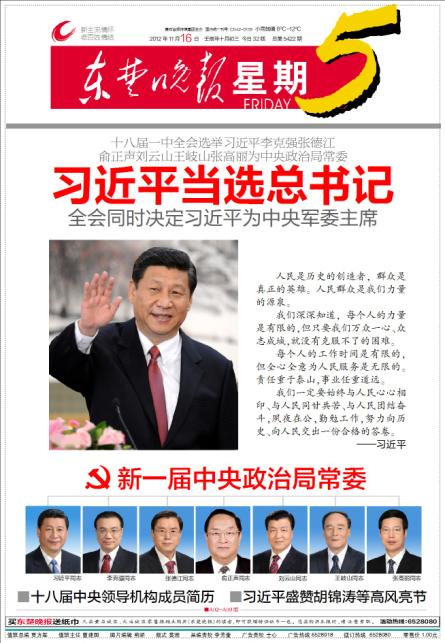
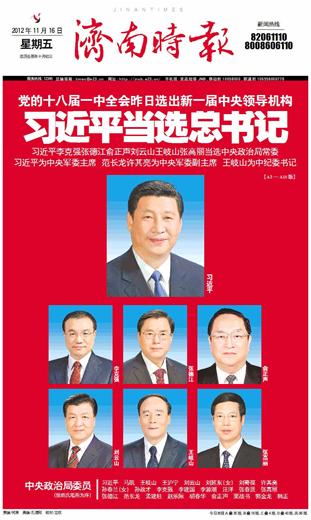
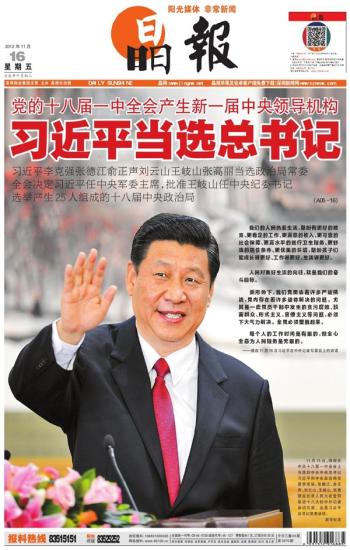
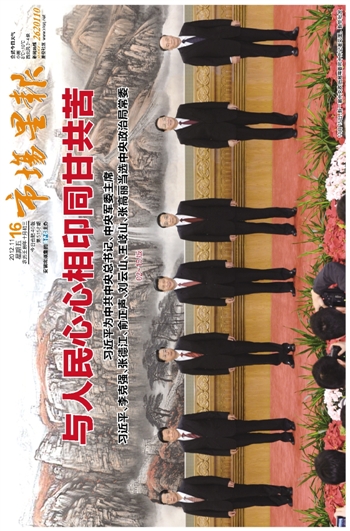
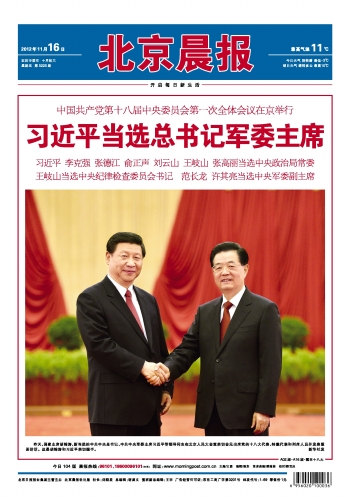
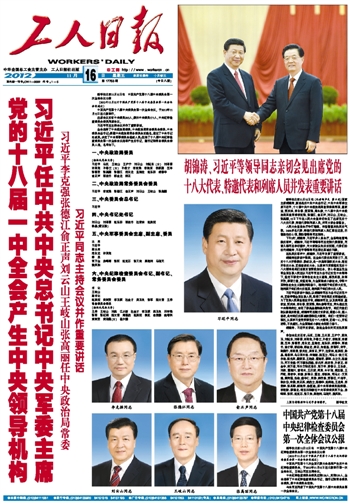
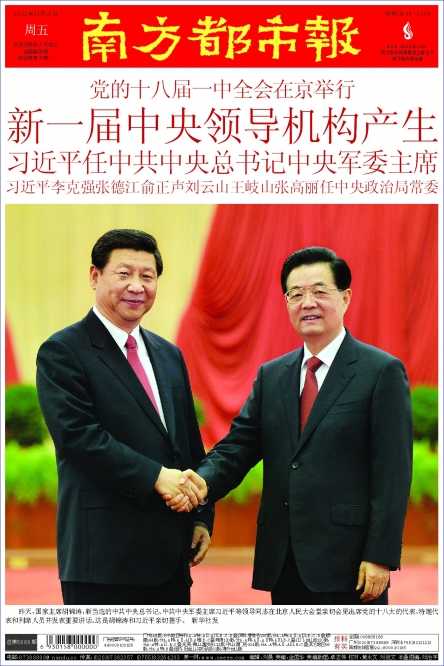
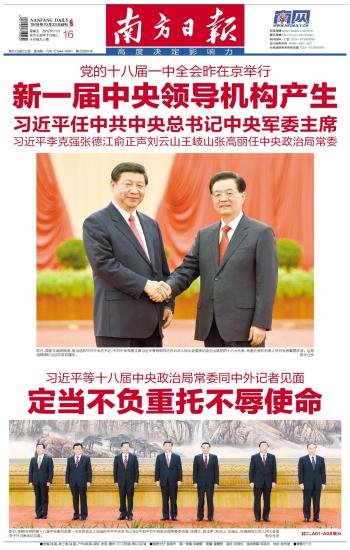
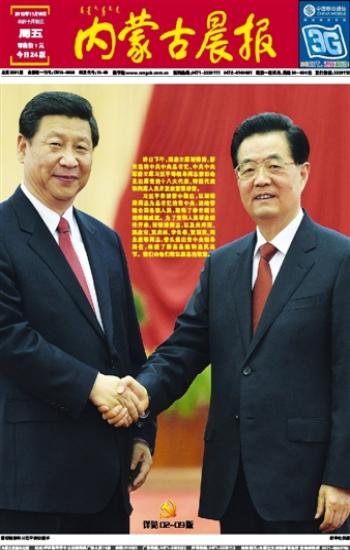
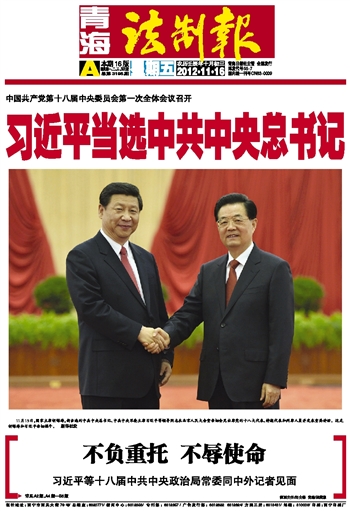
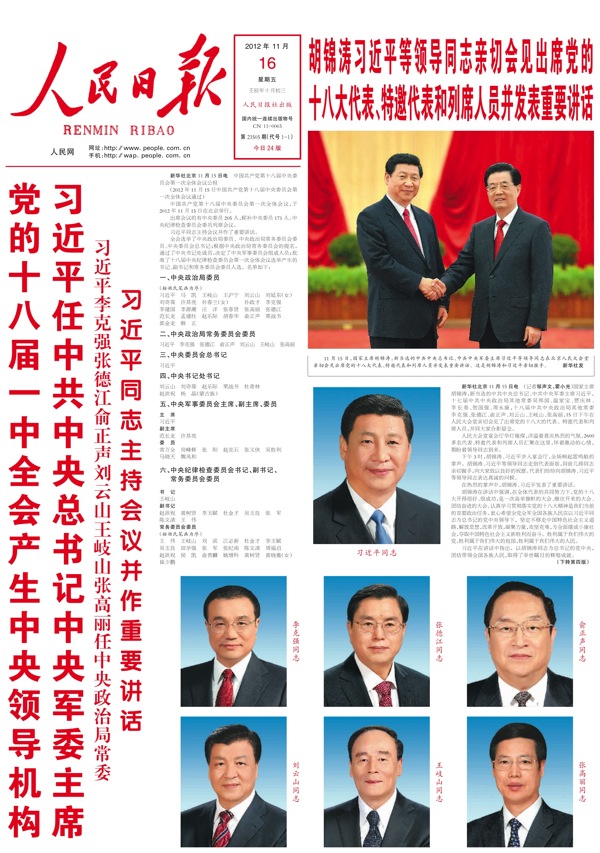
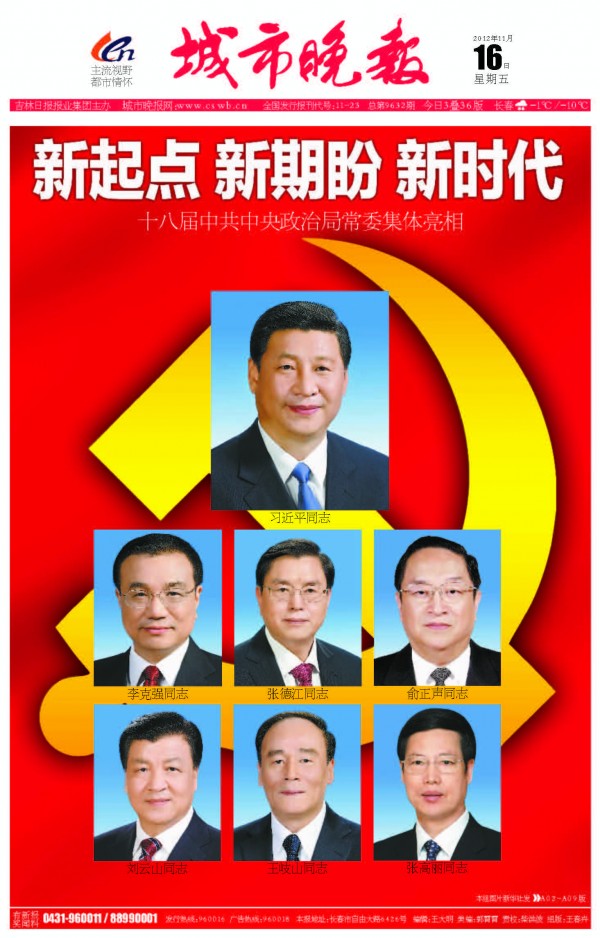
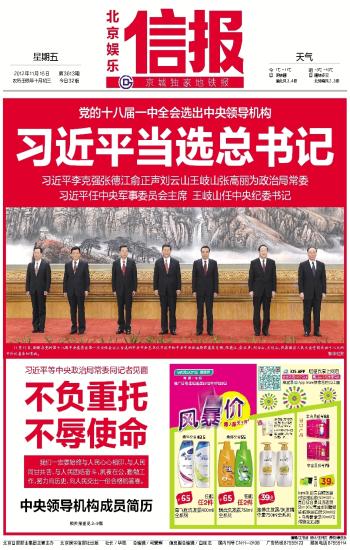
Xi Jinping has the biggest and most ubiquitous picture on the front pages of China’s newspapers today, signifying that he is now in charge, unlike yesterday when Hu Jintao’s picture was still all over the front pages. With the new seven-member Politburo Standing Committee meeting the media yesterday, there’s only one headline worth having in China today: Xi Jinping becomes CPC Central Committee General-secretary and Central Military Committee chairperson. A few newspapers even deigned to describe Xi Jinping’s elevation as a near-messianic event. The City Evening News (城市晚报) from Jilin province, for example, put large pictures of Xi and the other six members of the new Standing Committee on its front page next to a headline reading “New start, new expectations, new era” (新起点 新期盼 新时代). Yet while many newspapers hailed a new era, various others opted to place a picture of Hu Jintao shaking hands with Xi Jinping on their front pages, signifying the peaceful and stable passing of the mantle.

Amazingly, a very small number of newspapers even neglected to report the story on their front pages at all.

Gallery one: Xi Jinping – The man of the hour:


Gallery two: From one great man to another – Stability reigns:


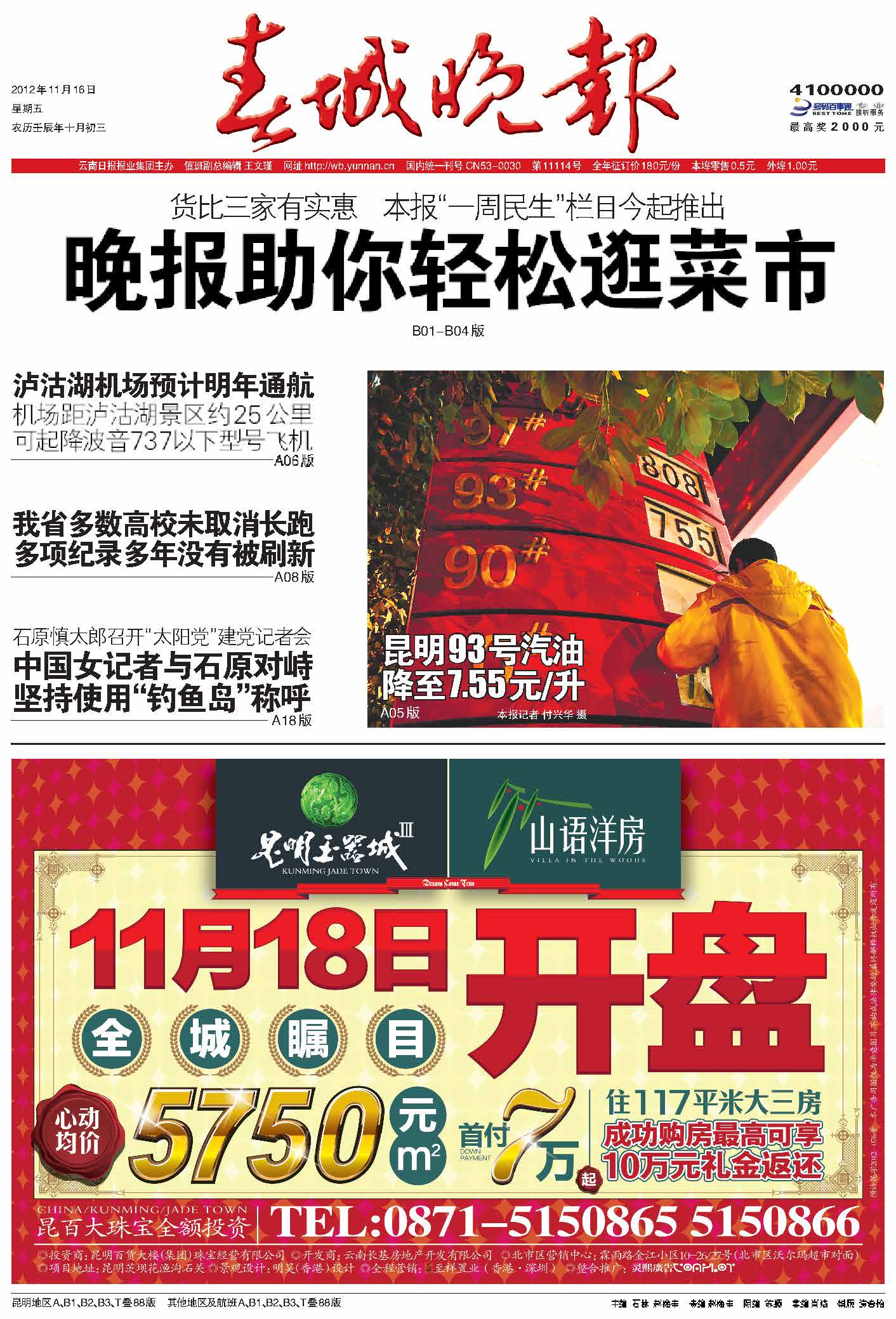
Amazingly, there were at least two newspapers today that completely sidestepped the main story of the day, for whatever reason. The Spring City Evening News (春城晚报) from Yunnan province instead used the main headline “We help you make a relaxed visit to the food market,” while the Nanchang Evening News(南昌晚报) from Jiangxi province for its part went with a headline announcing a rise in the price of gas.

Gallery three: More important things to discuss:


Gallery four: From the horse’s mouth – The People’s Daily


Links and sources
City Evening News (城市晚报): 新起点 新期盼 新时代

Posted in Front Page of the Day | Tagged , , | Comments Off on Xi Jinping: “New start, new expectations, new era”

The Wrinkly Arm of the Law

galaxy-red-guard

A photo diary of encounters with retiree security volunteers in Beijing during the 18th Party Congress.

It’s something of an unusual policing tactic, employing tens of thousands of smiling, crinkly-eyed pensioners as the first line of defense against the unending menace of ‘hostile forces’, hellbent on disrupting China’s most important political meeting in a decade. It’s also, you might say, a touch of genius. “I’d be out on the corner chatting anyway, so why not serve my country?” explains Granny Li, 69 years old. “Though it is colder than I imagined.”

Over the last few weeks, a squadron of retirees took to the streets of Beijing as security volunteers to keep watch over the city during the 18th Party Congress. With an infamously keen ear for gossip, and in a society where seniority traditionally commands respect, grannies and grandpas are the ideal impromptu guardians, both all-seeing and utterly approachable. They are the perfect embodiment of the smiling authoritarian ruling style that the CCP is so good at. The retiree police force even works free of charge – most talk of proudly serving their country as their sole motivation. “The cold will not keep me from this task,” announces 60 year-old Granny Zhang.

In fact, the government had thought of the weather too, supplying participants with bright red winter jackets with “volunteer service” printed on the back. “I think we will have to return these when we are finished,” points out 66 year-old Granny Zheng. These official wind-breakers, along with red armbands, bolster an air of natural authority these ladies radiate within their communities, though it is not entirely clear what mandate to police they actually have. Pro-active duties largely seem to involve pointing lost tourists in the right direction.

Grandpa Li, 66, says they have basically only been told to look out for “suspicious” people or incidents. ”I can immediately tell bad people from the good ones,” he insists. “Bad people are afraid of being seen.” One volunteer reports encountering a drunk: “But he was with friends so I left him alone. If he was by himself I would have reported him to the police as suspicious.” Another talks of a colleague discovering someone putting up posters of an outlawed religious sect. But normally, the highlight of most days is a loved-one arriving to top up drained flasks of tea with hot water.

“Really we are just acting as a warning for criminals,” says Grandpa Li. “Like an alarm system.” It is certainly one you cannot fail to notice.

These grannies and grandpas were part of an estimated 1.4 million-strong security force that blanketed the capital for the 18th Party Congress. Public service workers such as bus conductors and street sweepers have also been enlisted, though for them extra security duty is mandatory. Behind these are increased teams of police on patrol, uniformed and undercover, People’s Armed Police, and PLA troops around and surrounding Beijing. Combined, the capital temporarily resembles something like a police state, with every major corner closely guarded. The atmosphere is incredibly paranoid.
The retiree security details mostly succeed in leavening this,  like a welcome exchange of brief humour at a funeral. But it is clear they also take their jobs very seriously.

———–

As the sun goes down on the  last day of the 18th Party Congress and the light begins to fade in the hutong of Beijing, I approach a group of septuagenarian volunteers busy knitting scarves and ask if I can photograph them. They immediately refuse, one lady shaking her head furiously and explaining “it is not proper to knit while on duty! Someone will see!”

I wonder who exactly would be watching these unpaid watchmen. But even as I begin to ask, the ladies are already packing away their knitting needles, smiling with glowing cheeks and beckoning me forward to take a picture. As I raise my camera, their gentle expressions quickly give way to a gaze of intense vigilance, as if they are imagining how a real security officer would deal with this. I pause, then lower my camera accordingly.

All photographs by Christopher Cherry

Additional research by Liu Ying

Posted in Urban Culture and Cities | Tagged , | Comments Off on The Wrinkly Arm of the Law