Celebrating Singles’ day

32fa828ba61ea8d394e80876970a304e241f58fd


This is the 1510 Digest, a weekly roundup of recent essays and articles published on the Chinese web, with links to translations on the Marco Polo Project.

On November 11 – 11/11 – China celebrated ‘Singles’ day’. The origins of the festival are somewhat obscure – it allegedly started within a group of friends on the Nanjing campus in the early 90s – but it has since become a popular celebration. The festival has grassroots origin, and its fame spread over the internet, though business has also encouraged this festival, seeing urban singles as an attractive consumer group. A form of ‘bachelor pride’ for unmarried young people, singles’ day is an occasion for them to come together and indulge, or – for others – it is a day to get married and say goodbye to single’s life.

This festival also reflects changes in contemporary Chinese relationships and families, which this week’s digest will focus on. Li Yinhe’s post looks through the causes for the growing number of single-person households in China; Peng Peng reflects on the reasons why Singles’ day turned into an e-shopping festival; and Wang Feng’s more melancholy piece, ‘Chinese lonesomeness’, gives us insight into the spiritual life of a single Chinese urbanite.

Li Yinhe discusses why more and more people choose to remain single
By Li Yinhe, 09 November 2012

In this article published shortly before Singles’ day, famous sociologist Li Yinhe, specialist of gender and sexual questions, discusses the reasons for the increase.

There has been a global increase in the number of single-person households, which is extending to China – with an estimated over 1 million young people of marriegable age living alone in Shanghai and Beijing, and over 10 million across China. This marks a significant change with traditional sociological descriptions of Chinese society, where family interests were said to dominate.

Li Yinhe sees four main causes for this change. First, the rise of individualism that has accompanied urbanisation and modernisation – so that many people now choose the lifestyle. Second, gender equality, giving women the possibility to become economically independent, has also given them the possibility to choose a single lifestyle. Third, and more complex, the increase in life expectancy is a cause. With longer life, the idea of a life-long partner has taken on a different meaning, and this accounts partly for the increased divorce rate. In turn, some people choose to not get married due to the high cost of a divorce. And finally, the end of the worship of fertility, as ancestor worship declines as a religious practice, and pension systems reduce the pressing need for offspring to look after the elderly, has led to a decrease in the necessity of marriage for reproduction.

Li Yinhe encourages not to think of this wave of single life along moral lines, as a good or bad thing – morality changes over time, the choice of a single lifestyle is in line with the rights of people, and we should rejoice to live in a time of such freedom and personal choice.

The piece finishes with a short interview in which Li Yinhe proposes her views on turning a passionate relationship into a stable marriage, the possibilities of negociating free love within a marriage instead of divorcing, and the importance of sex education in light of a growing trend of premarital sex.

Marco Polo translation: Li Yinhe discusses why more and more people choose to remain single
Original link: 李银河谈为何越来越多人选择单身

How did Singles’ day become online shopping day?
By Peng Peng, 13 November 2012

In this article published in the Southern daily, blogger Peng Peng describes the way the online shopping economy took over singles’ day.
Acknowledging the importance of the festival – a grassroots celebration developed from China – though inspired by Western festivals such as Valentine’s day, Mother’s day and Halloween. It is quite common for festivals to become occasion for shopping, but this year saw a new phenomenon: Singles’ day became a special day for online shopping, with discounts offered to singles. This is part of the shift towards new models of retail and consumption: in 2013, China is expected to become the largest online retail market globally, and Guangdong is leading the way in China. The use of Singles’ Day by electronic businesses in turn led to promotions in other retail sectors.
This taking over of Singles’ day by electronic commerce, argues Peng Peng, is not incidental: singles spend an increasing amount of time online, including on dating sites – ironically, Peng Peng shows how the desire to ‘lose you single status’ by online dating leads to a shift to online commerce – where they buy gifts for prospective partners. The discount is also appealing, 11 November is a good date to buy clothes for the winter, and is just between Autumn Festival and Christmas.
He concludes by seeing the economic and sociological importance of that celebration, and envisaging the possibilities of this Chinese social innovation spreading to the world.

Marco Polo translation: Li Yinhe discusses why more and more people choose to remain single
Original link: 光棍节缘何变成了网购节?

Chinese lonesomeness
By Wang Feng, 12 July 2012

In this melancholy post, blogger Wang Fend describes a certain sense of lonesomeness pervading contemporary China – a . In spite of all the material progress China has made, yet there has been a spiritual change for the worse, a loss of values and grounding, and a sense of loss. This, he also connects to migration: many dynamic and enthusiastic Chinese people are leaving the country, aspiring for a better life the new context has given them the desire for – but this, he also attributes to a general sense of anxiety, sadness, and lonesomeness.
He distinguishes two feelings, loneliness – a weakness, a gap to be filled – and lonesomeness, a much stronger, relentless emptiness that does not want to be filled. This sense of lonesomeness, he relates to the growing materialism – a ceaseless, bottomless desire for material goods, that can never be satisfied, and has taken the place of love. Meanwhile, the successes of China, or moments of patriotic coming together – like aid for the Sichuan earthquake – alleviate this lonesomeness somewhat, but only temporarily. The joy is gone, the sparkle is gone, only anxiety remains.

Marco Polo translation: Chinese lonesomeness
Original link: 孤独的中国人

All articles in this digest and a large range of other Chinese readings are accessible at Marcopoloproject.org. Some are available in English, French and Spanish translation. (You can join the project if you’d like to help with translations.)

Danwei is an affiliate of the Australian Centre on China in the World at The Australian National University. This posting is a result of one project that is part of that on-going collaboration.

The China Story, China Heritage Quarterly and East Asian History are publications of the Australian Centre on China in the World.

Posted in 1510 Digest | Tagged , , , , | Comments Off on Celebrating Singles’ day

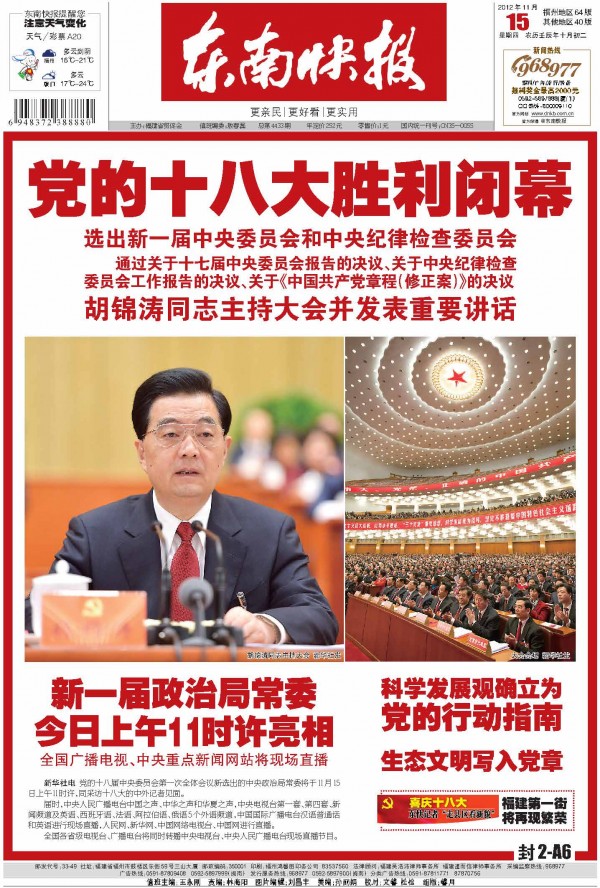
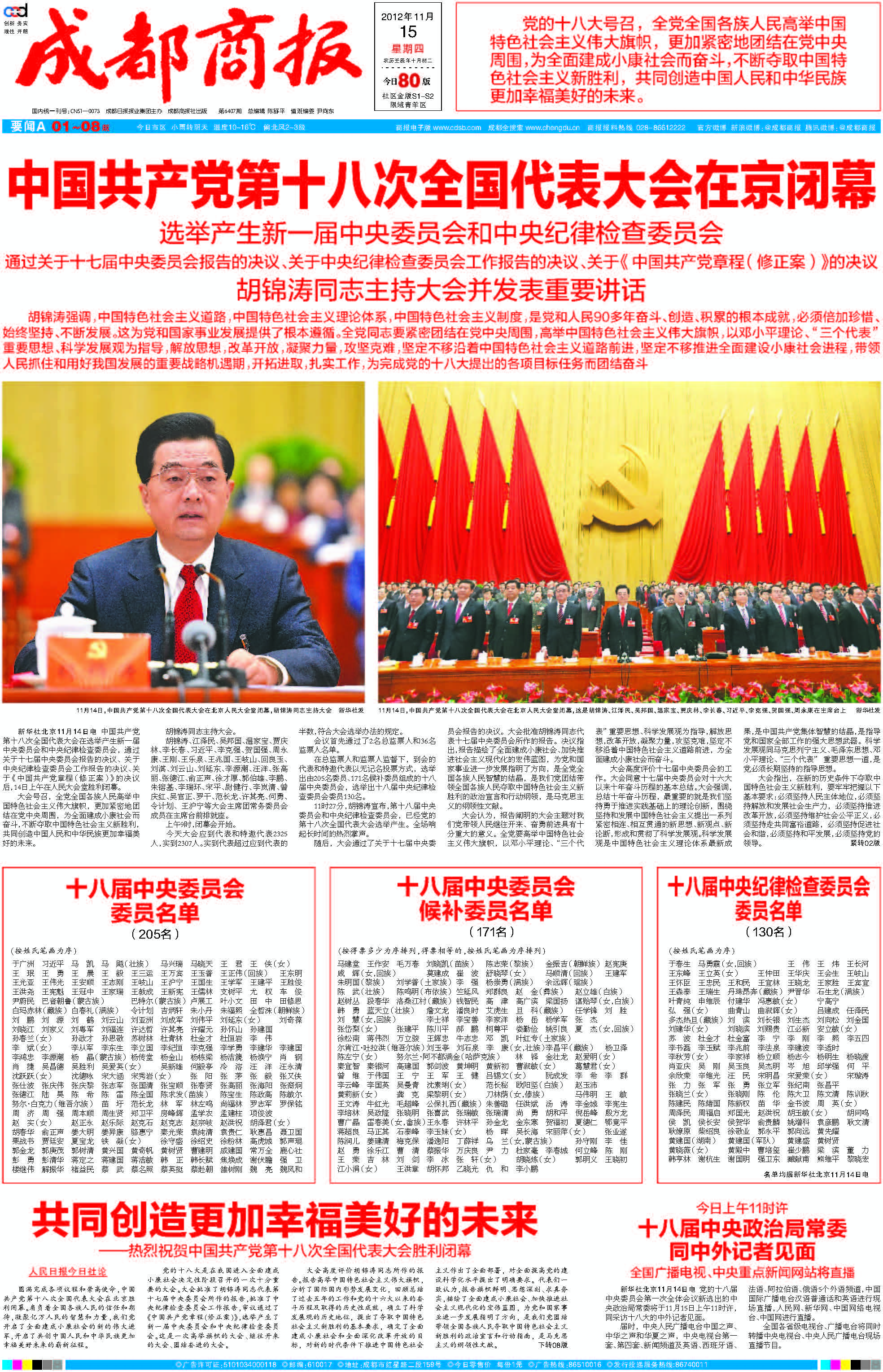
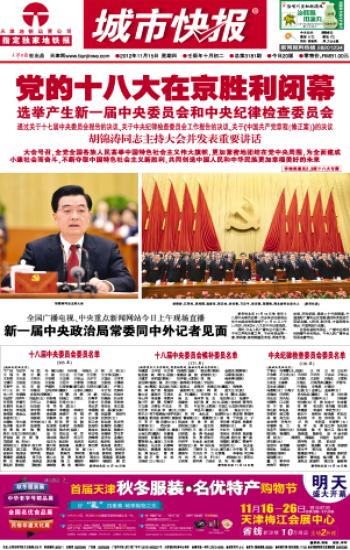
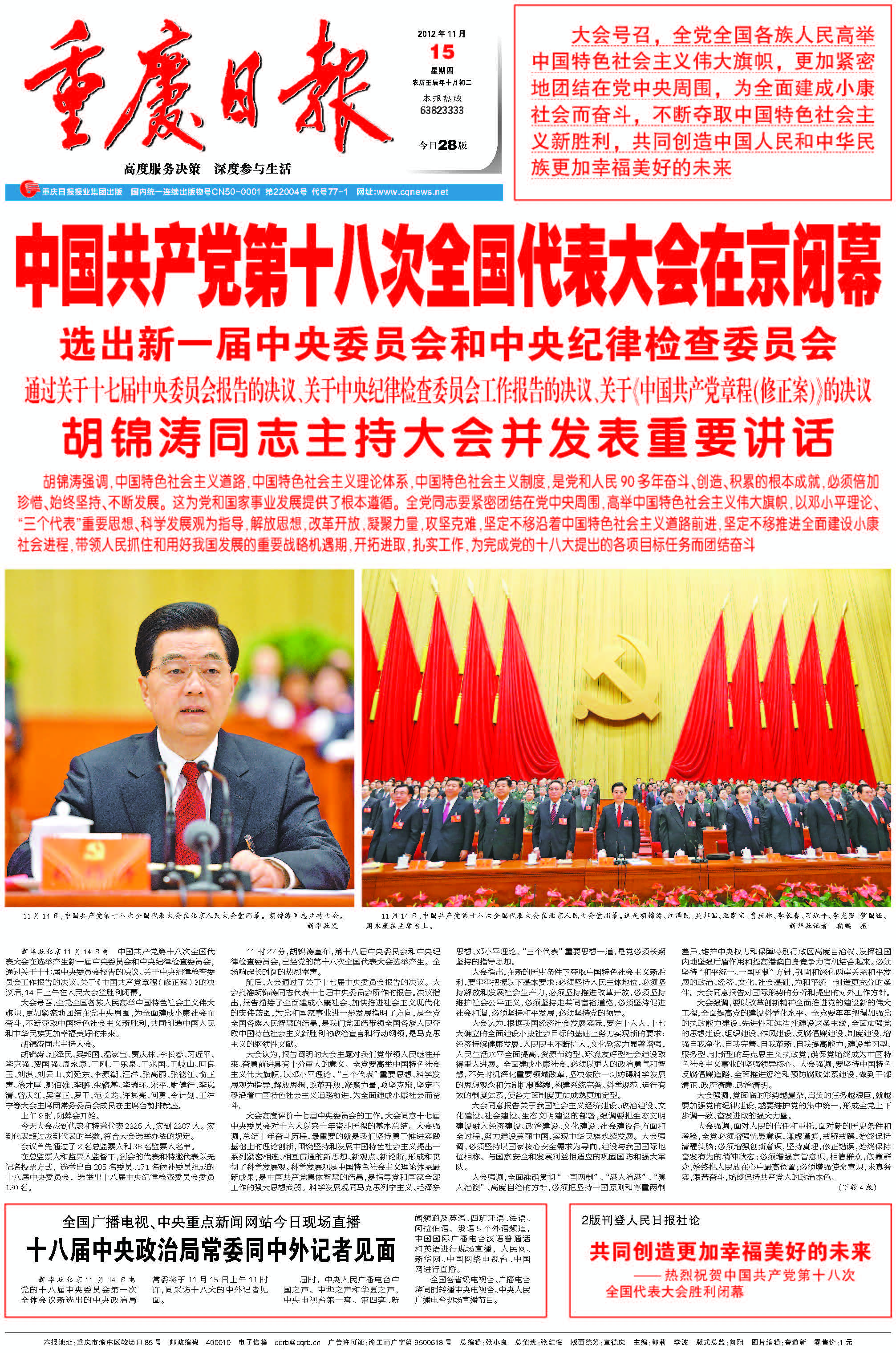
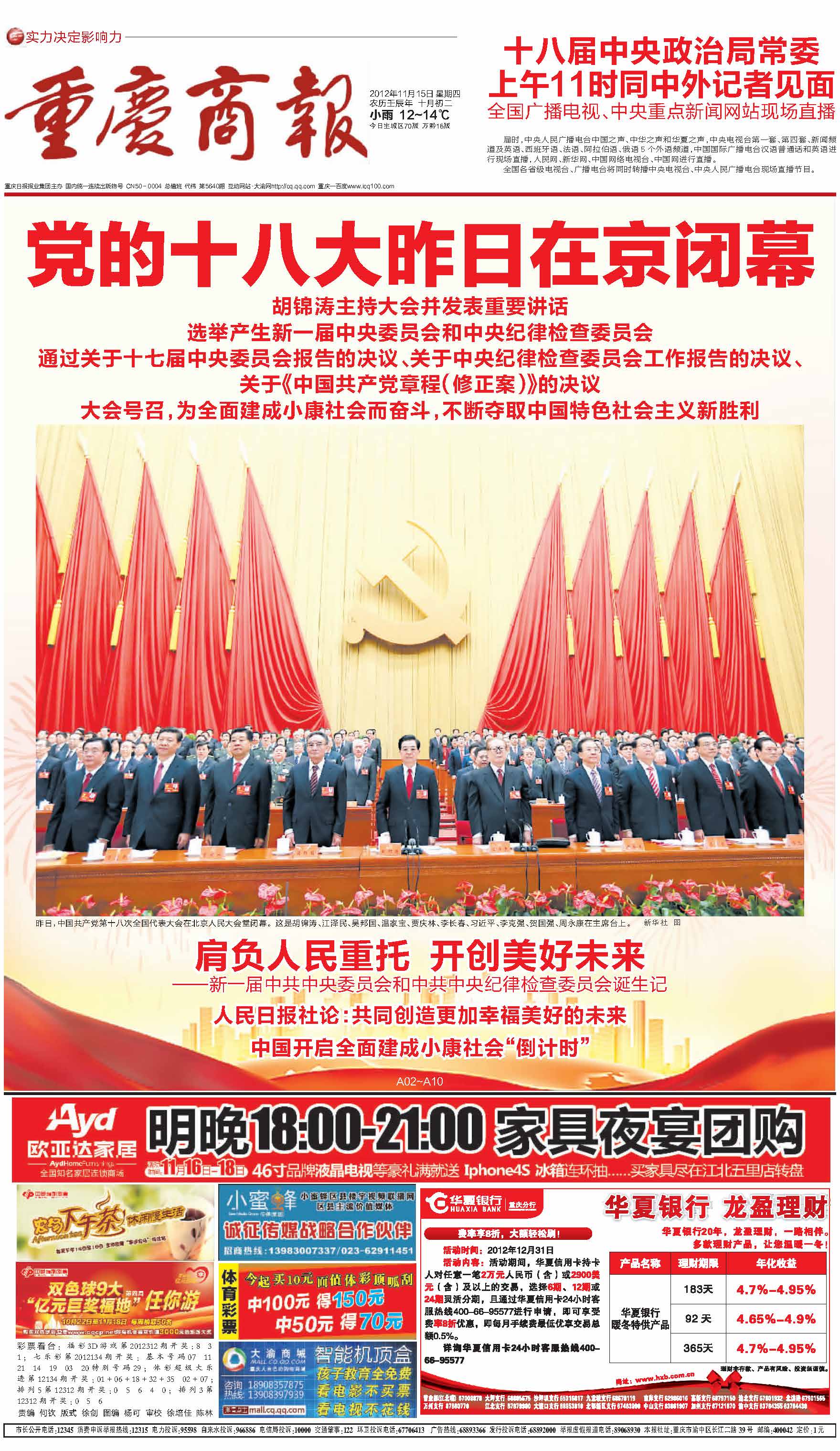
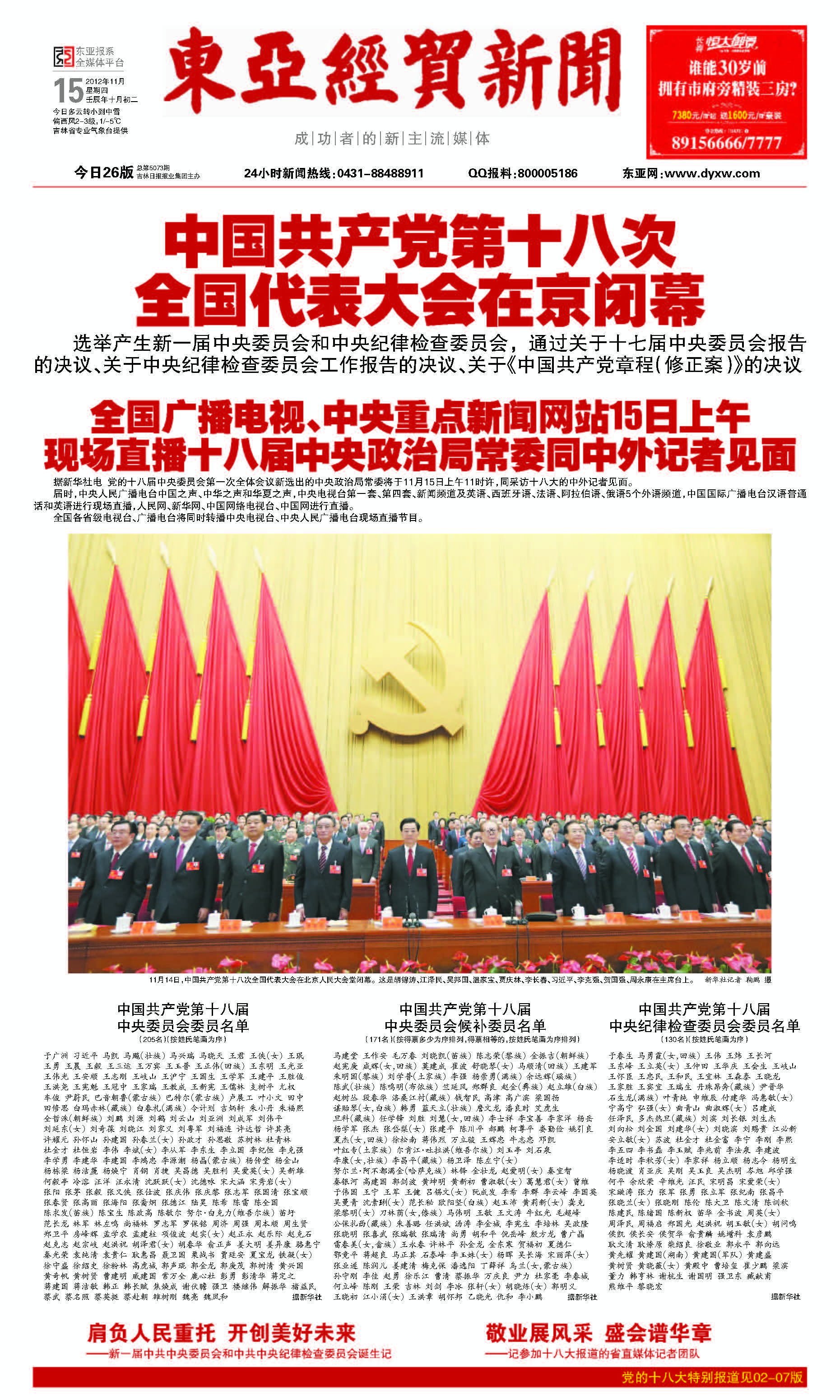
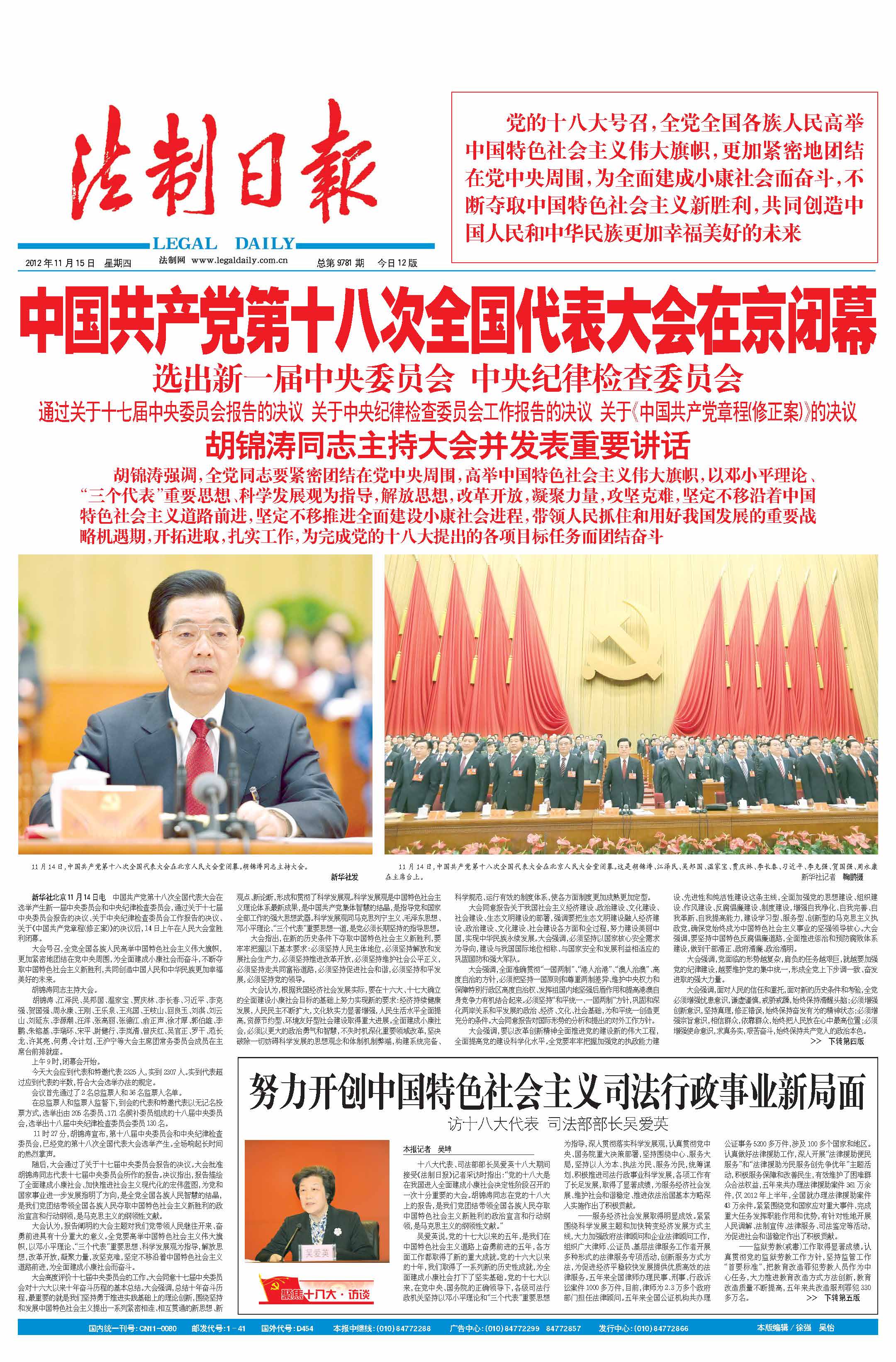
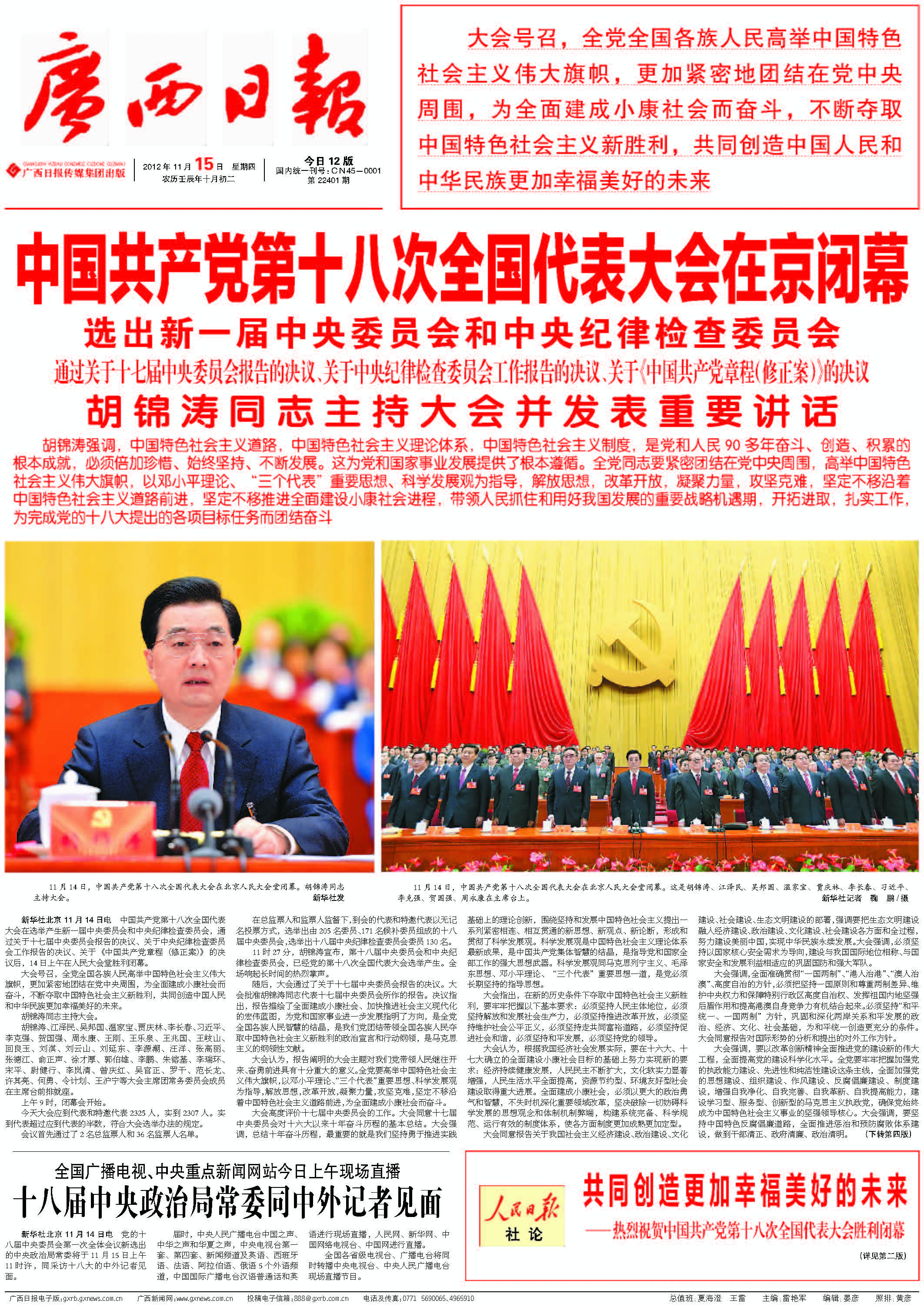
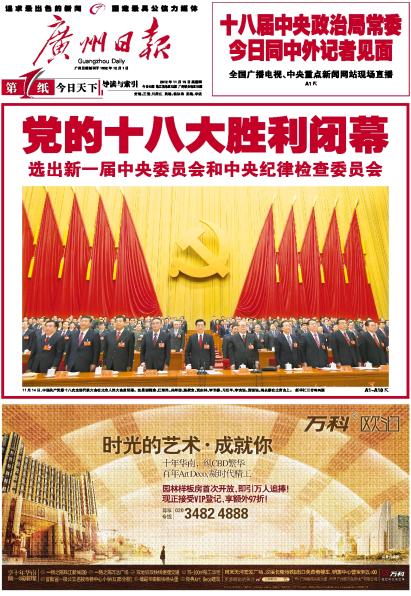
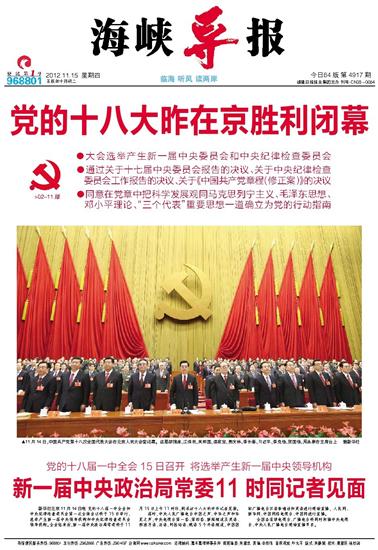
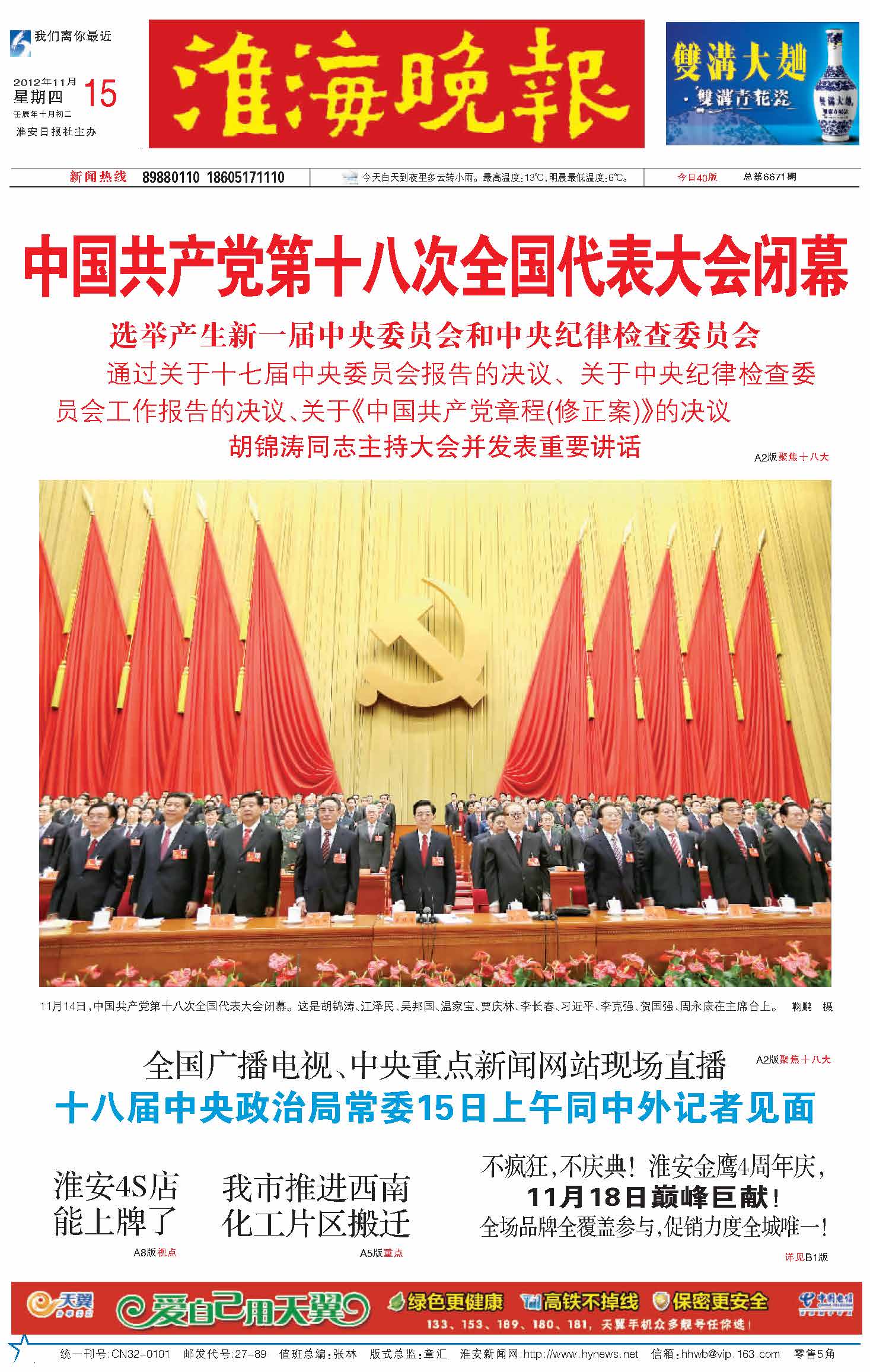
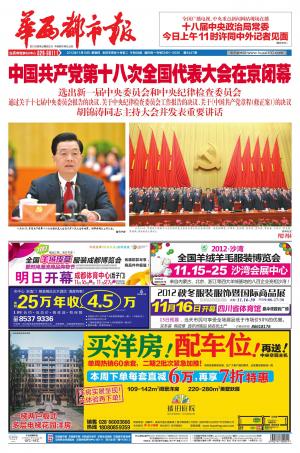
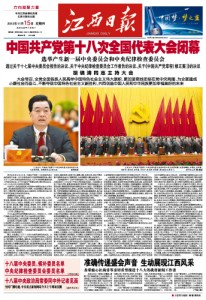
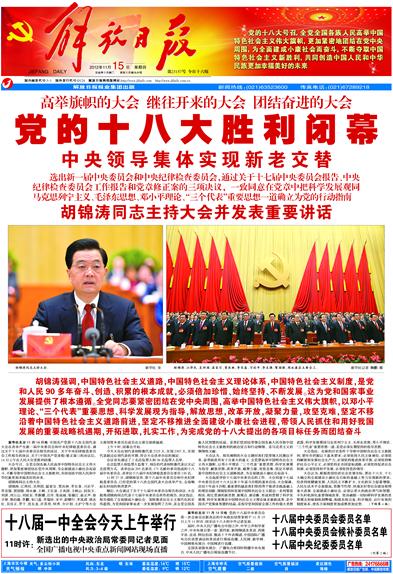
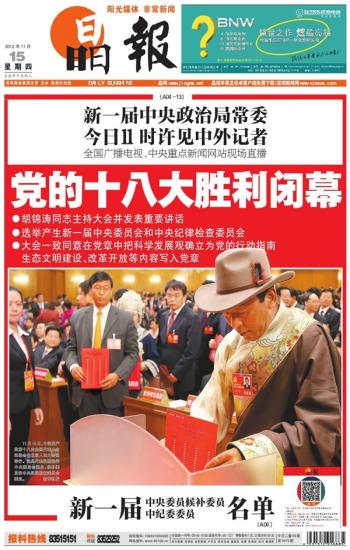
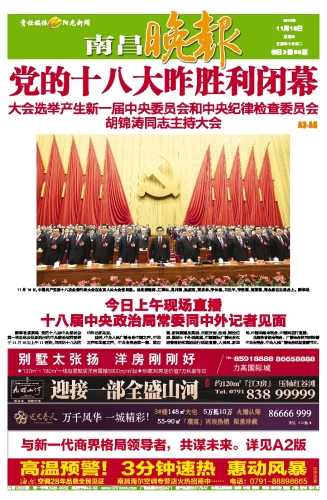
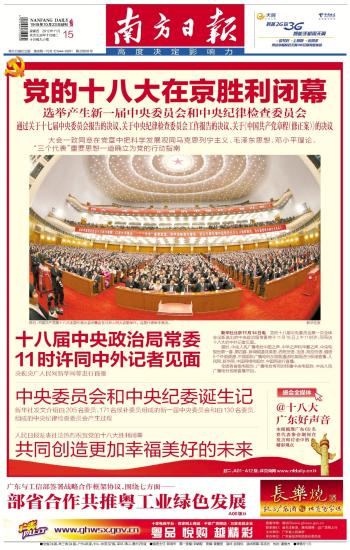
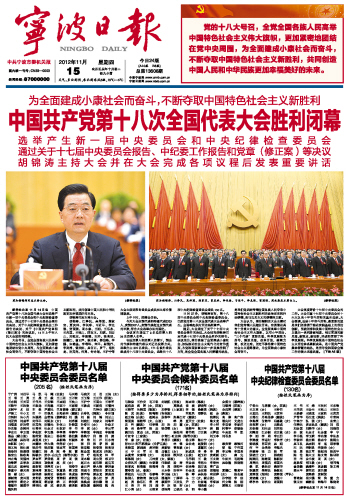
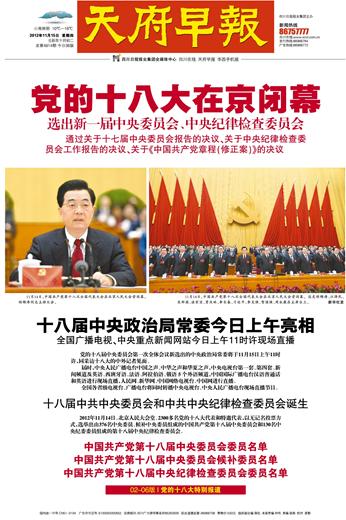
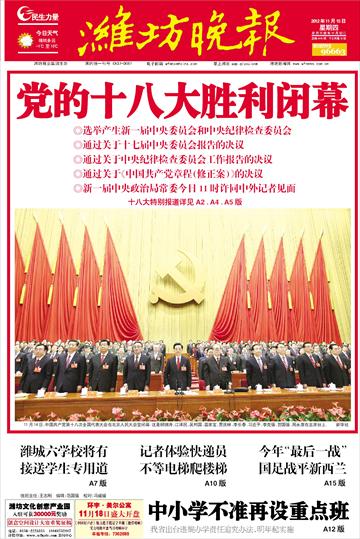
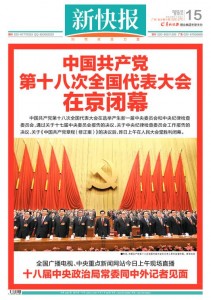
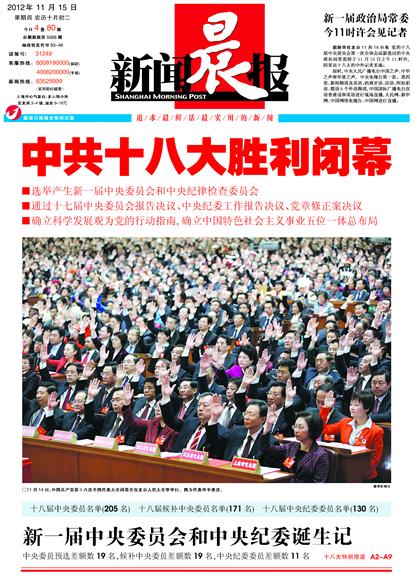
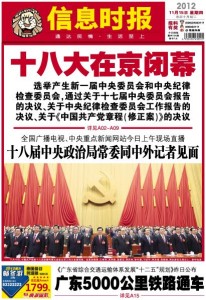
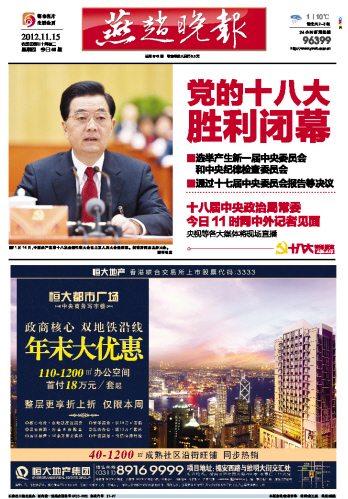
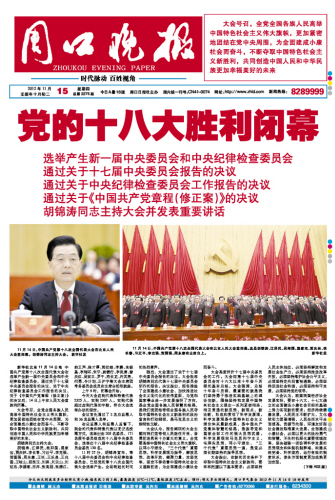
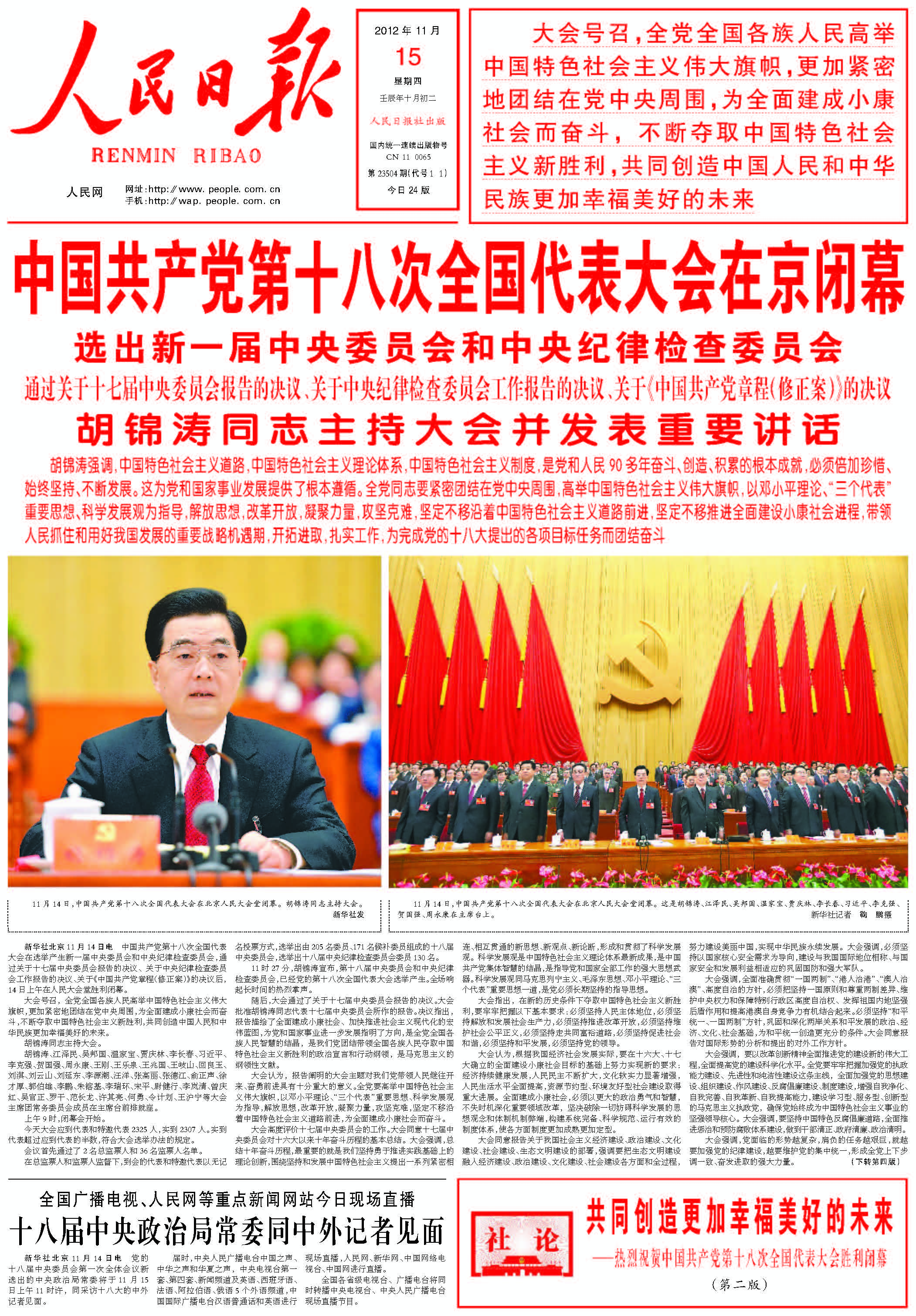
“The CPC 18th Party Congress successfully ended yesterday”

Dongnan Kuaibao 15 Nov

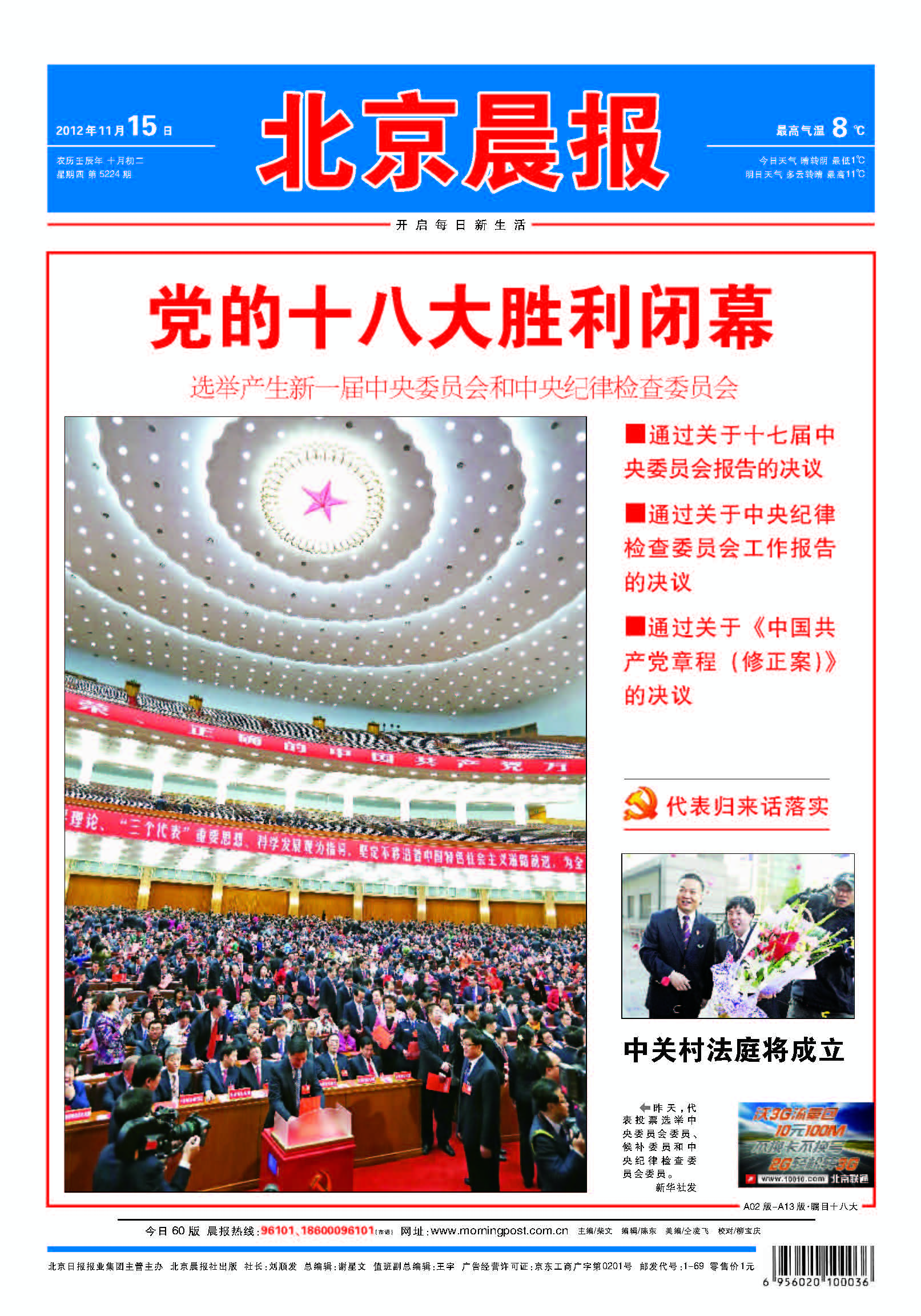
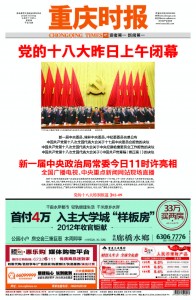
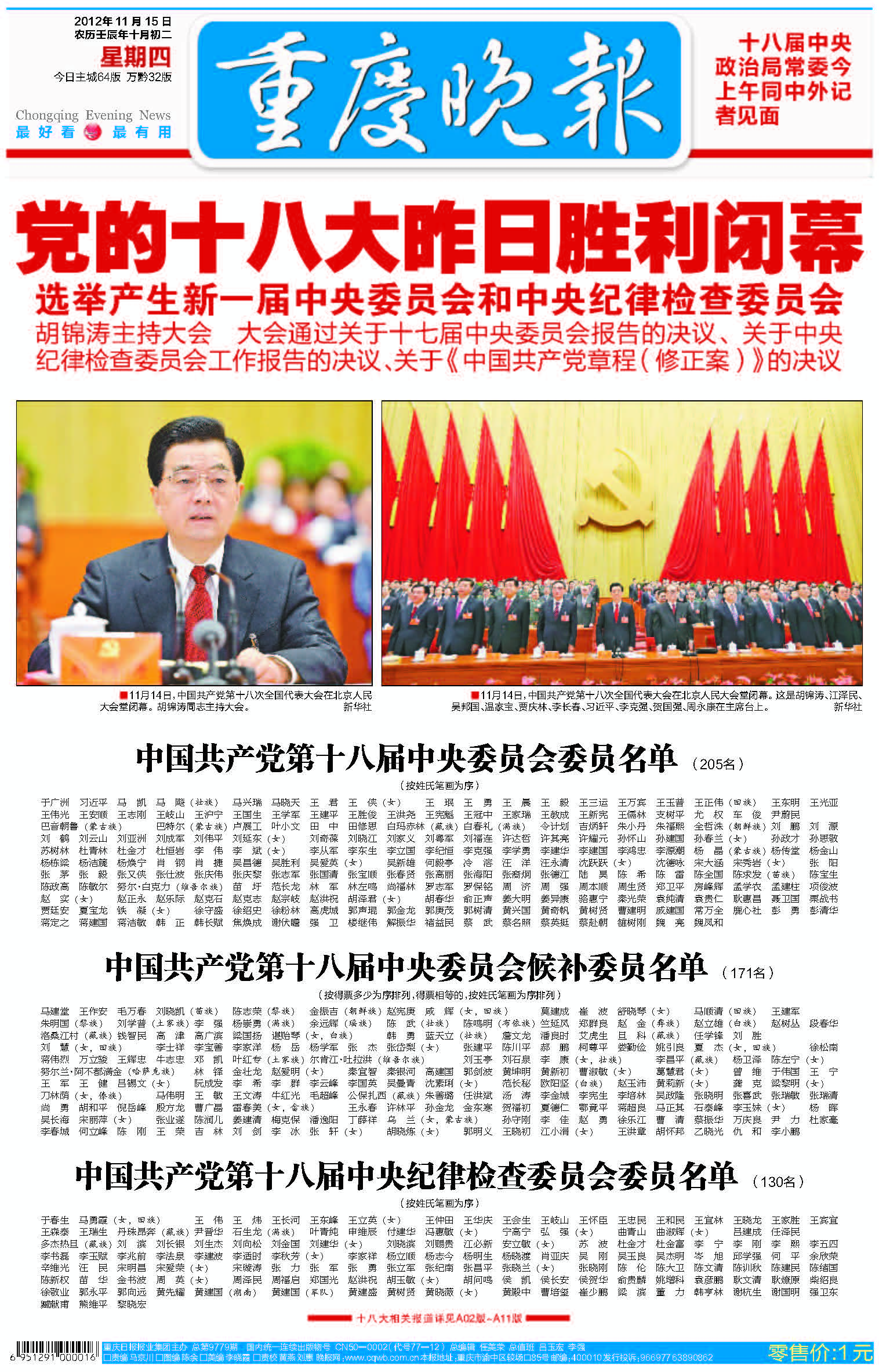
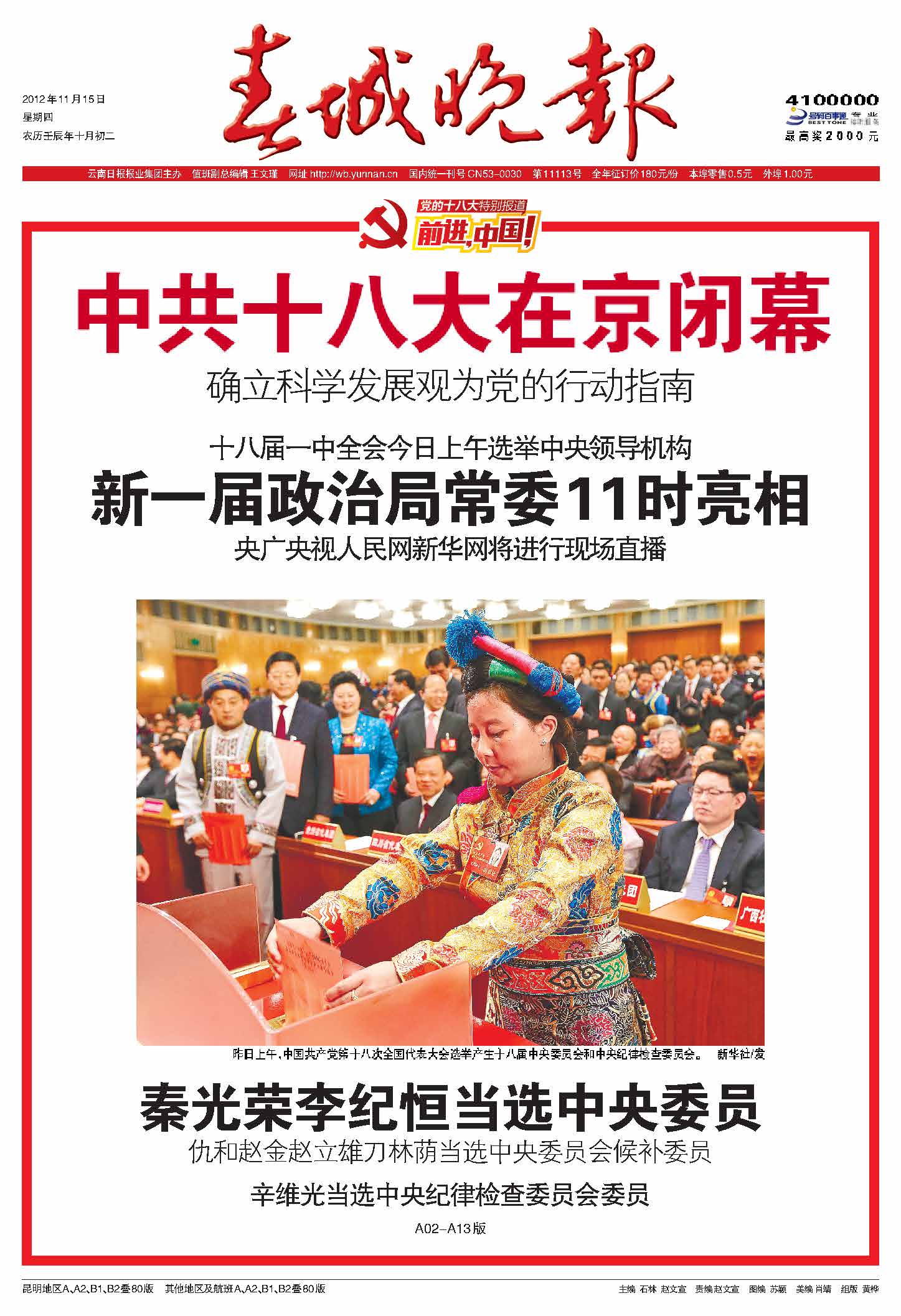
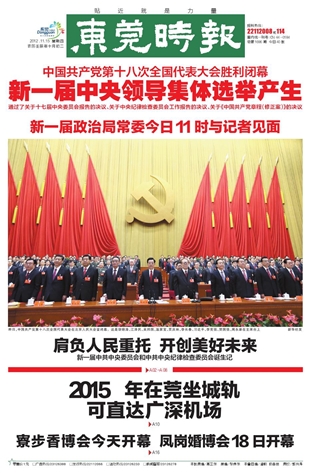
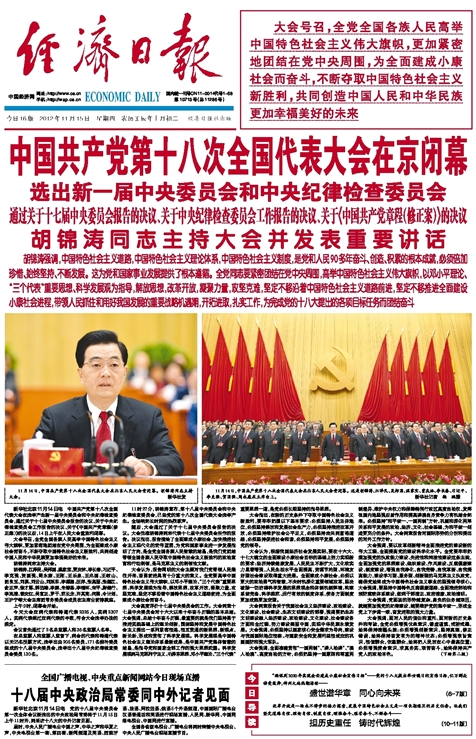
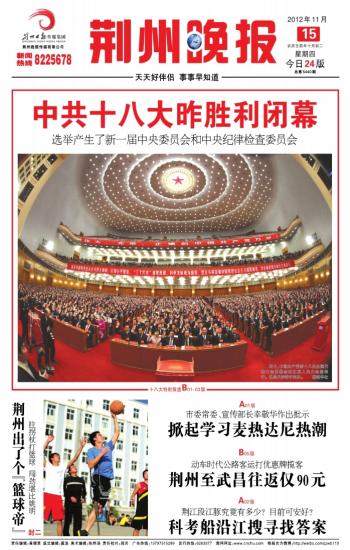
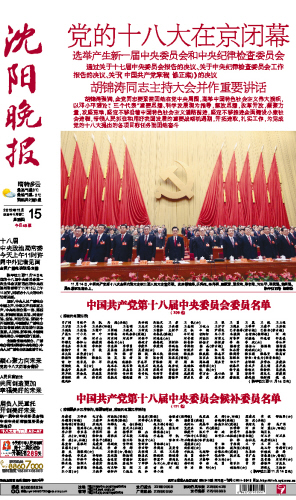
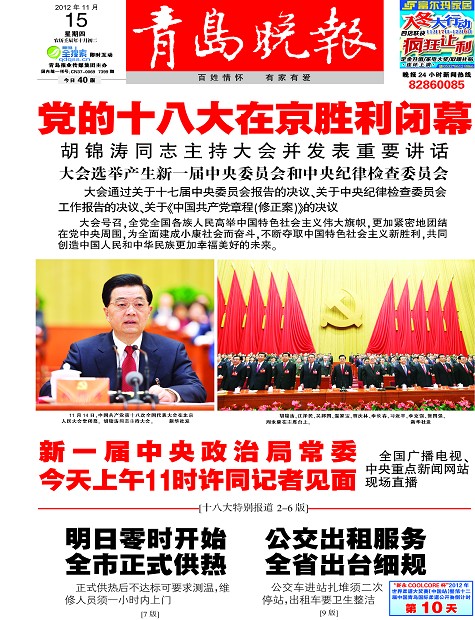
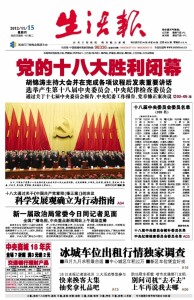
China’s newspapers went to press today before the new seven-member Politburo Standing Committee under Xi Jinping was presented to the media (see Shanghaiist for a recap). Hence, in uniform anticipation of tomorrow’s big news, they all today simply announced that the 18th Party Congress yesterday ended “successfully”.

We’ll do another review tomorrow when they will report on the events of today, and we’ll see if the newspapers might replace the image of Hu Jintao, which dominated today’s front pages, with that of Xi Jinping.

Posted in Front Page of the Day | Tagged , | Comments Off on “The CPC 18th Party Congress successfully ended yesterday”

Ways of reporting the end of the 18th Party Congress

Wuhan Wanbao 14 Nov

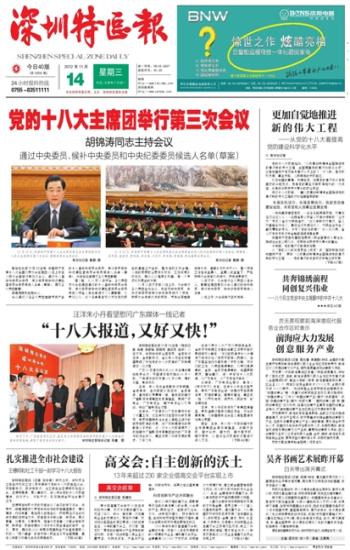
The 18th Party Congress ended today, and this naturally dominated the front pages of China’s newspapers, who used a small variety of headlines related to the last day of the Congress, the most common of which were “18th Party Congress ends today”, “18th Party Congress today elects Central Committee”, “CPC’s 18th Party Congress Presidium holds third meeting”, or simply “Formal election to take place this morning”. There were some newspapers today, however, that spiced up their 18th Party Congress-dominated front pages with a little more detail or a slightly different focus.

The following three newspapers are examples of front pages anchored to a simple headline and not much else. Beijing Morning News (北京晨报) went with “18th Party Congress today elects Central Committee”, Beijing Star Daily (北京娱乐信报) used “Formal election to take place this morning”, and the headline on the Spring City Evening News (春城晚报) from Yunnan province reads “Curtain falls this morning on the 18th Party Congress”.

A few other newspapers, however, padded their front pages with a little extra 18th Party Congress spice:

The Wuhan Evening News (武汉晚报) from Hubei province ran with the headline “New Politburo Standing Committee to appear on stage tomorrow”. Yet in contrast to this main headline looking forward to when the new top leadership will be presented to the world for the first time, the Wuhan Evening News has placed front and center on its front page the images of four Party members who represented migrant workers at the 18th Party Congress, which is the first Party Congress where this occurred. Under the headline “Behind us, hundreds of thousands of migrant workers”, the newspaper tells the story of how these four representatives experienced the 18th Party Congress. One of them, Yu Kang (余凯) from Hubei province, says that he has already forgotten how many requests for interviews he received at the Congress.

The Wuhan Morning Post (武汉晨报) ran the headline “CPC’s 18th Party Congress Presidium holds third meeting”, yet the main image on its front page is of the “little journalist” Zhang Jiahe (张佳鹤) from the Chinese Teenagers News (中国少年报) who bravely raised his hand to ask a question at a press conference at the Congress. And last and least, there is the Southern Metropolis Daily (南方都市报) from Guangzhou province which seems to have tried to build a large square block out of its main dry headline today, which reads “Passed through the Central Committee: draft list of names for the next Central Committee and Central Disciplinary Inspection Committee”.

Links and sources
Beijing Morning News (北京晨报): 十八大今日选举中央委员
Beijing Star Daily (北京娱乐信报): 今天上午正是选举
Spring City Evening News (春城晚报): 十八大今日上午闭幕
Wuhan Evening News (武汉晚报): 新一届政治局常委明天亮相
Wuhan Evening News (武汉晚报): “我已经不记得接受了多少媒体采访”
Wuhan Morning Post (武汉晨报): 我提问
Southern Metropolis Daily (南方都市报): 今日上午选举十八届中央委员

Posted in Front Page of the Day | Tagged , | Comments Off on Ways of reporting the end of the 18th Party Congress

China’s drones and new aircraft on display at Zhuhai Airshow

Huaxi Dushibao 13 Nov 12

The 18th Party Congress has a more muted presence on the front pages of China’s newspapers today because an event started today that can provide much better visual front page material: the 2012 Zhuhai Airshow. Instead of pictures of Hu Jintao and other men, today’s front pages are plastered with pictures of all kinds of helicopters, jets, large aircraft and drones. The Huaxi Metropolis Daily (华西都市报) from Sichuan province today has chosen to highlight one of China’s new drones that are being displayed at the airshow: the Wing Loong Unmanned Aerial Vehicle (翼龙无人机), and the newspaper boasts that this drone is “Made in Sichuan.”

If you look at the Wing Loong from the outside, Huaxi Metropolis Daily says, it looks “enormous”, and if you put it side-by-side with the US manned drone L-39, the Wing Loong is “not inferior in any way. And at 1 million US dollars apiece, its cheaper than the US and Israeli drones to boot.” Manufactured by the Chengdu Airplane Design Research Institute (成都飞机设计研究所), the Wing Loong can reach an altitude of 5,300 meters and a range of 4,000 km, and has an endurance of 20 hours. It will be used for a variety of roles including reconnaissance, surveillance, ground attacks, disaster monitoring, anti-narcotics smuggling, disaster monitoring, and meteorological observation.

The Wing Loong is only one of the many interesting pieces of hardware on display at this year Zhuhai Airshow, which include

  • Five types of advanced fighter jets
  • Six types of training aircraft
  • Eight types of drone aircraft
  • “Chinese-made” helicopters
  • Aerial acrobatics shows
  • A new Sichuan Airlines Airbus A-320 with special “China Dragon” markings
  • Special types of transport aircraft, and
  • 19 different types of weapons systems

So here’s a look at the various other fancy aircraft from the Zhuhai airshow on display on China’s front pages today:

Links and sources

Huaxi Metropolis Daily (华西都市报): “四川造”翼龙无人机首露真容
Huaxi Metropolis Daily (华西都市报): 飞行汽车 堵起了飞起来去上班
Chuncheng Evening News (春城晚报): 2012珠海航展今日开幕
City Express (城市快报): 2012空客A320珠海争艳(图)

Posted in Front Page of the Day | Tagged , , | Comments Off on China’s drones and new aircraft on display at Zhuhai Airshow

Hotly debated at the 18th Party Congress: “What does a fairer China really mean?”

Jing Bao 12 Nov

Various newspapers in China today published headlines that are supposedly based on hot debates at the ongoing 18th Party Congress on the question of how to create a fairer and more equal China. The debates on this issue have come to rest on three core elements: equal rights, equal opportunities, and equality under the law (权利公平·机会公平·规则公平), of which the last one is the most important. All these headlines are based on a Xinhua report from yesterday which provided a few brief insights on what is being discussed at the Congress. Of the three elements that are highlighted for making a fairer China, the newspapers’ discussion of the third element (equality under the law) doesn’t shy away from a pressing issue in China: the unfair privileges of the richest people and largest companies in China. 

“What does a fairer China really mean?”:

The headlines on this issue in China today have either copied yesterday’s Xinhua report outright (see for example the Jing Daily [晶报] or the Sanjin City News [三晋都市报] in the gallery above), or expanded and republished it in a more detailed form (see for example the Star Daily (新报) and Guizhou Metropolis Daily [贵州都市报] in the gallery above.

Taking its cue from Xinhua, the Jing Daily from Shenzhen in Guangzhou province today laid out the essentials of the three core elements that are apparently being discussed at the 18th Party Congress for a  fairer China. The first element is “equal rights”  (权利公平). Irrespective of where you are from or what you do, the editorial says, everyone should enjoy the same rights. According to “experts,” the editorial goes on, the people’s awareness of their rights and their insistence upon them should now rise from a subsistence level to a development level (人们对“权利”的认知与诉求从生存层面上升到发展层面).

The second element is equal opportunities (机会公平), and here the editorial quotes statements from a few delegates at the 18th Party Congress about how important it is for poorer and rural children to have the same educational opportunities as the more well-off members of society do. The third and last element is the one that the editorial says is the most important of the three: equality under the law (规则公平). Here the editorial openly states that private companies are being unfairly disadvantaged compared to state-owned enterprises. Yet not only this, it continues,

Some Party delegates believe that privileged people can find a good job based on their father’s influence, and some people have unfair access to better medical care, among other such unfair things in society. These things could easily make the rest of the population resentful.

All the platitudes and meaningless complex sentences aside, these musings in China’s newspapers today might indicate that the 18th Party Congress is seeing at least some discussion of how to address pressing issues in China.

Links and sources
Guizhou Metropolis Daily (贵州都市报): 公平,一个来自报告的热议话题
Jing Daily (晶报: 权利公平·机会公平·规则公平
Star Daily (新报): 收入分)强调“更公平” 发展成果惠及全体人民朝着共同富裕方向前进

Posted in Business and the Economy, Front Page of the Day | Tagged , , | Comments Off on Hotly debated at the 18th Party Congress: “What does a fairer China really mean?”

Out of Tibet

Tibet - by Alec Ash

Now readable in full on Danwei, and with a new update from the author two years on, “Out of Tibet” by Alec Ash is a chapter in the new book Chinese Characters: Profiles of Fast-Changing Lives in a Fast-Changing Land, edited by Angilee Shah and Jeffrey Wasserstrom, published by the University of California Press, © 2012 by the Regents of the University of California. Click here to buy the book.

*****

When Tashi calls, I am in a temple overlooking Xining, the capital of Qinghai Province in western China. Loud, slurred, distraught, he asks me to come quickly.

Tongren, or Rebkong in Tibetan, is eight bumpy hours south, high on the eastern edge of the Tibetan plateau, and the next bus is at noon. When I arrive, it is dusty evening. Tibetans in cowboy hats or Adidas beanies walk the markets, where Hui Muslims in characteristic white hats sell fried chicken and chilled Coke to Han Chinese immigrants. Monks from the Tongren monastery stretch their legs, trainers poking out from underneath their dark crimson robes. Although this region is not politically defined as Tibet (“China’s Tibet,” the autonomous region established by Beijing in 1965, is many miles to the southwest), ethnically and historically, it is firmly Tibetan. It is Tibet out of Tibet.

I find Tashi in a bar on the outskirts, in the middle of a self-hating drunk. He is in his mid twenties, with dark Tibetan skin, brown puppy dog eyes, and a greasy waterfall of black hair. On the table in front of him is a small Everest of cigarette butts and a display of beer and liquor that would make the poet Li Bai, famous for his verses on wine, blush.

“I’m an animal,” Tashi says, looking up. “She left me.”

•••

I first met Tashi—not his real name—eighteen months before that night, in his home village of Shuangpengxi, half an hour’s drive northeast of Tongren. To go there by taxi costs fifty yuan (about US$8), but passengers often pool together so that no one pays more than the cost of noodles and a beer. Taxis making the return journey are scarce, so you’re better off hitching a lift, squeezed in between a grinning nomad and his dog, or holding on for dear life in the back of a pickup.

Shuangpengxi (also known as Zhoepang) is, for now, the calm eye of a materialist storm that Chinese modernization has brought to many other areas of Tibet. It is set on a gentle incline, sloping toward yellow barley fields, with a swift, shallow river at its base. A wooden temple at the village heart punctuates low rooftops and brittle wooden racks where animal skins dry in the hot sun. On one side of the mountain face, watched over by brightly colored prayer flags, is a new middle school, whose brick walls, painted red, look unnaturally clean against the village’s clay houses and twin stupas.

In the summer of 2007, fresh out of university, I was amazed to find myself in such a windswept, Lost Horizon location. I called it Songpongshee, in my best monkey-hear imitation. Later, as I began to learn Chinese, I discovered that the name Shuangpengxi means “two friends in the west.” I was there with five British friends. We were English teachers at a new school built in 2005 through the generosity of French donors who had studied Buddhism in Nepal. A hundred or so shy Tibetans between the ages of ten and eighteen were in our charge. Their numbers decreased steadily as “summer religious festivals” drew them back home. We soon realized that these holidays were almost entirely made up.

As the weeks went by, the floor of our dorm slowly filled up with dry bread buns, empty fruit beer bottles, and a carpet of multicolored paper scraps left over from various activities. We rose too early for our liking and taught through the morning, with sport, art, and drama options in the afternoon. In the evening, we walked into the village to eat dumplings with new local friends, or to buy vegetables to stir-fry ourselves. On days off, we explored the mountains on either side of the school. Sometimes young monks from a nearby monastery would come down to play basketball with the foreigners, dirtying their ankle-long robes.

When Tashi heard that there were foreign teachers in the school, he came by to introduce himself. He was dressed in flared jeans, a shirt, tie, and waistcoat, with a heavy sheepskin coat over it all. By turns shy and boastful, he invited us to his home for tea with yak butter, cheap cigarettes, and tsampa, a Tibetan staple food made out of barley. Later, we went to his girlfriend Lhamu’s larger house, where we watched Michael Jackson videos on a crackly color TV.

Tashi and I became fast friends. When my classes ended, the two of us traveled to his best-loved grasslands in a neighboring province. As a picnic, we bought a rump of yak, the corresponding weight of bread buns and (at Tashi’s insistence) twenty bottles of beer. Beer bottles in China flirt with the liter mark. Tibetans deserve their reputation as formidable drinkers, and Tashi is no exception. Taking huge power gulps and chugging through smoke after smoke, he began to really talk.

•••

Tashi’s father and mother were both fifteen when he was born in 1983. Fifteen years later, in one of life’s symmetries, Tashi married, and a son was born. The marriage had been decided on by Tashi’s grandfather a good many years before that. The bride’s family was rich and held high status in the village. But neither Tashi nor his new wife was happy. “At that age,” Tashi says, “you don’t know anything—what is love, what is marriage, nothing. But there is no choice. Custom is more important.”

The couple also shared a secret. The child was not Tashi’s son at all. For the first two years of their marriage, Tashi slept in the same bed as his wife but they did not have sex. Only the boy’s real father and some village elders knew the truth. Everyone else assumed that the child was Tashi’s, and he raised him as his own.

Four years later, Tashi’s grandfather died. Tashi’s wife—none too discreetly—found another boyfriend. This time there was no secret. Everybody knew, everybody gossiped. Soon after, she left their home to move back in with her parents. Tashi tried to persuade her to come back. A month passed before he found out why she had left. She was pregnant again, and she insisted that the child was his. Three months into her pregnancy, against Tashi’s wishes, she had an abortion. Tashi divorced her. He was not yet twenty.

To escape this sour episode, or perhaps out of simple wanderlust, Tashi took off. There was nothing to keep him in Shuangpengxi. Estranged from his mother and father, who had sent him to a monastery when he was three (he left at seven to go to school), he was close only to his grandmother. Young and ambitious, he felt he had more to see than what his village could show him.

Tashi studied Tibetan history and English for three years in Xining, then Chinese for a year in Beijing. At first he went home once a year to celebrate Losar, the Tibetan new year, with his grandmother. But his fifth year away, Tashi didn’t make it back. He was busy exploring the bright lights and romantic prospects of Shanghai, and (fruitless) business opportunities in Shenzhen near Hong Kong. In Sichuan, he got in trouble for restoring a sign marking the historical border of Tibet – in prison for a few nights, he claims he was fed tsampa with mouse droppings inside, which made him violently ill. He taught English in Xining, and opened an art school in the nearby Kumbum monastery. He traveled to Lhasa and worked for a month as a scribe, tracing golden ink over fading letters in a monastery library.

When I first met Tashi in that summer of 2007, he was twenty-four and in Shuangpengxi for the first time in a long while. Back from the grasslands, and somewhat worse for wear, we retreated to his house on the outskirts of the village. The following morning, I asked Tashi to make good on a drunken promise from the day before and write me a poem.

Obliging, he sat cross-legged on the heated platform of his room, where a hard mattress formed his bed. Like a schoolboy, he had plastered posters on his walls, but instead of footballers, the blue Buddhist god Tara sat in the lotus position, framed by two fake stuffed birds and a miniature ram’s head. To their left was a large landscape poster of Lhasa, with Potala Palace unmistakable at its center. The fourteenth Dalai Lama, its former resident, looked down from above it, framed by a white ceremonial scarf, or khata. The Dalai Lama is still a familiar face in Tibetan homes and the bolder monasteries, despite the Chinese ban on his image.

Scratching diligently on a sheet of paper with my fountain pen, Tashi wrote for thirty minutes, the crumpled spiders of his Tibetan characters hugging their lines from below, vowels hovering over every third or fourth consonant like halos. Later, I asked an ethnic Tibetan who teaches at Oxford University to translate the poem for me. It is called “Potala Palace”:

Red prince of my heart
That quenches my thirst for the history of a thousand years, In your presence sprouts the life force of knowledge
In the garden of my consciousness.
The eternal flame of the butter lamp that flickers in my eyes Is stoked by my sweat and blood.

The land of snows has entrusted everything to you, And you too
Fearlessly speak the word of truth
For the sake of our hopes and prayers.

Potala Palace!
The consciousness of my forefathers rests On your high throne.
I forever
Will decorate your pillars with golden rings.

But the fierce wind from the East
Has many times racked with tongues of flame Your tender form.

O great yogi, in whose heart swirls unadulterated compassion, You forever
Like the blood moving in my body
Will rise to face the challenge of history.

Embodying the integrity of a nation,
Even though you are hurt you lick your wounds And stand proud in all circumstances.
While the sharp fangs of a dark beast
A tailless dog pretending to be a lion
Utters empty threats from its cave.

Potala Palace!
The solitary hero, never changing. I forever
Will serve under your blessing.

Potala Palace!
From the first time I welcomed the sun and the moon Until when the circulation of my blood stops,
My loyalty to you in body, speech, and mind
Shall remain eternal.

As he handed it to me, Tashi smiled sheepishly and said, “There is some … what is the English word? … metaphor.”

•••

China was worried about more than metaphor the following spring. In March 2008, riots broke out in Lhasa and spread across ethnically Tibetan regions, including Qinghai. Monks, workers, and the angry unemployed joined the fray, some peacefully, others violently. Over a dozen people died in Lhasa. Han immigrants were targeted by Tibetans who felt that the Chinese were unfairly reaping the benefits of the area’s economic stimulus, which on paper was intended for Tibetans. As the fire ebbed, ethnic tension was further stoked by the refusal of many Chinese to understand that Tibetans had just cause for discontent.

The first signs of trouble that year were in Tongren in February, during Losar. I returned to Tongren the following new year and interviewed a monk at the topmost temple of Longwu monastery, a hot spot of the protests. His recollection of the events the year before more or less corresponded with what I had read in wire reports and other eyewitness accounts.

During that Losar of 2008, riots were sparked by the smallest of quarrels. According to the monk, a Hui Muslim was selling balloons, one of which caught the eye of a passing Tibetan child. As it changed hands, the balloon flew up and away. The father of the child refused to pay three yuan for it, and the merchant was angry. Police officers tried to break up the ensuing fracas, but by then a large Tibetan crowd had gathered. The crowd felt the police were being too harsh on the nomad father and formed a circle to protect him from being arrested. Blows were struck, and the nomad was taken in. But later that night, against the backdrop of new year fireworks, a larger crowd—including monks from Longwu—threw rocks and protested, as much against pervasive injustice toward Tibetans as about this specific case.

After that night and the arrests that followed, the monk told me, the police increased their presence in the monastery, searching rooms randomly and smashing portraits of the Dalai Lama, even stealing hoarded money. “It felt like 1959,” he said, referring to the protests in Lhasa that culminated in the Dalai Lama fleeing to India. “Sure, I’m angry. But I can do nothing. What can I do?”

One year on, the festivities of 2009’s Losar in Tongren were decidedly chilly. In remembrance of those who died in Lhasa, locals refused to celebrate the new year with fireworks. Instead, the police lit their own fireworks and bribed other Tibetans to follow suit in an attempt to create an air of normalcy. Meanwhile, just north of town, the foundations were being laid for a new barracks of the People’s Armed Police. Control was tighter than ever. A short while before the night of the new year, Tashi introduced me to two monks who had been imprisoned for six months after having taken part in the Tongren riots. They were being tailed, they told me, and they couldn’t agree to an interview. In fact, they continued, the dormitory we were in was probably bugged. Tashi and I left quickly.

Afterward, in his brother’s office—his brother is a property developer, a lucrative business in expanding towns like Tongren—I asked Tashi what he thought of the riots of the year before. Up until that moment, we had never really talked about politics. “We all agree with the Dalai Lama,” Tashi began, “that the world needs peace, not violence. But the Dalai Lama doesn’t know about these things… . If you beat, beat, beat an animal, for a long time it can sit still. But it also becomes angry, and in the end it will fight you.”

“This is kind of a joke,” he went on, fired up, “but if I ever have power, I want to go to Obama or some other president, take a lot of new guns, fight the Chinese, and take my land again. Why can’t I do this? In Tibet, the highest leader is always Chinese. I’m Tibetan, but I had to study Chinese law and language and history. I can’t act like I’m Tibetan. I have to act like I’m Chinese, or I can’t get my school graduation receipt. And if I don’t know Chinese, I can’t find a job in my land, my motherland. In my own motherland, I have to speak Chinese.”

My natural sympathies were with Tashi—how could I side against such an underdog narrative?—but I couldn’t help thinking of the benefits he reaped from this new world he protested against. Tashi’s exwife’s son attended a school bankrolled by the local Chinese government. And just days before, we had visited a sick friend of Tashi’s at a refurbished hospital in Tongren. He was receiving far better medical attention than he would have were it not for the modernization that Chinese rule had brought with it.

Most of all, I thought of the school in Shuangpengxi where I had taught English a year and a half before, and of the kind of future my students now faced. When I was there, all classes were taught in Tibetan, and the children’s Chinese was poor by comparison. It was clear that they should have been focusing on their Chinese, not their English, if they wanted to get ahead in life. Now the school is under pressure to teach all its classes, except Tibetan and English language classes, in Chinese. It is not the only school in the area to feel such pressure. In October 2010, thousands of Tibetans took to the streets of Tongren again to protest this threat to their language and culture. But from a young age, the trade-off for Tibetans is between identity and opportunity.

After his outburst, I returned to Shuangpengxi with Tashi, camping on his floor the way I used to. I visited my old school and offered to teach a refresher English class for its students. Once so hospitable, the head teacher told me he must decline. My friends and I had been the last foreigners to teach there; after the 2008 riots, the local authorities had forbidden any more foreign teachers in Tibetan classrooms. The atmosphere was just as muted in the village itself. It was one day until Losar, and the residents all knew that their neighbors might be reporting on their behavior to the local police, whose presence was more noticeable and now included Han Chinese minders.

Instead of staying in the village, I resolved to climb the high mountain ridge beyond the school with my girlfriend, with whom I was traveling. The ridge cut an irresistible silhouette, with stegosaurus contours culminating in a jutting outcrop of rock. We had been hiking for several hours and were resting at the top when we spotted a black dot below, climbing up toward us. Half an hour later, the dot turned into a man. He gave us the occasional friendly wave, his shouts lost in the winter wind. Another half hour and a flushed local policeman was with us, the very picture of good cheer, chuckling at how hard we were to find and asking if we would kindly come down with him now so that we could all take a trip to the police station.

What was this? Were we at an illegal altitude? Together we picked our way down to the valley, where—conforming far too neatly to ethnic stereotype—a thoroughly nasty Han minder awaited his beaming Tibetan deputy. In a back room of Shuangpengxi’s police station, the nasty minder sucked on a cigarette and rifled through the photos on my camera. Luckily, it contained the unoffensive one of my two memory cards. We were staying unregistered at Tashi’s house, he explained, and should move to the hotel for foreigners in Tongren that night and leave for Xining within two days. “Why?” we asked. “For your own safety … dangran,” of course.

Of course, we weren’t the ones in trouble. Tashi told me later that he didn’t get more than a slap on the wrist from the police, but suffered a lasting humiliation in the village when his neighbors misinterpreted the police car outside his home and assumed that he had stolen something. I felt terrible and asked if he knew who had told the police we were staying with him. I had assumed it was a neighbor, but the truth was worse. Tashi’s own brother had informed on him. He had been in the room during Tashi’s earlier tirade and disapproved of such a cavalier attitude with foreigners, no doubt among more self-serving motives. Not every Tibetan, it was evident, remains eternally loyal to Potala Palace.

•••

That was the first of two betrayals of Tashi that winter. The second cut much deeper. Before leaving our police-approved hotel in Tongren, we snuck back into Shuangpengxi to say goodbye to Tashi. At that point, he was set to be married to his girlfriend Lhamu in just a few days—Losar being an auspicious time for unions. But two days later the call came in Xining. “She left me, brother. Please come quickly.”

Lhamu (also a pseudonym) is an unassuming policewoman with a shy, low laugh. She was born into a relatively well-off family in Shuangpengxi and is a bit shorter than Tashi, with the characteristically strong build of Tibetan women. She and Tashi had been together for two years, through which she was unwaveringly patient with his restless wandering and his roving eye for other women. They shared the same sense of humor, loved each other, and had been talking about marriage for some time.

There were initially two problems with this idea. Problem one: An obscure village law said that no man could remarry within the same village. Tashi’s childhood wife was also from Shuangpengxi, so the elders of the village said he had to look further afield for a second bride.

Tashi came up with an ingenious solution for this. Knowing that the only thing village elders believe in more than tradition is religion, he went to get the blessing of the nearest incarnate lama. Incarnate lamas aren’t to be found just anywhere, mind you. We had to drive a full forty minutes down the valley to a monastery where an octogenarian incarnate was supposedly in deep meditation. Together we performed the preliminaries—a full circuit of the monastery, turning every prayer wheel on every stupa in three clockwise circuits—before we came to the central temple and gave the door a rap. A monk came out. Tashi delivered his pitch. A brief exchange. The monk went in. Fifteen minutes later, he emerged with a piece of paper from the lama, not larger than a fortune cookie slip. Written on it, with the directness of someone in his eleventh life, was: “Pray to Buddha once in the morning, once in the afternoon, and once before sleep, and this marriage will be successful.” It was good enough for the elders.

Problem number two was both more familiar and a tougher nut to crack: Lhamu’s parents hated Tashi’s guts. They thought he was a layabout. He rarely sticks with a job for longer than a few months. He never visits his mother and father, even if he is devoted to his grandmother. He dresses like a Chinese yuppie. His long hair is often tinged with artificial red. And he is almost always away from Shuangpengxi, in Xining or further afield.

When visiting me in Beijing, Tashi would flirt left and right. In the American-style bars of the student district, he would try his luck with Western girls and text old flames. When I showed him how to bypass the “great firewall” of Internet censorship, he first asked me to look up Radio Free Asia, which he heard had reported truthfully about the 2008 riots. Next, he googled “American girl sex”—which he had heard was more experimental than Tibetan girl sex.

At the eleventh hour, Lhamu—who had agreed to the marriage against her family’s wishes—caved into parental pressure and decided that Tashi would make a poor husband. He learned of her decision one day into the year of the ox, when he saw her walking hand in hand with another man.

The humiliation of this breakup was so great that Tashi did not feel he could show his face in Shuangpengxi. He moved back to Xining, and threw himself into a more Chinese pace of life. One new venture was a monastery being built in the south of Qinghai, funded by a Californian millionaire and born-again Buddhist. Another was the impractical idea of selling Tibetan yak and sheep wool direct to factories in southern China—a business that has long been the monopoly of Hui Muslims in the region.

Tashi once told me his role model was Gendun Choepel, a famous twentieth-century Tibetan monk whose face appears on mouse pads from Lhasa to Tongren. Like Tashi, Choepel was born in Shuangpengxi. The school where I taught is named after him—Gendun Choepel Middle School—and its gatekeeper claims to be his direct descendant.

Choepel is sometimes called a “rebel monk.” In the 1920s, as a young man, he befriended a Christian missionary despite his family’s warnings that his hair would turn blond and his eyes blue. As a monk, he was open about his drinking, smoking, and love of women. Later in life, he traveled to India, where he translated the Kama Sutra into Tibetan, writing that “if natural passions are banned, unnatural passions are grown in secrecy.”

In Choepel’s time, Tibet was tragically missing the opportunity to modernize. The death of the progressive thirteenth Dalai Lama returned power to reactionary elites. The 1930s could have been the moment in history when Tibet secured its lasting independence from China. But history went the other way. Vocal in his criticism of the status quo and a founding member of the Tibetan Revolutionary Party, Choepel was accused of being a communist spy, spent three years in a Lhasa prison, and died shortly after his release. He lived just long enough to see Chinese troops “liberate” Tibet in 1950.

Tashi is no rebel monk. He may drink and sleep around as much as Gendun Choepel did, but he lives in a very different Tibet. Choepel wanted to see Tibet change on its own terms. Sixty years after his death, it has changed on China’s. It has more than its fair share of injustice and ethnic inequality. But it also has new hospitals and schools, a modernized infrastructure, and opportunities for success for Tibetans who play by China’s rules. Tashi, along with so many of his generation, embraces those opportunities with the same breath that he protests against their inequalities.

It was a long time coming, but Tashi’s mental journey away from his Tibetan heritage and toward a world of new possibilities in China or abroad was thrown into sharp relief after Lhamu left him. Sometimes we talk about Lhamu, and Tashi tells me that he wants a foreign girlfriend next. He used to say that he would take a Tibetan wife, or else he might lose his identity as a Tibetan. He used to say that he would always live in Qinghai—before he became alienated from his home village. Now he dreams of living in London or Paris, or of being a professor of Tibetan history, but in a Chinese or overseas university. In short, he wants to get out of Tibet.

•••

It is summer, a year and a half after that tumultuous Losar of 2009, and Tashi and I are together in Shuangpengxi again. Leaving Tibet is no easy matter for him, and whenever I am there, I don’t want to leave. I have finally climbed that high ridge—with no police interruptions— and command a sweeping view of the village. The scene looks much the same, with one addition: a new China Mobile tower rises high over the police station. Making use of full signal, I text Tashi that I’m coming down for tea.

Shuangpengxi is all but deserted at this time of year. Mid June is high season for picking caterpillar fungus, called “winter worm, summer herb” in Chinese, which is highly valued as medicine. If you have a keen eye and the patience of a Buddha, the high plains of Qinghai are among the only places to find it sticking up a half inch from the brown earth. One season’s harvest can be worth several times what a Tibetan farmer earns in a year. Every able-bodied man and woman in Shuangpengxi is away from home, caterpillar hunting. But that is not so drastic a change from the norm. In small villages across Tibet and the rest of China, droves of adults are leaving to work in big cities. Shuangpengxi is swift becoming a ghost village of children and the elderly.

It is dusk when I reach Tashi’s house, which he built himself out of stone, sand, clay, mud, and wood. His grandmother, bent double like a crowbar by the weight of her seventy years, greets me with a toothless smile. I step through a small courtyard to the kitchen, where she puts a charred kettle on the fire and lays out a bag of roasted barley and three bowls. We each take a handful of barley, add warm water and a generous chunk of yak butter (I ask for extra sugar), then knead the mixture until it’s about the size and consistency of a stress ball. Tsampa. Gulps of yak butter tea help it down.

After we have eaten, Tashi lights a cigarette, takes a terrifyingly long pull and exhales endlessly, then sucks the smoke back through his nose for another inhale. He grins at me and lifts a bag from a hidden nook. It clinks and sloshes with the sound of beer.

Six months later, when I am back in England, Tashi tells me on Skype that he has sold that house in Shuangpengxi. Now twenty-nine, he lives in Xining, where he works for a Chinese company that exports steel to Australia.

*****

Postscript from the author

Two years after I wrote this chapter, I am back in China, and went to visit Tashi in Qinghai once more. The changes in Xining and Tongren were striking – higher skylines, rising prices, ballooning business opportunities. Give it another ten years, and much of China’s west will be unrecognisable. But tensions are running high too. Tongren is now at boiling point after three Tibetans killed themselves with fire this last week, and thousands of students took to the streets in protest on Sunday.

The changes just up the valley in Shuangpengxi, meanwhile, were imperceptible – a billiards room, a mahjong table where locals gamble, a new statue of a Buddhist deity up the mountain. (Every villager contributed to the building of this statue. Tashi chipped in 500 yuan, and this was the first time he had seen it, having been away for so long.) The most impactful change is also the most familiar – more and more residents, especially the young, are leaving to work in Tongren. The village felt thin.

The changes in Tashi’s life? For one, he is married, to a Tibetan from a well-off nomadic family. Although they haven’t yet registered, both families held a big marriage party last Tibetan new year. In Xining he now works in publishing, while also meeting clients of behalf of his property developer brother back in Tongren. He admitted he had felt the pressure to settle, as all of his peers have. But he is still restless, and still plays the field, seeing girlfriends behind his wife’s back. People, they say, never change.

*****

Alec Ash is a freelance writer and journalist living in Beijing. Follow him @alecash, or at his new group blog, the Anthill

Previous posts by Alec Ash on Danwei
Tiananmen turns twenty one
How do Peking University students read the news?

Posted in Music, Books and Art | Tagged , , , | Comments Off on Out of Tibet

Q&A with author David Wolf on Huawei, ZTE and China’s telecoms industry

20069192323410372

Beijing-based business strategist David Wolf is the author of a new book on China’s telecoms industry: Making the Connection: The Peaceful Rise of China’s Telecommunications Giants.

The book tells the story of how previously unknown companies have emerged from one of China’s most dynamic industries to the forefront of the high tech business of global telecommunications infrastructure. Yet the likes of Huawei and ZTE have recently got some resistance in the US. We asked the author what he made of these developments and of the state of the industry.

Making the Connection is available in Kindle format on Amazon.

In recent weeks, China’s telecom industry and its leading companies Huawei and ZTE have controversially been subjects of a US congressional report as well as a White House-ordered review that cleared the Chinese companies of spying but still concluded that their equipment contained security vulnerabilities. What in your view is really happening here?

Whether or not there is a security threat is up the engineers to decide rather than the politicians. It comes down to whether it’s technically possible for there to be an intentional bug in the hardware or in the software that would open the door to espionage or that would defeat encryption. If this is possible, then the US government does have a legitimate concern. The challenge of course is that such a legitimate concern probably wouldn’t just be limited to Huawei, ZTE, or to any Chinese manufacturer. It would affect gear made by any manufacturer that is not based in the US and/or develops its products and software in China. So if there is a legitimate security threat and the government is not just being paranoid, we need a blanket means to address this. But by essentially red-lining two companies, one of whom is commercially more successful than its US rivals, then Congress’ actions do just look like protectionism.


These latest developments regarding Huawei and ZTE are part of ongoing image problems that many Chinese companies face in the West. However, is the broader issue here not about the search for a smoking gun in Huawei’s routers but rather about a political system in China that could allow the Chinese government or military to demand Huawei hand over sensitive information about US customers?
It might be a significant part of the problem in the eyes of Congress, but if the Chinese government can compel any home company to do whatever they want, are they unique? Couldn’t the US Department of Defense make similar demands of any US-based technology company?
I think the paranoia is about the government system in China, but any government can compel such cooperation from its companies. If you have this with Huawei in China why wouldn’t you have it with Alcatel in France or with Nokia-Siemens in Germany? Why wouldn’t you have this in Israel? Why wouldn’t you be concerned about any gear made by any company in China? So if this is an issue, everybody needs to be worried about every piece of equipment coming into a telecoms network.


Your book describes this as a problem of perception that Chinese companies face in the US. Do you expect that this problem will gradually fade away or will it persist as long as China’s political system remains largely opaque to outsiders?

I think the issue is going to be around for a very long time regardless of the political system in China. Even if China woke up tomorrow and found itself a monarchy or a democracy, the issue would still exist because it isn’t a matter of competing companies or systems but of competing countries and interests. The only way to get beyond this challenge is for a company and its products to rise above national origin in the eyes of its audience. Microsoft has achieved this to a degree in China, having built credibility as a firm and quietly shedding its American mantle. This is the challenge for Chinese companies: they really have to see their Chineseness as a liability, not an asset.

This process will take time. Credibility doesn’t come from spending money; it comes from behavior, from actions, from a long familiarity and from a track record that supports mutual trust. One of the reasons that US companies are willing to buy Huawei equipment is that they trust them and have had a long association with them. They can see what Huawei has done elsewhere. The challenge for Huawei and ZTE is that they have to do more than just PR. They are held to a higher standard, and while perhaps unfair this is just the nature of the game. Given that Huawei and ZTE are sort of the lead companies of what will be a batch of Chinese companies working their way into strategic industries, they are taking the brunt of this sort of cognitive dissonance. So it will take a while for the West to adjust.


Your book describes Huawei as a Chinese company that was able to prosper because it was a purely private company – it had very little government control placed on it and was thus able to get on with the job. Yet is Huawei a private company in the same way that the concept would be understood in the West?

The extent to which Huawei is private is that the company is not controlled either by the central or local government. As far as we know the company is 100% owned by itself or its employees. So the government apparently has no direct ownership stake in the company. But as to whether it’s a partnership or sole proprietorship or joint stock company – it is probably none of the above. The challenge apparently is that China’s laws on share ownership make it very difficult for the company to grant shares to its employees. Also they want to keep the shares in the hands of the employees; they don’t want somebody to show up and take a big clump of the company’s shares and then run away with them. They want to keep them close and they are still figuring out how they can work these things out.

Huawei and ZTE can certainly do with greater transparency in terms of their ownership. But as we all know, transparency and Chinese companies are very rarely mentioned in a positive way in the same sentence. We think we know that Huawei is owned by its employees, that those shares are held in trust for them by the company. This ownership structure doesn’t look like an ownership structure that’s familiar to people used to doing business in the West, and that’s what makes it murky. To a certain extent Huawei is still trying to work it out themselves.


Huawei’s CEO apparently does not do interviews and gives no statements. How important and/or detrimental is this to Huawei’s image in the West and what other simple PR options are available to Huawei?

As someone who has some experience with PR and who has worked with both foreign and Chinese chief executives, I can say in all honesty that there are some chief executives that I’ve worked with that I would never, ever want to put in front of the media because they are loose cannons. They either have a really hard time to say anything with any degree of comfort or they will say too much. I’m not saying that this is the issue with Ren Zhengfei, Huawei’s CEO, but regardless of the issues both Huawei and ZTE need to be more out there and more open with their CEOs because its simply a part of the cost of entry in Western markets. You have to put a human face on your company and the higher up you can put that face the better.

Another PR option open to the them is just to be more open; in fact, bend over backwards to show you are open. One example was last week in Australia when Huawei agreed to show its code and be open about it. They said that if anyone finds holes in their programming they should say so. It’s great to call the bluff of the Australian government, but what they cannot do is launch a counter-offensive and say people are being unreasonable or unfair. They have to stand up and say ‘we understand why you don’t trust us, but let’s work together to build trust.’


China’s home-grown 3G standard TD-SCDMA seems not to have achieved wide adoption. It is also unclear if it avoided existing wireless standard patents. You describe its development as successful. What do you think was successful about it for China?

If China Mobile had had its own choice it would probably have chosen a different standard. The success of TD-SCDMA was perhaps less commercial than it was political. For the first time in an emerging global technology set of standards China was able to put its version on the table and have it accepted alongside other international standards. In the end the adoption by China Mobile was only the icing on the cake. What was really important was that in getting TD-SCDMA officially accepted, it provided China with a seat on the table for the discussion on 4G.

If you look at the way 4G is rolling out, and if you talk to engineers who ten years ago would have laughed at TD-SCDMA (saying that it actually stands for ‘Tang Dynasty System Can’t Do Much of Anything), they are now looking at TD-SCDMA’s 4G successor, TD-LTE, and saying that this is a real contender. So for China the success of TD-SCDMA was buying them a seat at the 4G table, not the 3G table.


Under the administration of Hu Jintao and Wen Jiabao, China’s largest SOEs or so-called national champions have become very prominent and central to government policy. Yet your book on China’s telecom industry suggests that State Capitalism and large SOE national champions is not the right way to go. Does China’s telecoms industry point to the future path of reform for other industries in China?

What the telecoms equipment industry points out is that at the very least, China does not need to follow the state capitalism model, and it can allow companies to flourish in a range of enterprises. By simply sitting back and allowing the market to do it’s worst, China probably has a better chance of creating global champions than it does by simply choosing champions and hooking them to the government teat.

It is also entirely possible that the telecoms industry is the first case study that suggests that the state capitalism model is of limited use in building global champions. You cannot raise a child on parents that spoil it and then send it into the world where everyone is adversarial and expect it to survive. So at the very least both Huawei and ZTE suggest that China needs to hedge its bets: it can choose state champions all it wishes but it must also leave the door open (particularly in the so-called non-priority industries) for market forces to take over and to see if they can develop global winners in those industries. We are going to see more of these types of companies venturing abroad along with the state-owned enterprises. But the ones that I think are going to make the best plays are the ones that are ostensibly private and that have been allowed to grow despite government benign neglect rather than those who have grown because of government favor.


Your book ends with the observation that rising stars like Huawei in China really do innovate, but they do so incrementally. This could be said to form part of a new type of Chinese competitive advantage, i.e. the ability to manufacture products comparable in quality to the world’s best but at a still cheaper price. Do you see this model (and by extension a company like Huawei) as the future of China’s competitive advantage?

I think that Huawei is indeed a harbinger of this kind of model. It’s a move from being an independent imitator to innovation that is customer-driven and incremental. A company will then use this kind of innovation to gradually ladder itself up to the kind of innovation that comes out of laboratories and from genuine technological breakthroughs. But you can’t instantly make the leap from being an incremental to a laboratory innovator, you have to do it gradually and this is a lesson that we are learning from Huawei and one that the rest of China has to learn. I expect that in those sectors that begin innovating, this is how it will begin. It will be breakthroughs that are driven initially by a sales process, and will then over time eventually be driven by R&D and the kind of laboratory innovation that we are used to seeing in the high-tech industries.


David Wolf is President and CEO of Wolf Group Asia (WGA), a Beijing-based strategic corporate communications advisory firm, and also serves as Senior China Strategist for global public relations firm Burson-Marsteller. He is also an Editorial Advisor for the China Economic Quarterly, and serves on the advisory board of the Research Center for Chinese Politics and Business at Indiana University in the US. Making the Connection is his first book.


Featured image is of Huawei headquarters in Shenzhen, China (百度贴吧).

Posted in Business and the Economy, Consumer Culture | Tagged , , , | Comments Off on Q&A with author David Wolf on Huawei, ZTE and China’s telecoms industry

Hu’s the boss

The Weibo user Media Man Old Wang (传媒老王) posted a selection of newspaper front pages from November 9, the day after the 18th Party Congress started. He notes that all of these papers are commercial metropolis papers that do not usually carry pure propaganda on their front pages. But for the 18th Party Congress, even the feisty Southern Metropolis Daily, looks like the People’s Daily.

See also yesterday’s Danwei front page of the day: The 18th Party Congress opens

Posted in Front Page of the Day | Tagged , , | Comments Off on Hu’s the boss

The 18th Party Congress opens

Beijing Chenbao 8 Nov

Its finally here, the day we’ve all been waiting for so long, and there really is not much else that can be found on China’s front pages today. The Beijing Morning Post (北京晨报) is indicative of the kind of headline that is out in force today: “CPC Party Congress opens at 9 am today”. Yet it would be remiss not to mention one newspaper that once again today stands out from the crowd by flagrantly having nothing about the 18th Party Congress on its front page at all. On this historic day, the front page of the City Lady (都市女报) instead asks: “China’s sons-in-law, do you own a house?” Scroll down to view the gallery.

Clearly striving to give the 18th Party Congress its proper place, the Beijing Morning Post today has a 10-page special section on the event. The newspaper’s front page provides the following highlights:

  • The Congress will last from 8 to 14 November, a total of 7 days; 2,268 Party delegates will attend
  • The opening ceremony will be broadcast live in 10 different languages
  • New Politburo Standing Committee to meet the media; 63 delegates will represent Beijing

The Liaoshen Evening News (辽沈晚报) from Liaoning province has a six-page special feature today on the Congress, and its front page tells us that Hu Jintao and Jiang Zemin and 41 others yesterday elected the membership of the Assembly Presidium Standing Committee (大会主席团常委), of which Xi Jinping was elected secretary-general. It also briefly summarizes the agenda for the Congress:

  • Hear and discuss the report of the 17th Party  Congress Standing Committee
  • Examine the report of the 17th Party Congress Central Disciplinary Inspection Committee
  • Consider a revised amendment of the Constitution of the CPC
  • Elect the 18th Party Congress Standing Committee (this new Committee will meet the media right after the conclusion of the Congress), and
  • Elect the 18th Party Congress Central Disciplinary Inspection Committee

If perhaps you really don’t want to read anything about the 18th Party Congress or have already had enough of it, there’s only one inimitable newspaper you can turn to. Completely side-stepping the dominant story of the day, the front page of the City Lady (都市女报)  today leads with a story on the relationship between wives, mothers and their sons-in-law. The issue has been hotly debated of late due to a popular TV series called “New Era of the Son-in-law“; much of the discussion has focused on the so-called Ten Standards for selecting the right son-in-law.

Can you spot the odd one out?

Links and sources

Beijing Morning Post: 中共十八大今日9时开幕

Laoshen Evening News: 十八大今天开幕

City Lady: “国民女婿”你家有吗

Posted in Front Page of the Day | Tagged , , , | Comments Off on The 18th Party Congress opens

“Hold the people dearest in our hearts”

Qingnian Bao 6 Nov 12

The front page of the  Shanghai Youth Daily today leads with a big headline reading “Hold the people dearest in our hearts” (or foremost in mind, if you will – 把人民放在心中最高位置) (The Shanghai Youth Daily was established in 1949 and is closely tied to the Chinese Communist Party, but is not related to the China Youth Daily that is published in Beijing.)

Today’s Shanghai Youth Daily gears up for the start of the 18th Party Congress this week with a look back at the last ten years since the 16th Party Congress in 2002. The large image on the front page shows Politburo Standing Committee member Zhou Yongkang (周永康), who oversees security forces and law enforcement agencies in China, undertaking an inspection tour of the security facilities put in place for the 18th Party Congress. The editorial emphasizes that the Party cares only for the people, and it even recounts a touching anecdote of the day Hu Jintao visited a hospital and his red AIDS ribbon “flashed with the hope of spring.”

The editorial was first released by the Xinhua News Agency as a “record of the rule of the Party Central Committee since the 16th Party Congress”, and begins as follows:

Since the 16th Party Congress, the Party has faced unprecedented opportunities and challenges, and complicated internal and external circumstances. Under the leadership of comrade General Secretary Hu Jintao…the Central Committee has thoroughly implemented practical and scientific development, uniting the whole Party and every citizen to work with one purpose to forge ahead with determination in realizing the thriving opportunity of socialism with Chinese characteristics.

The editorial then proceeds to list the various achievements wrought by scientific and economic development in China in the last ten years. Yet when it comes to the next section with the same heading as the headline of the editorial, we see an attempt to put a very human and caring face on the Party with a touching anecdote about Hu Jintao. In these last ten years, we are told, there was one objective which was held by the Party in highest esteem: “Party members have striven above all to be people-oriented and to put every effort into improving the people’s livelihood.”

We are then provided with a practical example of this behaviour from the very top. On the afternoon of 30 November 2004, in a hospital in Beijing, Hu Jintao, smiling, stretched out his hand to a patient who had fallen ill due to HIV/AIDS, and said: “The Party, the government and the whole society will do everything to help you.” Then with a poetic touch, the editorial adds the observation that “on that winter’s day, the red ribbon on his chest flickered with the hope of spring.”

Links and sources
Shanghai Youth Daily: 把人民放在心中最高位置
Xinhua: Backgrounder: China’s major events since CPC’s 17th national congress
CCTV: Five Glorious Years in China
People’s Daily: [Oriental Outlook] Magazine highlights China in 10 years

Posted in Front Page of the Day | Tagged , | Comments Off on “Hold the people dearest in our hearts”