
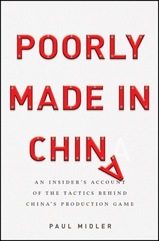
Poorly Made in China is the title of recently published book about China’s export manufacturing sector. The title has been reviewed by a number of publications, including The Economist and South China Morning Post.
The book’s author, Paul Midler, has granted Danwei permission to run an excerpt. The book can be found on Amazon.
Midler writes for Danwei an introduction about his book:
Poorly Made in China is a reminiscence of my years spent in China manufacturing. The book explores a broad range of topics through a behind-the-scenes narrative set primarily in China. One of the book’s primary themes deals with a natural link that exists between business and culture. China is a different place, as most already know or imagine. The short excerpt involved an episode where I am traveling back to my hotel from an assignment. I haven’t been working in manufacturing for long at this point, and I am curious about all of the random factories that I see along the way…
Excerpt from Chapter 3: “All We Need is Your Sample”
by Paul Midler
First-time visitors to the world of Chinese manufacturing are often surprised by what they find. Imagining imposing, industrial structures and filth and noise, they expect to see something inspired by Charles Dickens, Charlie Chaplin’s Modern Times, or maybe even Charlie and the Chocolate Factory.
In reality, the working environment is not as oppressive, and the buildings themselves are simple in their design. Missing from many of these companies are common signs of industry; in fact, there are few smokestacks and no factory whistles. In southern China, the buildings are typically multistoried boxes made of reinforced concrete, the sort of bland architecture that brings to mind housing projects.
What gives away these buildings as being industrial is that they tend to come in pairs. The factory is the plainer-looking of the two, and its twin, the one with flashes of color, is the dormitory that houses the workers. Living in tight quarters, workers conserve space and keep their clothes fresh at the same time by hanging them outside their doors.
What would happen if I randomly stopped at one of these Chinese manufacturers and just walked in? I asked my driver if he minded. He glanced at me sideways, said nothing, and then gave a delayed shrug. We were about to pass one manufacturer when I asked him to stop.
A guard who sat in a shelter box by the front gate came out to approach the car. He went to the driver’s window, and I leaned down so that I could see him.
“Shenme shi?” he wondered, wanting to know my business. “I was just wondering. What do you make here?”
He considered me carefully and then asked whether I was a customer. It was a question that answered itself. If I were a customer, I would already know what they made. And since I did not know… The guard picked up a phone and spoke to someone in a muffled voice. I noticed that on the wall in his small station hung a riot baton and a rifle. Putting the phone down, he said nothing and lit a cigarette.
I stood outside, while the taxi driver took the time to move his car away from the gate, pointing it toward the main road as though anticipating the need for a fast getaway. A few silent moments passed, and then a stout man in a brown work shirt emerged from the factory. He came walking toward the gate at a brisk pace, his arms swinging.
“Huanying! Huanying!” he said. Welcome! Welcome!
He grabbed my right hand with both of his, which were plump and calloused. He shook my hand for longer than was necessary, or comfortable, and I felt the sudden need to make excuses.
“I was just passing by your factory,” I said.
“No problem,” he said.
“I was just wondering…”
“Come in and sit for a while.”
“I just wanted to ask you a question.”
“Sure,” he said. “We’ll talk all about it.”
When mixed with business, Chinese hospitality could be suffocating.
I tried to explain that I was merely passing through the area on my way back to my hotel. In other words, I was curious, but I wasn’t exactly up for a major detour. Going into his office would mean having a lengthy meeting, and then he would try to serve me tea, or try to take me out to dinner, and I didn’t have the time for it. Could he simply tell me what they manufactured?
“Aiyooooh!” he cried, sounding like a man stuck with a sharp stick.
The look on my face must have suggested weakness or pity, because he then seized my arm and began pulling me inside. Having worried earlier that I might be chased off the property, I now wondered whether I would ever be allowed to leave.
Because the factory was located in a remote area, it was fair to assume that this factory boss didn’t receive too many random visitors. Still, he apologized for the state of the place and made excuses about why things were not in order. He appeared genuinely flustered by his lack of foresight, as though he should have presumed that foreigners would one day soon begin showing up at his factory unannounced. So many from abroad were coming to China to chase down merchandise; surely such random visits were the next, inevitable step.
He asked me to sit in his office, and I managed to convince him to start with the factory tour instead. This was no showcase factory. It was a rough-looking place, and I noted that the benches and stools had been banged together with wood scraps. Along one grimy wall, by a workbench, one of the workers had written the same Chinese character over and over.
Zheng, Zheng, Zheng, Zheng, Zheng, Zheng, Zheng…
In Chinese, it meant “correct,” and it was a character that was made up of precisely five strokes. The workers had apparently been using this ancient character as a way to keep a record of how many pieces they completed. It was a counting system comparable to the American way of drawing four vertical lines followed by a diagonal mark made at the count of five—the sort of thing you saw in the movies—scratch marks made on a wall by a prisoner who was tracking the days as they passed…