
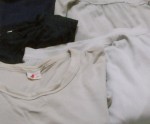
Temperatures dropped sharply in Beijng this week, so it’s certainly welcome news that thermal underwear prices have reached record lows. For consumers, that is; major brands are not liking it too much. There’s shakeup in the candy sector as well, as low prices are no longer sufficient to keep consumers from chosing more expensive, foreign brands.
And in IT this week, apart from the big Bokee-Hexun deal that went nowhere, Zhongsou sued Yahoo over search bars and Alibaba revealed it bought ad spots in the CCTV auction.
Warm long johns for cheap
People in other parts of the country have been wearing thermal underwear for weeks, but it’s just gotten cold in Beijing, so we are only now seeing attention paid to the industry. The major brands are battling cut-rate discounters (many of which are dealing in less-than-100%-cotton) as well as a general impression on the part of consumers that thermal underwear is just not sexy anymore.
The “hundred-yuan underwear” promotions that hit stores last year have turned into standard prices this season. Consumers are happy, according to Consumption Daily, but many manufacturers are considering clearing their inventory and exiting the market after this season, since the barriers to entry for no-name brands has become too low.
Cashmere and natural colored cotton are two areas that remain relatively stable, but they are plagued by imitations and fakes. Colored cotton, for example, comes in light brown and pale green, but shelves are full of rose and sky blue “natural colored cotton thermal underwear.” Regulations have been in the works for some time that will standardize what can be called “colored cotton” (at least 90% natural colored cotton) and what must be called a “blend” (between 30% and 90%). But the standards won’t come out in time for this season.
Pig vs. Tiger
This week’s online scuffle was between Zhongsou and Yahoo over unfair browser bar practices. Zhongsou claims Yahoo’s browser bar deletes prior installations of Zhongsou’s “Net Pig.” As Zhongsou tells it, there are informal rules in the industry that permit a certain amount of sneaky practices – covering up the competitions’ installations is a-okay – but draw the line at wholesale deletions. One could argue that it’s just the law of the jungle that allows the Yahoo tiger to wipe out the Zhongsou pig.

Candy: It’s good for what ails ya
As in other sectors, Chinese confectioners are finding that they can no longer compete merely on the basis of lower prices. Consumers are more and more frequently seduced by the big names from overseas. In chocolate, for example, 70% of the market is controlled by Dove, Cadbury, Hershey, and Le Conté, with only the last one a domestic company. Diversification, then, is key. Numbers from the National Bureau of Statistics predict that specialized candy will pass the market share of traditional candy within the next five years.
Case in point is Yake, a Fujian-based snack company. You may recall Yake from a series of commercials featuring starlet Zhou Xun leading a crowd of people running down the sort of empty city streets you never see in any actual Chinese metropolis. But as annoying as those TV spots were, they led Yake’s V9 to a 91% lock on the vitamin-fortified candy market.
Vitamin fortification is only the tip of the iceberg, however. Get ready for cavity-fighting, FOS-rich, weight-loss, and – get this – vision-enhancing candy.
Alibaba gets CCTV ad spots
More news on the CCTV ad auction this week: web company Alibaba bid 80 million yuan for ad space after the CCTV evening news next year. Alibaba’s bid is an indication of the rise of China’s Internet companies, since this is the first time an Internet company has taken part in the annual ad auction. Alibaba will use the spots to promote its brand and the newly made-over Yahoo search engine. Unfortunately, for those of you reminiscing over the high-concept, monkey-laden ads of the Internet ad boom in the US, Alibaba’s bid was for five 5-second spots on CCTV, so we’re likely to be more informed than entertained.
Also in the news this week:
- Blog host Bokee was rumored to be talking to financial website Hexun about a possible merger. Both companies were coy about the speculation, leading some observers to suspect that the hype was a deliberate attempt to increase visibility in advance of further financing.
- Liquor giant Wuliangye announced its intention to enter the automotive parts sector.
- Lenovo entered the low-end video MP3 market with the release of its 400-yuan flash-based V707.
These summaries were collected from the The China Perspective, which covers major business news and trends in the China marketplace.