
A recent college textbook, Essentials of Modern Chinese History (中国近现代史纲要), is misinforming students about the history of colonialists in China, says one scholar.
In a posting on the Academic Criticism Web, Shanghai Normal University professor Zhou Yumin outlined four historical facts that Essentials gets wrong, along with a number of other instances of imprecise language.
Here’s a list of the four major concerns – first an excerpt from Essentials and then Zhou’s specific complaints:
- Age of Global Navigation: “In the 15th Century, western adventurers ocean-crossing, globe-spanning voyages and accompanying conquests opened the curtain on modern colonial expansion.”
Zhou says: This really ought to be the late-15th and early 16th Centuries.
- England’s motives for trafficking opium: “England’s industrial products met with stubborn resistance from China’s natural economy and closed government policy…so English colonialists used trafficking in opium as a strategy to reverse the balance of trade.”
Zhou says: “This is a lie formulated by western bourgeois historians, not the truth of history….the fundamental motive for the large-scale trafficking in opium that western colonialists undertook in China was to use drug trafficking to reap large profits. I have always believed that unbridled opium trafficking was in objective terms the cause of the reversal of the balance of trade between China and England; to say that this result was the reason for the opium trade is a fallacy of transposing cause and effect.”
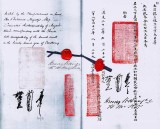
- Joint control over tariffs: “Control over tariffs is one of the major sovereign economic rights of a country. However, the Treaty of Nanjing stipulated that the tax rate assessed on goods imported by English merchants would be a Sino-British ‘fair and regular tariffs’ (秉公议定则例); that is, it set the bad precedent of tariff-by-agreement, causing China to lose sovereignty over its customs.”
Zhou says: “Many modern history textbooks on the mainland take the ‘fair and regular tariffs’ stipulation in the Treaty of Nanjing as evidence for tariff-by-agreement….it’s obvious that 秉公议定 is an insufficiently appropriate translation for ‘fair and regular’….so when England took part in setting customs tariffs in 1843, this was not because of any unequal treaty rights granted it under the Treaty of Nanjing – this was the actual precedent for ‘treaty-by-agreement’.”
- International trade figures 1870-1894: The textbook uses customs figures during this period to show the size of the trade imbalance. Zhou argues that Chinese customs statistics calculated goods according to market value, which means that imports include tariffs, shipping, storage, and labor, while the value of goods for export was figured before tariffs and harbor fees. Hence the total value of imports appears inflated compared to exports; the customs office introduced corrections to its figures in 1889.
The publisher, Higher Education Press, disputed Zhou’s claims. From The Beijing News:
Essentials editor Fan Jun said in an interview that the textbook is for a non-major required course and hence is different than a normal history text. It must express a Marxist outlook on history. “Dissent from a few scholars is just their own opinion. Essentials touch on each and every point.”
Fan Jun said that three full years were spend editing the book. The manuscript was reviewed at least thirty times, and all citations were carefully recorded. Essentials uses as its main thread a revolutionary paradigm, and it utilizes mainstream evidence and concepts while being extremely stringent in its choices of materials and viewpoints.
Then there’s the reaction of an unnamed student:
This reporter also interviewed college students who are currently using Essentials. A student at one school said that lots of instructors from the school’s Marxism Department taught their classes, and they used that very book. He said, “My feeling is that there are some things in that book that can’t stand up to close inspection. There are lots of problems.”
Zhou’s article has further details and a full list of his other complaints. Any historians or Chinese history buffs care to enlighten us on whether he’s got a valid argument?
- ACriticism (Chinese): Zhou Yumin: A discussion on some historical facts in Essentials of Modern Chinese History
- The Beijing News (Chinese): College history textbook accused of mistakes of historical fact
- Image from Signed and Sealed
- Earlier on Danwei: High-school history textbook controversy, China/Korea/Japan joint history text, Ye Yonglie: China’s Textbook Problem