
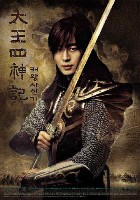
For the past few years, Korean soaps have been a staple of Chinese television. Despite repeated attempts by the country’s broadcast regulators to push domestic programming, audiences still enjoy watching teen soaps and costume dramas about life in Korea.
But not every Korean TV show finds success on the Chinese mainland. Historical epics, particularly those that depict national founding mythology, don’t really sit well with SARFT. Just last week, Chinese media reported that the Administration “blacklisted” the 42-billion-won (US$45 million) blockbuster drama The Four Guardian Gods of the King (太王四神记 in Chinese) for “distorting history.”
According to a report in the Oriental Morning Post last week, domestic distributors had been quite interested in the show, whose first episode drew a 20.4% viewership share in Korea (climbing to 26.9% for the third episode). However, certain elements of the story are controversial in China. Writes Darcy Paquet in Variety Asia Online:
Complex plot covers multiple periods in ancient Korean history, including the founding of the kingdom Gojoseon in 2,333 B.C. and the reign of King Gwanggaeto of the Goguryeo Kingdom (391-413 A.D.). The Goguryeo era has emerged as a point of contention in recent years, with Chinese scholars claiming it should considered part of Chinese history.
From this and other reports, it appears that Guardian Gods won’t be coming to Chinese television screens any time soon. It joins a number of other recent historical dramas that have been accused of “distorting history”; here’s a rundown courtesy of the Chengdu Evening News:
Many Korean soaps smear Chinese history
In recent years there have been many television shows in Korea concerning Goguryeo history. In addition to The Four Guardian Gods of the King, Bae Yong-joon’s return to the screen and the first show on SARFT’s black-list, Yeon Gaesomun, The Immortal Lee Soon Shin, and Dae Jo-yeong turned the camera on that period of history. Li Shimin, Emperor Taizong of the Tang, was one the greatest emperor in the history of China; to unify Chin he personally set forth to suppress Goguryeo. But in Yeon Gaesomun, Taizong is depicted as an ugly, foolish invader who is blinded in his left eye by the Goguryeo Generalissimo Yeon Gaesomun, while the Tang army must beg for mercy from Goguryeo before they are allowed to return to the Tang. At the end of the first episode of Dae Jo-yeong, Taizong is again absurdly shown as getting a knife shoved in his abdomen by an assassin dressed up as as an army officer, and he nearly dies. In The Immortal Lee Soon Shin, soldiers and equipment from China’s Ming Dynasty are shown much feebler than they were, and Ming Dynasty figures are not in accord with history. Ming generals are depicted as practically useless, and though Korea actually allied with the Ming Army to defeat Japan, the show clearly implies that Korea could have defeated Japan without the aid of the Ming. In addition, the show The Last Empress that was brought over by CCTV a few years back kicked up quite a bit of controversy even though most of the parts that smeared China had been changed or deleted.
Netizens blast the shamelessness of Korean soaps’ “distortions”
Concerning the falsehoods about Chinese history that appear in Dae Jo-yeong, director Kim Dong-Seon told the Korean media, “Historical dramas aren’t documentaries. Plot elements may be at odds with the historical record; the aim of shooting the show is to cultivate feelings of pride in young people!” Reportedly, although the show received high ratings in Korea, Korean audiences were very dissatisfied with some of the fictional elements and characters in the story, and many people said that they couldn’t understand it – they thought the entire story was recklessly thrown together. Chinese netizens on various BBSs instigated a tide of attacks against Korean shows’ “distortions”; one netizen posting under the handle “Goryeo Cornmeal” spat out in righteous indignation, “These Korean shows mistake true and false and they mix up history. It’s comparable to Japan’s covering up and distorting its invasion of China. Shows describe Han armies slaughtering Korean civilians, intervening in domestic affairs, carrying out oppression and exploitation…all manner of crimes. Written in this way, China is no better than Japanese pirates!” Another netizen wrote, “Dae Jo-yeong and the other Korean costume dramas imply or outright declare that 80% of China’s territory belonged to ancient Korea. And they maliciously smear Emperor Taizong and make the Great Tang look clownish! Utterly shameless and ignorant!”
In addition to quoting random fenqing online, the newspaper also spoke to a few domestic TV directors:
You Xiaogang: “I don’t think there’s anything to criticize so long as they do not trumpet secession. But filming a historical drama means appropriately fictionalizing on a foundation of respect for history; it’s not just haphazardly writing anything you please. If the historical dramas are like you say, with Emperor Taizong losing an eye, then that’s too far afield. It’s narrow-minded nationalism. Such a show should be resolutely boycotted, the censors should strictly censor it, and it should be banned if necessary.”
Nie Yuan: “I haven’t seen those shows, and I don’t know what their motivation was in filming them, but no matter how you mock or how great your plot is, there’s one thing you must remember, and that is respect for history and the original work.”
Zhang Jizhong: “Every country wants to beautify history. Look at Japan – they won’t admit their guilt even in the face of iron-clad evidence. You have no control over whether they film them, but you can control whether you watch. I choose not to watch.”
Thanks to SARFT, Chinese audiences won’t have to make that choice.
- Variety Asia: “Guardian Gods” rule in Korean TV debut
- Oriental Morning Post (Chinese): Bae Yong-joon’s Guardian Gods banned on the mainland?
- Chengdu Evening News (Chinese): Korean dramas accused of distorting Chinese history