
In early February, Wen Jiabao took a trip to two cities in Jilin Province, where he toured businesses, villages, schools, and hospitals.
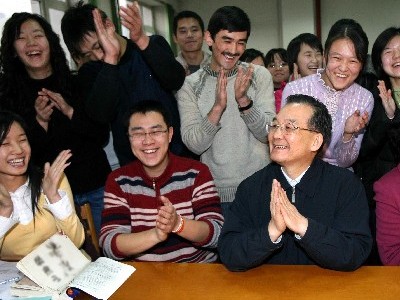
In this Xinhua photo, the premier laughs with students in the library of Northeast Normal University in Changchun. Oddly, the cover of the book in the lower left corner has been blurred. It’s a copy of The Classic of Mountains and Seas (this edition), an ancient mythical geography.
Why was it blurred? Is the Classic unscientific claptrap detrimental to the harmonious society? Is it a generous face-saving gesture to the student in the front row who was reading mythology when he ought to have been studying engineering? Was Xinhua afraid that the fabulous mythological beasts would upstage the premier? And why blur it only half-way with the title still decipherable?
We bring this up at such a late date only because the photo was reprinted this week as part of an Oriental Outlook cover feature on the reading habits of Chinese officials:
The idea to do a survey of officials’ reading habits originated in the regret of some senior journalists. At the end of the 1980s, the news magazine those journalists were at began a survey of the reading habits of high-level officials. The survey was aborted because according to a preliminary understanding, that level of officials had absolutely terrible reading habits. It was expected that the survey results would be detrimental to the image of officials and as such would be difficult to announce, so it was halted. This unforgotten regret finally finds an opportunity to be redeemed through our hands. For more than a decade, the ruling Communist party has spearheaded learning as a leading trend. The Central Committee Political Bureau’s collective learning has become a system-wide example; it has spread to local governments, where it has excited an impulse to study. And in the bookshops there is an even more enthusiastic call to build a “literate government.” So what are the reading habits of officials? What books do they like to read? What is their goal in reading books?
The survey collected the responses of 100 officials – mostly ranging from departmental to divisional officials, with a few sectional officials included – from Heilongjiang, Jiangsu, Chongqing, Guangdong, and Shaanxi. Some notable results:
- Half of officials read more than six books a year.
- Officials who don’t read say that they are too busy with work and social interaction to read.
- When asked “What book have you read in the last few years that had a deep effect on you?” 35% of respondents named either Romance of the Three Kingdoms or Dreams of the Red Mansions. The World is Flat was another popular choice.
- More than half of respondents said that bookstores are their primary source information about reading material, followed by colleagues’ recommendations, book reviews in the media, friends’ recommendations, online sources, and superiors’ recommendations.
- Image from Xinhua
- Earlier on Danwei: For better government, read fewer books