
Beijing’s print media has discovered revolutionary toilet humor, and boy is it controversial!
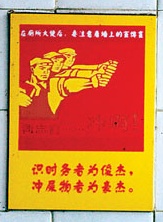
The image at left, a woodblock print of a worker, a farmer, and a soldier, was found on the wall of a toilet stall in Beijing. It plays on the word 冲, which usually means “charge” in the battle-cry, “Comrades, charge!” (同志们,冲啊!). But the same word also means “flush,” giving the poster new meaning in the toilet.
The poster text:
After defecating, look to the propaganda poster
Comrades, flush!
Those who know the customs are worthies!
Those who flush their excrement are heroes!
Do workers, farmers, and soldiers deserve to be “image ambassadors for toilet flushing” (in the words of Beijing media)? Is this a harmless joke, or yet another symptom of how socety has forgotten the sacrifices made by revolutionary heroes like Dong Cunrui? (Dong’s last words may have been “Comrades, for new China, for Chairman Mao, charge!”)
The Mirror published a few responses from Beijing residents last week:
· Chen Xu: Many people admire the rich and famous these days, but the image of workers, farmers, and soliders has not sunk to a level where they must keep watch over toilets and tell people to flush after relieving themselves, has it? I think that creative and design work must first respect others, particularly common laborers. In China, workers, farmers, and soldiers make up the largest grout, and no individual should trample on their image.
· Xin Mu: The propaganda poster is only meant to remind people to flush the toilet; don’t read any deeper meaning into it, ok? When some middle-aged people find that their beloved workers, farmers, and soldiers have become “image ambassadors” for toilet flushing, their feelings are hurt. This I can understand. On the other hand, middle-age is a stage of life involving great stress, and people at this stage of life typically lack a sense of humor and can easily take good-natured ribbing as an insult.
Actually, there is no need for the middle-aged, weighed down by the cares of life, to take a propaganda poster so personally. Can’t we all find a bit more wisdom to handle our own foibles, and meet the poster with a smile?
· Jin Maodao (who also wrote a piece in Shanghai Youth Daily): Young people who have not personally experienced things may not be able to feel the same sense of gratitude, but they should be able to learn understanding and respect.
In the past when people spoke of “the generation gap,” it was always to urge the older generation to extend tolerance and protection to the younger generation and not to be paternalistic. But at the same time, the younger generation ought to be understanding and respectful of the feelings and emotional symbols of the older generation.
The best way to eliminate the misinterpretation and misunderstanding that exists between the young and the middle-aged over this propaganda poster is to open up a two-way street of respect and understanding.
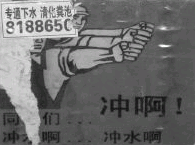
After the story broke in the Beijing press, Ningxia Daily received a tip that a web cafe in the city had a similar notice posted in the bathroom.
It’s an obvious joke, and one that’s been told before. Back in 2005, an article in the Information Times ran the image as an example of “twisted online culture” (网络BT文化); at the time, “Comrades, Flush!” was making the rounds of online forums. Like other recurrent jokes (for example, Deng Xiaoping on the 500-yuan note), the print media seems to discover it anew every few months.
Last year, Strait News reported that that a similar poster was found in a toilet in Quanzhou. The paper included man-on-the-street opinions, some of which commended society for its tolerance of humor and mockery, and others that called for the government to take steps to protect the reputation of revolutionary heroes.
Much like what the Mirror found last week.
- Beijing Morning Post via Netease (Chinese): Workers, Farmers, and Soldiers promote flushing
- Ningxia Daily via People Online (Chinese): Workers, Farmers, and Soldiers propaganda poster appears in Yinchuan net cafe
- Strait News (Chinese): Should “Comrades, Flush!” be posted up?
- Yangcheng Evening News via CS (Chinese): Comrades, Flush! (in Foshan)
- Information Times (Chinese): Abnormal online culture springs up all over
- Hongliu BBS: Funny pictures
- ESWN: $$$, $$$, $$$ and more $$$
- Earlier on Danwei: Beijing’s toilet travails and a foreskin poem