
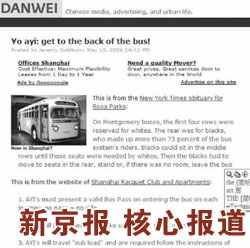
Last week, I wrote a post about a page on a Shanghai tennis club’s website that stated rules for ayi‘s or domestic workers to use the club’s bus. I compared the rules to the segregation rules in the American south in the 1950s, using a few sentences copied from Rosa Parks’ obituary. The blog Shanghaiist reposted and commented on it.
Thursday last week, my phone rings: it’s a journalist from the Shanghai bureau of The Beijing News (新京报). He tracked me down on the Internet: which, I have realized, is not too difficult. The journalist asks me about the post and my feelings about the Shanghai club website.
I tell him that I don’t really have anything to say about it aside from what I wrote on this website, but that I think that the ayi rules that have since been deleted were ugly. But we end up chatting for a while, and I tell him that he can quote me, as long as he understands that I know nothing about the club in question and was just making a comment about one page on their website.
The next day another journalist calls me, from Shanghai’s Xinmin Evening News (新民晚报), and then another from the English language Shanghai Daily. The same thing happens.
I don’t know if either of those two newspapers will publish anything about the affair, but today’s issue of The Beijing News has a full page story about it (Ayi, get to the back of the bus! in Chinese). The article includes plenty of quotes from someone at the club in question, who said that the rules were not discrimatory, but merely intended to ensure excellent service for their customers. It also quotes part of my conversation with the journalist, identifying me as ‘Jeremy’. I am quoted accurately, although there was one small mistake: I am described as coming from a black South African family.
What I had tried to tell the journalist was that I came from a liberal South African family, and grew up during the apartheid years in South Africa. My family has an ayi, who is black, who was a part of the household since I was a baby. I mentioned that perhaps growing up in apartheid South Africa made me more sensitive to different types of discrimination.
Anyhow, The Beijing News story has already been republished on the Wenxue City BBS forum (which is blocked in China), as well as on Sina.com. The Sina story includes a link to a BBS forum thread about the affair.
It’s a strange feeling: I am used to commenting on the Chinese media; I am not so used to having the Chinese media comment on me.
And I am forced to wonder: would anyone in the Chinese media care about this story if there were not foreigners involved?
At the risk of repetition: I do not know anything about the tennis club in question except that they had some rules on their website that I thought were offensive.
Below then, I would like to clarify my opinion about these ayi rules, and put that together with some translated comments from Chinese users on the Sina forum, which range from extremely critical of the tennis club to extremely critical of The Beijing News story.
A commenter named ‘dawanr’ had this to say about the original Danwei post:
I think this is totally fine, and the comparison with Montomgery specious at best. We are talking here about a PRIVATE transportation service operated by a PRIVATE company for its paying customers. It’s not a public bus service and it’s nothing to do with discrimination.
P.S. Bleeding-heart ayi sympathisers. It’s a Market Economy in China now in case you hadn’t noticed (Chinese characteristics or otherwise). There is supply, and there is demand, and there is a market for ayis. If ayi doesn’t like being an ayi, then she can always get onto a bus and go straight back to the far corner of Anhui whence she came; there are plenty of her fellow villagers bustin’ to get out of there and into her spot on the back seats of the Shanghai Racquet Club bus.
There is a valid point there. At some level, this incident has already become blown way out of proportion; no one is forcing ayis to do anything they don’t want to do.
However, my distaste at the club’s rules can be explained if you picture yourself getting on the bus after a nice game of tennis with your friends. You are taking the bus home to your $5,000 a month villa to sip on a Bombay Sapphire and tonic.
But the bus is nearly full! There are three ayis on the bus, sitting near the front.
You say to the ayis: Look, you have to stand up and get to the back of the bus, because I am a guest, and I just cannot deal with the terrible indignity of sitting at the back while the hired help lords it over me by sitting just behind the driver!
It might be a small indignity, but there is something poisonous in the thought that the members of the club would need such a ridiculous, petty symbol of their status.
As it turns out, according to a commenter on Shanghaiist, the members themselves did not like the rule:
The SRC members I know (expats)were totally up in arms about this policy by management and were completely opposed to it. It is my understanding it has since been reversed.
Enough said. Below are some roughly translated comments from Chinese netizens, all taken from the Sina board:
– An economist wrote that China’s reform is not taking us to our goal of being like Europe and America, but that we are becoming the next Phillipines: huge wealth gaps, social unrest. As long as the wealth gap increases, society will become more and more stratified, and there will be more and more class discrimination.
– Why don’t they just directly say ‘No Chinese and dogs allowed on the bus’?
– Guests at a restaurant sit and eat while the waiter stand by watching them. Is this discrimination? These small journalists have nothing to do all day except cause trouble.
– 1. The ayis are not employees of the tennis club… so the tennis club should not set rules for the ayis…
2. The ayis buy a ticket with their own money … there should be no question of a different job or identity forcing them to sit in a different place on the bus… …
Regulating the way the ayis sit on the bus is simply class discrimination!
– Ayis are not sensitive to this kind of discrimination, it is only netizens who care!
– This really is not discrimination, it’s just like hotel staff using the back door when they go to and from work, leaving the front door for the hotel guests.
– … The way the ayis are treated is different, what is this if it’s not discrimination?
– This kind of thing is very common in China: the leaders and the led, the office and the factory floor, full time and contract workers, contract workers and casual laborers, etc. etc. etc. Because their income is so different, they despise your money. As for respecting human rights, that can only lead to the development of Ah Q spirit.
– (Written by “jeremy605411”, nothing to do with your correspondent): I think they should just have different buses. I don’t know if anyone else, has had this experience: on the way to work in the morning, wearing spotless clean clothes, there are a lot of people on the bus. Some migrant workers get on the bus .. wearing filthy clothes. Do you mind standing next to them, getting your clothes dirty? … Don’t just speak of morality, put yourself in that position and think about it.
– What rubbish. Your parents, or at least your ancestors were peasants too. What’s wrong with peasants? So their clothes are a little dirty. Have you ever lived without money? If they had a choice, if it wasn’t that they have no ‘MONEY’, why would they wear ragged clothes? I despise this type of person like you, and your behavior; peasants also have their dignity!