
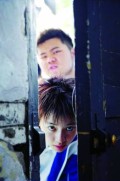
The movie Thirteen Princess Trees (十三棵泡桐) was supposed to premiere in China on Friday but was postponed at the last moment for a second review by the Film Bureau. The film concerns the lives of a group of high-school students and is based on a story by He Dacao that has been called “China’s Catcher in the Rye” (see the link below for a look at the novel).
Rumors began circulating mid-week that complaints about the film’s depictions of juvenile delinquency and domestic violence had caused censors to reconsider their approval. But Li Ke, the producers’ representative, denied rumors that the film had been killed.
Thirteen Princess Trees passed “content” inspection before showing at the Tokyo International Film Festival last October (where it won a special jury prize), but Li said that this second “technical” inspection was necessary because Thirteen Princess Trees was shot digitally. To show in the majority of Chinese cinemas, it had to be converted to film, and this required a license. She called it a marketing decision: given current screening schedules, the movie would only show for two weeks at China 200-some digital theaters, while in traditional theaters, it could follow a more gradual, longer-term distribution strategy.
A spokesperson for Forbidden City Films, the distributor, blamed the delay on unexpectedly tight scheduling:
According to their original plan, a copy was sent to the Film Bureau last Monday, and in as little as two days they should have received the go-ahead, giving them just enough time to start screening over the weekend. To that end they had gotten director Lu Yue (吕乐), who was about to start work with the Red Cliffs production team, to take two days for promotion of the premiere. However, they had not expected that so many films had been sent to the Film Bureau recently, and that their film would receive a “number” by the following week at the earliest. So they had to scrap plans to show the film this week. Most uncomfortable for the distributors was the fact that there were no open slots left in April, so Princess Trees had to be moved from March/April to the summer.
It’s not unprecedented for technical issues to be involved in late-stage approval problems; producers of Lou Ye’s controversial Summer Palace blamed Film Bureau rejection on technical imperfections.
Li Ke complained that the media was “reporting irresponsibly” by casually speculating about a ban. But Lu Yue was one of the sources for those speculations. From Chengdu Business News:
“This is nothing technical in the slightest – it’s the content that’s the problem again!” Lu was blunt with his views: “I don’t know whether this film will be shown now or not. If it is a technical problem then there’s no need to be so secretive about it.” Lu told this reporter that he had no idea what to do with the film: “Change it again? Thirteen Princess Trees has been changed five or six times already. I have no way to change it any further. Anyway, they haven’t told me what the next step is yet. I know nothing.”
Information Times reports that the version of the film that test-screened in Guangzhou last week was already substantially edited – plot points concerning a teacher molesting a student, the uncertainty of homosexual students, and a teacher’s suicide had been cut.
The TBN article included a short interview with Lu Yue in which the director talks about the process of editing down his film:
The Beijing News: How different is the version we’ll see in theaters from your original cut?
Lu Yue: Sixteen areas were adjusted from the original cut. [He] Dacao was very excited after seeing that edit. I told him, it’s enough to have this version in your mind; don’t watch it when it comes out on-screen. I feel that the adjustments made later did not make it worse, but rather made the movie more appropriate for the public to watch.
TBN: Reportedly, your first title was P.T.S.Z.X., but this did not pass so you changed it to Thirteen Princess Trees.
Lu: Right. The story on which the movie is based was called Knife and Knife, but this was somewhat violent and the investors anticipated that it wouldn’t pass. So I thought up the title P.T.S.Z.X., which is the abbreviation of the Pinyin for “Princess Tree High School” (Pāotóngshù Zhōngxué), and the children had this lettering across the bck of their school uniforms, looking at times like inmates in a prison. But later I was told that I could not use English for the title. I suppose I can understand this – there’s an intent here to protect culture.
TBN: What adjustments were made to the content of the film?
Lu: First was the expression of domestic violence. Domestic violence in the 70s and 80s was bluntly direct – crack, crack, crack, parents would slap their children on the mouth – not like the icy violence more frequently seen today. This movie has a lot of that, and during review, they thought that overly fierce strikes should be removed. Another area was sexual orientation and sexual relationships among students and teachers at the school – that received the most adjustment. Actually, we all understand that many schoolgirls have encountered suggestions, whether violent or veiled, from their male teachers – holding their hands, clasping them about the waist, or even more intimate things. These were all removed. One more area was content that showed violence in society. Many legal programs on television today show how the police heroically subdue criminals – this is good overcoming evil, but if it is put into a movie, it must be changed.
TBN: Have you thought about whether addressing these issues head-on in a movie might mislead young viewers?
Lu: Teen movies have been especially scarce in China the last few years. Indeed, there are many negative things that cannot be shown even if your motive is a good one.
In addition, there exists misunderstanding about adolescent education – artistic works are always stressed, particlarly about how great an influence film and TV can have on young people. But this doesn’t mean that without those works, young people’s problems would all be solved. There are many similar films and TV shows in the US, Europe, and Japan, but they haven’t over-exaggerated the influence of film and TV. I feel that the guidance of adults is more important, and the education of adults should be taken seriously.
- The Beijing News (Chinese): Brakes thrown on Thirteen Princess Trees
- Chengdu Business News via Sina (Chinese): Thirteen Princess Trees halted suddenly
- Information Times via Tom (Chinese): Review postponed for Thirteen Princess Trees
- China & The World Cultural Exchange (via Google Cache): He Dacao: Waving Good bye to His Youth with “Knife & Knife”