
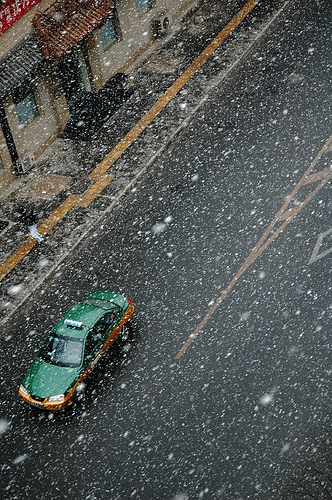
– by Snow Kisses Sky March 2006
Sort of a strike
The first indication of anything happening was a rumour earlier this week that the government was going to give Beijing cabbies a day off to celebrate the Party’s 85th anniversary on July 1. The next rumor to hit the Danwei inbox was that the city’s taxi drivers were going on strike.
But today, July 1, there were enough taxis cruising the streets to get around, although you had to wait for longer than normal. Your correspondent asked several drivers about the strike. They all expressed surprise that I knew about it. They basically said that they weren’t really striking, but that many drivers had decided to take it easy today, and work as little as possible.
In other words, it was a go-slow, not a strike. The message they wanted to send was: we are not very happy right now.
Beijing Taxi 2.0
There are a few reasons why Beijing’s taxi drivers are unhappy right now:
– Even China’s highly subsidized gasoline is starting to get expensive. The juice now costs more than 5 yuan a liter, just under double the price last year. Taxi drivers in Beijing pay their own fuel and maintenance costs.
– The recent compulsory rise in taxi fares to 2.00 yuan (up from 1.2 and 1.6 yuan) means that each cab gets fewer fares, as passengers who watch their pennies decide to use buses and bicycles. Most cabbies seem to report that they used to take about 20 passengers a day; this has now fallen to 10 to 15 a day. Passengers are especially avoiding long taxi trips, when the price increase would mean much higher fares. (The starte fare of 10 yuan has not changed.)
– Taxi drivers usually have to pay a management fee to the company that owns their cars of between 2,000 and 6,000 yuan a month. Most taxi drivers seem to be clearing about 1,000 to 2,000 yuan a month after paying those fees and fuel and maintenance costs. That’s not a lot of money to live on, especially when you consider that cabbies usually work seven very long days a week.
– Cabbies are on the lowest rung of Beijing’s ladder of car drivers: whereas cops will often turn a blind eye to traffic infringements by guys in black Audi’s, and yuppie girls in zippy new cars, the taxi drivers get busted everytime a cop sees them do anything wrong.
– The city government occasionally introduces kooky and arbitrary new rules that taxi drivers are supposed to follow. The most outrageous of these rules are that all taxi drivers are supposed to learn English before the 2008 Olympic Games; there will apparently be some sort of test in 2007. This is roughly the equivalent of requiring all of New York’s taxi drivers to speak fluent Mandarin by 2010.
The go-slow activity today was a very mild expression of frustration of Beijing cabbies at a city that does not seem to care.
While many of Beijing’s taxi drivers sure could use some lessons in the basic geography of the city, oral and foot hygiene, and customer service, on the whole they are a decent lot, ready to laugh and friendly. They almost never cheat passengers, despite what people tell you, and they are often helpful beyond the call of duty.
Taxi drivers are also the front line of the real welcoming committee that will greet most foreign visitors in 2008 when the city is packed with Olympic spectators. So if they are unhappy, the city should do its best to find out why, and make sure that they greet guests at the airport with a big smile.
– Thanks to Sarah Guldin for coining the phrase Beijing Taxi 2.0
UPDATE from DD (from USA?) in the comments section:
What is this site turning into – a pitch for “so called” injustices done to the blue-collar working class of China? Why not talk about my father, who worked as an tire man on an oil field? His union saw pay and benefit cuts from one employer and he striked against Coca-Cola. He was blue collar and suffered more than any taxi driver in Beijing. Write about him.