
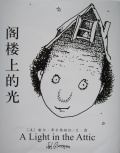
Lovers of children’s nonsense poetry will be pleased to hear that Shel Silverstein’s A Light in the Attic (阁楼上的光) appeared in translation last month. It joins his parables The Giving Tree, The Missing Piece, and The Missing Piece Meets the Big O as the first volume of his poetry to be available on the mainland.
Readers in Taiwan have had access to Shel’s poetry for several years – Where The Sidewalk Ends and Falling Up are also available on the island in translations by Zheng Xiaoyun. Instructional outlines are even available for teaching several of the poems in a classroom setting.
What kind of taste is it? The mainland translator, Ye Shuo, seems to have put quite a bit of effort into conveying the wordplay that marks Shel’s poems (although when it comes to something spelling-based like “Important?”, the translation resorts to English annotations). The Abbott and Costello riff in “The Meehoo with an Exactlywatt” gets turned into “‘我是谁’和‘就是啥’” and works out pretty nicely.
However, one of the delights of nonsense poems is their rhythms, an element that doesn’t come across very well in either of the two translations of A Light in the Attic. A strong rhyme, too, is left out of most of the poems. A few are song-like, but most probably won’t have children chanting them in the schoolyards.
Both the mainland and the Taiwan translations have this problem to some degree. Some of the poems in Zheng’s translation seem to read more smoothly than Ye’s, while for others, Ye seems to have the upper hand. Unfortunately, most readers won’t be able to compare for themselves since the books simply aren’t available on opposite sides of the straits.
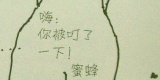
The book is a nicely-bound hardback, just like the original edition. The original whimsical drawings still accompany the text, and they also appear on a pack of bookmarks included with the book. English words in the illustrations have generally been translated into Chinese (with the exception of a snake that spells out “I love you” with its body – presumably readers will know what that means, anyway).
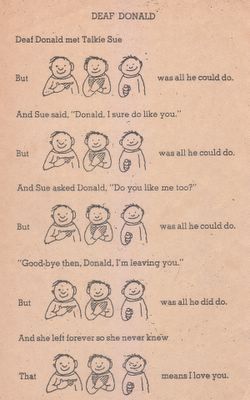
The sentence “I love you” also figures in a poem called “Deaf Donald” (聋子唐) (there’s an image of the English version here, found via Google). The signs for “I love you” in the translation are identical to those in the original version, even though at least one very widespread form of Chinese sign language uses different signs. The translator gets around that problem by spinning them as Donald’s signs, rather than as part of a general language.
Poking around the net for sign language grammars and vocabulary led me to two interesting sites: a categorized pictorial index of signs in Chinese sign language, and a video series teaching basic Chinese sign language in 22 lessons. The videos in particular are quite well done, introducing signs and sentences as well as the abbreviated usage that is common among users. Both of these resources are provided by the Shanghai Disabled Persons’ Federation.
- Fei Fei blog (Chinese): Sidewalk vs. Attic Translations from Taiwan editions
- LCenter (Chinese): Attic lesson plan