
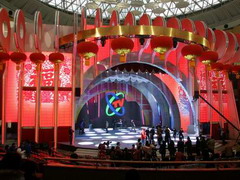
 The annual Spring Festival Gala on CCTV is an elaborately planned and meticulously choreographed affair that serves as background entertainment to the Lunar New Year festivities of half of China’s population. Although the organizers have released a tentative program, the list of performers changes over the several dress-rehearsals leading up to the live broadcast. Guessing at who will stay and who will go is a popular topic in the Style section of newspapers this week. There is particular speculation over the fate of a skit from Zhejiang that satirizes the overuse of official language, but running time and logistical concerns have led to other acts being cut. Also an open question is whether Olympic gold-medalist Liu Xiang would perform. While he was on the preliminary list, the final program lists only “Olympic Champions”, so the jury is still out.
Most of the attention is focused on Zhao Benshan. His performances have been the most eagerly anticipated items on the program for several years, but his contribution last year was nearly cancelled because of an unrelated flap he had with CCTV over decency. This year his skit is entitled Kung Fu, similar in name to the current Stephen Chow film though the two have no connection.
The program has drawn criticism in recent years for retreading the same material, throwing too many stars together in group performances, and having too many dance numbers. This year the organizers have added animated segments, and in a departure from the practice of most televised variety shows, they have promised that singers will not lip-sync their songs. Of course, the familiarity could also be ascribed to skit topics, dialogue, and photographs from the rehearsals hitting the media during the week before the broadcast.
The annual Gala commands huge sums from advertisers. Spots range from 3 million to 10 million yuan (US $360,000 to $1.2 million) for expected ad revenue of between 350 and 400 million (US $42-48 million). The fact that despite the trappings – ads are called “congratulatory messages” and performers “offer” their acts – the show is at its heart a giant moneymaker for CCTV, has many people more than a little upset.
For those without access to CCTV, the standard translation of the Gala as an “Evening Party” provides the opportunity to do a double-take at certain sentences in the China Daily: “More and more people have begun to criticize the party for lacking innovation and original designs.”
Chinese sources are: Final Program, Advertising, Speculation (with lots of pictures), Initial Program