

The current issue of the fashion magazine 1626 features an interesting set of illustrations mocking the way that the names of famous global brands are often pronounced in Chinese:
We can’t be timid about saying the name of major labels. We can freely make the most of big-brand style, and if we use other brands we can still find a name-brand feeling. Today, you’ll learn how to pronounce major brands so you can find that feeling!
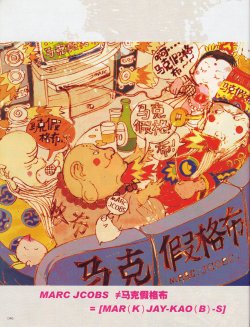
The drawings, which locate the mis-pronounced brands in an urban dreamworld populated by strange headless creatures and other beasties, are done by Yao Wenshuang (姚文爽), whose work frequently appears in the magazine.
Chanel is the first brand. Instead of 拆弄 (chāi nòng), or “tear down and mess with”), the magazine suggests reading it like “she ‘nai le,” which you have to admit is a little bit better.
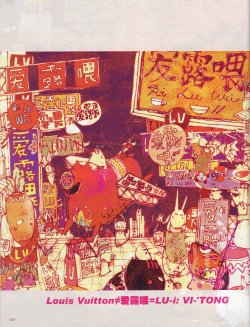
Louis Vuitton isn’t 爱露喂 (ài lù wèi), a rough approximation of the letters L and V. It’s “LU-i: VI-‘TONG”.
Marc Jacobs is “[MAR(K) JAY-KAO(B)-S]” instead of 马克假格布 (mǎkè jiǎgébù). This one’s actually pretty close already, as a fairly standard transliteration of two relatively common foreign names.
And Yves Saint Laurent is “YIFU S ENG(T) LA-HONGT” instead of 圣骡兰 (shèng luólán), which is a variant of St. Lawrence that Yao interprets as some kind of mule.
Seeing as how each pronunciation guide uses a different system, the feature is probably unlikely to help many readers improve the way they pronounce the name of their favorite brand.


Pronunciation also comes into play on the magazine’s cover.
The main theme of this issue is vintage clothing and fashion in a cover feature titled “So Vintage” (忒复古). The magazine provides the Pinyin for the title: tēi fùgǔ.
Tēi is an interesting choice for 忒. Many dictionaries list tè and tuī as possible readings; the xiehouyu (pun-riddle) “a cripple jumping” (瘸子蹦高) relies on 忒 being a sound-alike of 腿 (tuǐ) in order for “legs got better” (腿好了) to resemble “excellent” (忒好了).
But in Beijing and some other regions, the same word can be pronounced tēi. There’s considerable discussion online about who exactly pronounces it that way, and what the precise difference is between 忒 and 特 (when pronounced tè).
A lengthy conversation on the Xitek BBS over the pronunciation of 忒 in various regional dialects ended with one commenter saying, “Regardless of how it’s pronounced, it sounds bad. So lowbrow.” Which is probably part of the effect intended by the 1626 cover.
- 1626 homepage; 2009.09.07 cover
- Yao Wenshuang’s blog (Chinese)
- Xitek (Chinese): Is 忒 pronounced “tei” or “tui”?