
April 17, 2009
In Beijing, there are about 6,000 “Beijing Offices” (驻京办) originally set up by regional governments and state-owned enterprises as liaisons to the central government. Now that transportation and communication technology has diminished the effect of geographical distance, these offices have lost a lot of their usefulness, and people have started to question their very existence.
Last year, the government of Weifang, Shandong Province, decided to shut down its Beijing Office. According to reports at the time, “the office was doing business in the government’s name,” and its unsuccessful operation had put it into debt.
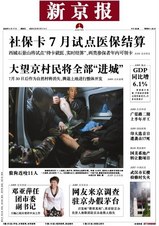
The Beijing Offices of two cities from Henan Province, Luohe and Xuchang, are in the news this week after they were found to have purchased 777 bottles of expensive Moutai liquor that turned out to be fake. Speculation about the likelihood that corruption was involved in the case sparked public indignation, as you might expect.
The offices responded by explaining that they the fake Moutai was not intended for their own use in their business in Beijing: they had merely purchased what they believed to be genuine Moutai at the request of restaurants back home.
The Beijing News reported about a “Hanwei Fenggu,” a netizen who has been actively defending the two offices against online criticism. He is suspicious about the facts in the case and has come to Beijing “at his own expense” to conduct an investigation into the purchase, with the intent of exonerating the offices.
Also on the cover of the newspaper, former table tennis world champion Deng Yaping was appointed to be the vice chief of Beijing’s Youth League. The same article also reported that another player, Wang Nan, is now working for the Central Youth League. For readers unfamiliar with official trajectories, the current president of China was the head of the national Communist Youth League from 1984 to 1985.