
Summer is buzz-making season for beverage manufacturers. Every summer brings countless new brands of bottled drinks to the heaving shelves of corner stores across China.
This year’s fad is the ‘nutritional’ or ‘functional’ beverage: Gatorade-type sports drinks, Red Bullish cocktails, vitamin-enhanced drinks and just about anything that you are encouraged to drink because of its medicinal benefits rather than because it tastes good or it’s cool.
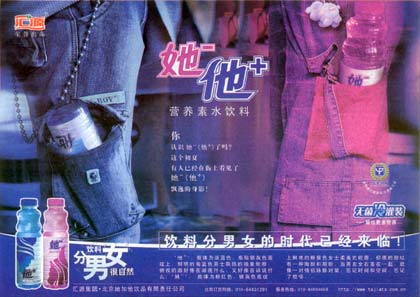
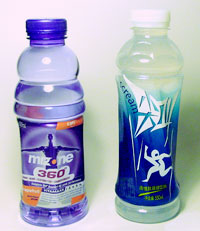
New brands this summer include Mizone, Scream and He+ & She-.
Mizone is made by bottled water heavies Robust. This is what it says on Mizone’s packaging:
For peak performance to face any challenge, Mizone gives you amino-acids, electrolytes, carbohydrates and Vitamaxx essential vitamins to replenish lost fluids and nutrition in your body.
The packaging of most of the nutritional drinks looks alike, except He+ & She- (pictured), which boasts that it’s the first gender-specific drink, and announces that the age for gendered drinks is coming.
There seem to be four other major categories of drinks spending money on marketing this summer:
Traditional carbonated beverages
Surprisingly, Pepsi is top, with 29.7% market share in this category (according to The Beijing News, May 27, 2004). Coke is not far behind, although we couldn;t track down a figure for market share. The two heavy-weights are trailed by a gaggle of smaller competitors who are often quite keen to “learn” from bigger brands. The “learning” can take many forms; some forms might result in legal action, as in this case of the sincerest form of flattery to Coke previously reported on Danwei.
Water
This market is comparatively mature and stable, and heavily dependent on distribution rather than branding. After almost ten years of development, local brands Robust, Wahaha and Nongfushanquan dominate the market.
Fruit juice and fruit-based drinks
The competition in this sector is becoming fiercer and fiercer. President (Tongyi) is a Taiwanese company well known for its instant noodles. It has been extremely successful in the last two years by creating “juice beverage” concept in China, with its Xianchengduo range of blended fruit drinks. Previously, juice manufacturers like Beijing-based Huiyuan focused on ‘pure fruit juice’ as the major selling point.
President’s Xianchengduo currently ranks No.1 in the fruit juice stakes with a market share of 24.39%, followed by Xianchengzhi, a similar product made by Kangshifu. Last year Coca Cola entered the fray with a range of fruit-based drinks called Qoo.
Iced tea
Green and black iced tea both sell well in China. They are often lumped together with fruit juices, because both they are supposed to be healthy drinks. Leading brands include Kangshifu, President, Coca Cola and Nestle.
UPDATE: This article originally stated: “As elsewhere, Coca Cola rules the roost from Kashgar to Kowloon, with Pepsi still trying harder somewhere behind.” This has been corrected: Coke apparently has to try harder now.
The other two images are photographs of bottles of Scream and Mizone.
Figures and ratings are from China Business Info Center.