
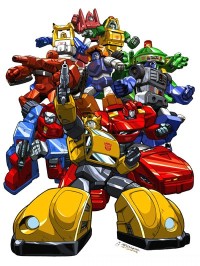
Amid all of the hype surrounding the new Transformers movie, some Internet users are looking back at the last time China was caught up in “Transformers Fever.”
The year was 1989, and some people were worried about the effect that this violent fantasy cartoon would have on the nation’s youth.
From People’s Daily, 1989.02.19:
The Transformers cartoon, whose TV broadcasts are popular with young people, was criticized today by Hu Dehua and nineteen other NPC Standing Committee members.
These committee members made a statement at the sixth session of the 7th NPC, saying that the Transformers was absurd, that it promoted violence, and that it would contaminate the younger generation.
Reportedly, the American cartoon Transformers has recently been airing on several TV stations. A publisher has brought out a Transformers picture book. At the same time, “Transformers” toys rejected from the American market have been sold to the Chinese market in large quantities; one set of “Transfomers” toys can cost more than 1000 yuan; a single toy costs between 10 and 100 yuan, putting a large financial burden on many households.
Hence, Hu Dehua and the other committee members have recommended that TV stations and publishers stop broadcasting and publishing Transformers, and that the import of “Transformers” toys be strictly halted and the importers be dealt with.
And on 1 March:
…this reporter interviewed Comrade Hu Dehua. She took out a Transformers picture book, and said, “Once, my little grandson wanted me to tell him Transformer stories. I hadn’t seen the TV show, but when I looked at the book, the pictures and text were ugly, the content was absurd, and it promoted fighting. And it didn’t even make any sense, so there was no way to tell the story. Then there was the price: for a picture book of less than twenty pages, some places it was 0.8 or 0.9 yuan, others it was more than 1 yuan. 60,000 or 70,000 copies printed, or even 250,000. I brought this issue up before the NPC Standing Committee team, and lo and behold the old men and women in the team were sympathetic. They talked of how the TV broadcast times affected kids’ eating habits, and then moved on to how the high price of toys exceeded what the average Chinese family could bear. So I made a few suggestions to various government agencies.”
However, Xinmin Evening News issued a signed editorial that said that the Transformers TV show was brimming with the wisdom, enthusiasm, imagination, and strength of industrial society. Optimus Prime (擎天柱) and Megatron (霸天虎) represent righteousness and hegemony, goodness and bellicosity; right and wrong are clearly demarcated. Adults have no way to understand the pleasure and edification that this brings to children.
Other articles talked presciently about how the popularity of Transformers toys could spur China’s own toy manufacturing:
“Transformers Fever” is a wake-up call to our own toy industry. Don’t blame everyone else for taking away your rice-bowl. This is a time for reflection and forging ahead. The attraction of the Transformers is in their transformation. Why can’t we make an issue out of transformation, design and produce toys that are loved by today’s childred? Why don’t we have marketing and sales strategy like they do? Some may ask, aren’t our rag dolls and duck pull-toys good enough? Here, let me emphatically state: relying on those things to “defeat” the Transformers would be very difficult. The positive side of “Transformers Fever” lies in the fact that it tells us that closed, outmoded toy design and production cannot compete with the open, swiftly updated western toy industry. Our toy industry, in both manufacturing technology and business strategy, needs a “transformation.”
- THCB (Chinese): When the bastard representatives wanted to ban Transformers
- Image from Haotuku
- Earlier on Danwei: Cartoon violence raises hackles