
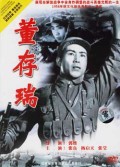
In 1948, during the Chinese Civil War, the Nationalists held a defensive position on a bridge that blocked the PLA advance. Dong Cunrui was sent to blow up the fortifications, but when he reached the bridge he discovered that there was no place to affix the explosives. To fulfill his mission, he held the pack of explosives against the bridge until they detonated, making him an instant martyr and hero.
That’s the version that’s been accepted for more than half a century. However, in an article in Popular Cinema last summer, director Guo Wei told a different story when he discussed the making of the 1955 film Dong Cunrui. At the time, he said, no one was certain what Dong Cunrui’s final actions were:
No one personally witnessed the scene in which he lifted the bundle of explosives; it was entirely a conjecture after the fact based on clues. Dong Cunrui had no frame at the time, and there was no place to put explosives on the underside of the bridge. After the war, they unearthed the bottoms of the socks his wife had made, so military experts believed that Dong Cunrui very likely held up the explosives to blow the bridge.
As historical revisionism goes, Guo Wei’s reservations about the absolute certainty of Dong Cunrui’s martyrdom hardly upends the accepted historical narrative, but the suggestion that Dong’s heroic sacrifice is only a “very likely” conjecture rather than a historical fact angered Dong’s family and comrades-in-arms. They sued Guo, Popular Cinema, and CCTV, which ran a program in which Guo made similar remarks during a discussion of the circumstances behind his award-winning film.
During the CCTV program, a clip was shown of Dong’s army buddy Zhi Shunyi explaining how he went up with Dong to destroy the bridge. Guo says in voice-over:
No, no, no – the old guy’s memory must be faulty….Zhi Shunyi did go up with Dong Cunrui, but when Dong Cunrui charged the fortification, he could not find him….
Guo ‘s remarks are contradicted by the claims of other parties: Dong’s sister says that Dong was neither married nor engaged when he joined the army, so the socks theory is ridiculous. And a number of other witnesses retold their stories to the news media last summer after the controversy arose.
In the Popular Cinema piece, Guo explained how he became attached to the Dong Cunrui project after several other directors had turned it down. He initially wondered whether he was being passed a politically-sensitive film but quickly realized that the story itself was considered unfilmable:
The story of Dong Cunrui had passed through the hands of many directors. They all felt that the protagonist was an overly idealized hero who would be difficult to dramatize, so they all begged off. The higher-ups, deliberating over the project, naturally thought of Guo Wei, whose first movie Taking Mt. Hua (智取华山) was favorably received and brought him instant recognition.
…Guo Wei faced a dilemma: such an idealized character appeared fake, but he did not know enough to make him more life-like. After considerable thought, a daring idea passed through his mind: Dong Cunrui’s life wasn’t all that clear, but he was no stranger to wartime life himself. Rather than create a fictionalized Dong Cunrui, why not use the real people and events he had personally encountered?
Is Guo confusing his fictionalized story with reality? Or are old soldiers relating vivid recollections of events that they did not personally witness?
For some observers, the situation is symptomatic of society’s general downward spiral. “Bullshit!” said a 65-year-old man reading the Beijing Daily Messenger beside your correspondent over the weekend. “Society has changed. This is something we’ve known, something that’s been taught for decades, and now this director comes out with all this bullshit.”
For others, there’s more at stake here than just the truth of a legend. Zhi Shunyi died in late 2005, so he is no longer able to defend his memories against doubters like Guo Wei. As the remaining witnesses to this and other historical events pass away, who will preserve the facts of incidents for which no visual record exists? While Guo does not deny Dong’s heroism, his categorical dismissal of eyewitness accounts strays uncomfortably close to the arguments of Japanese rightists who question the claims of “comfort women” seeking redress from Japanese courts.
One online essay concludes:
We live in an era where television is king. TV obscures our vision, it makes us unwilling to think, satisfied with stimulating and entertaining consumption, and it leads to an ever-growing fast-food society. No wonder so many educators have suggested with no little anxiety that in the future, TV will destroy humanity. The younger generation’s history textbook is the television, and now we have a national television station showing them the so-called true face of history in the guise of historical restoration – who can say with certainty that the truth of history will not be distorted? The cat-and-mouse game that Japan has played with the Asian people in its history textbooks is a question of precisely that historical period. Amid our anger, should we not take a look at what is happening right beside us?
- Beijing Daily Messenger (Chinese): Blowing up the pillbox is an extrapolated heroic tale?
- Liaoning Evening News via Hangzhou (Chinese): CCTV feature on the “conjecture” of Dong Cunrui blowing the bridge faces lawsuit
- LANews (Chinese): Dong Cunrui blew up the pillbox? CCTV says not necessarily!
- ESWN: The End of Popular Cinema?
- Earlier on Danwei: Creating the Lei Feng legend