
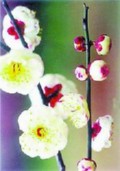
With 5000 years of history you can’t have just one National Flower. China is finding it difficult to chose a single representative from among the vast field of candidates that show up throughout traditional art and culture – peony, plum, orchid, chrysanthemum, bamboo, water lily, Chinese rose, azalea, camellia, osmanthus, and narcissus.
Front-runners all along have been the peony (牡丹) and the plum blossom (梅花). And now 62 scholars from the Chinese Academy of Sciences and the Chinese Academy of Engineering have thrown their weight behind a “dual national flower” plan to name both flowers to the position.
The Recommendation Concerning Setting the Peony and Plum Blossom as National Flowers as Early as Possible calls China’s lack of a national flower a hinderance both to propagation of China’s rich heritage of flower culture and to the flower industry’s ability to compete on the world stage. As the only major nation without a national flower, China should be spurred to make a decision by the impending 2008 Beijing Olympics and 2010 Shanghai World Expo.
The two-flower recommendation is only one of several possibilities, however, each with its own numbered formulation. There’s “One Country, One Flower,” which would require breaking somehow the peony-plum deadlock. “One Country, Two Flowers” is the name of the academicians’ choice. “One Country, Four Flowers” adds the chrysanthemum and the water lily. And then there’s “One Country, Five Flowers,” also known as “One Primary, Four Supplementary,” which would name the peony as the main national flower and add one supplemental flower for each season in a new version of the traditional “four gentlemen” – chrysanthemum (autumn), plum (winter), and orchid (spring), with water lily (summer) substituting for bamboo.
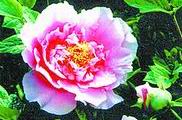
These candidates were proposed in the 1980s but no resolution could be reached. China Daily reported back in 2003 that authorities were close to putting it to a vote, but that too was just over-optimistic speculation.
And, as one would expect, the decision to declare so significant a symbol as a national flower is not free from political considerations. The peony was named national flower in the late Qing dynasty, so it has historical precedence. But the national flower of the Republic of China is the plum blossom, first declared in 1929 and then again in 1964. The latter declaration tied the plum blossom to Sun Yat-sen’s Three Principles and Taiwan’s five branches of government, so “One Country, Two Systems” may require “One Country, Two Flowers” for the mainland to avoid the appearance of blindly following Taiwan by choosing the plum blossom, or leaving it to its own devices by choosing the peony.
- Wen Hui Bao via People Online (Chinese): 62 academicians urge peony, plum blossom to be “dual national flowers”
- China Daily: National Flower, Tree, Bird to Be Chosen